Airbnb Peak Season Pricing: Hold the Line While Others Drop
TL;DR
Sean Rakidzich finds that holding peak-season Airbnb rates 20 to 40 percent above PriceLabs recommendations can lead to higher earnings by ensuring listings remain competitive when demand is high.
The article compares Airbnb's Q4 2025 data showing 12 percent revenue growth and 16 percent GBV growth with hosts who drop rates early, highlighting the risk of losing premium pricing.
Sean recommends setting rates 60 days in advance for top peak dates, holding them until 14 days before the date, and only then adjusting to a floor price to maximize revenue. By Sean Rakidzich, 155-property operator. Strategy session at rakidzich.com/book.
Key Facts
| Weeks out | Action | Signal to watch |
|---|---|---|
| 8 | Set rate at 130 percent of last year’s peak | Wish-list still full |
| 6 | Hold | Wish-list peers starting to book |
| 4 | If peers selling, nudge rate up 5 percent | Your wish-list drops to 60 percent |
| 3 | Set strict floor | Emotions start to kick in |
| 2 | If still open, drop to floor, not below | Wish-list under 25 percent bookable |
| 1 | Let market come to you | Last-minute guests arrive |
Key Takeaways
- Airbnb Q4 2025 revenue grew 12 percent and GBV grew 16 percent year over year.
- Nights and Seats Booked rose 10 percent in Q4 and 9 percent in Q3 2025.
- Skift reported vacation rentals saw 12 percent YoY growth in May 2025.
- Set peak rates 20 to 40 percent above PriceLabs for your top 10 peak dates.
- Hold until 14 days out. Only then drop to your floor, never below.
- Scottsdale's 38-day median lead time means peak dates book 45 plus days out.
What peak season really is
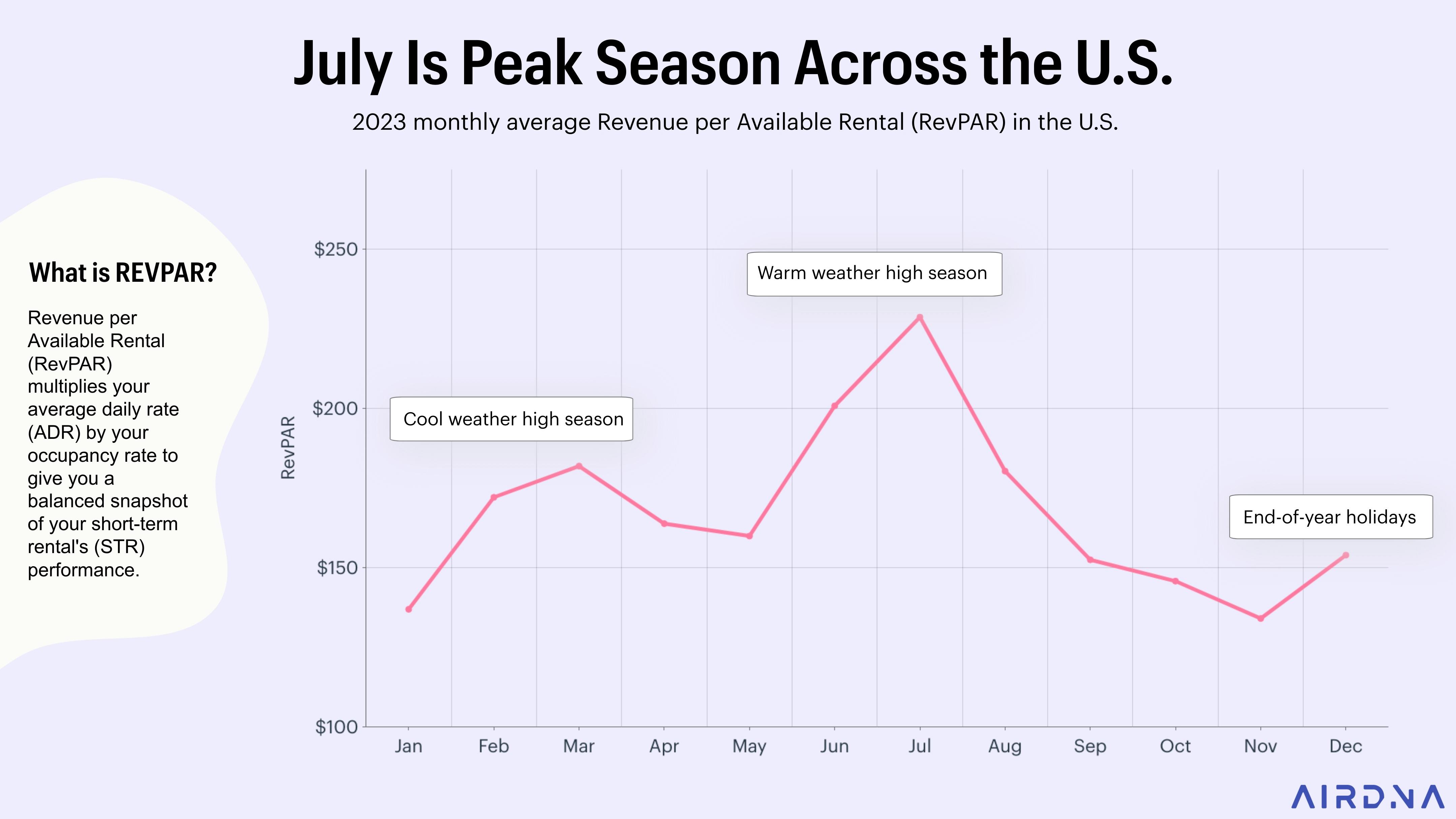
Image via AirDNA
Peak season is any window where demand for your market runs hot. For beach towns, it is summer. For ski towns, it is the months around Christmas. For big cities, it is graduation weeks, conventions, and local festivals. Sean Rakidzich treats each of these the same way. During peak, your job is to hold your rate while the market drops around you.
Why average hosts drop rates in peak season
Most software, like PriceLabs and Wheelhouse, smooths out demand. Software sees empty days on the calendar and lowers the rate to fill them.
Hosts who trust the software see the lower rate suggestion and accept it. Their calendar fills fast, and they feel happy. Then they watch the guests who booked them rebook nicer homes at twice the price two weeks later. That is the trap.
The Airbnb 2025 quarterly data says peak is real
Airbnb’s Q4 2025 shareholder letter reports Revenue grew 12 percent, exceeding the high end of guidance. Gross Booking Value grew 16 percent year over year. Nights and Seats Booked rose 10 percent.
Q3 2025 backs this up with Nights and Seats Booked up 9 percent on 133 million total.
Skift reported that vacation rentals saw 12 percent year-on-year growth in May 2025, outpacing hotels.
The hold-high move in three steps
- Identify your top 10 peak dates 60 days in advance.
- On those dates, set a rate 20 to 40 percent above what PriceLabs or Wheelhouse suggest.
- Do not drop the rate until the dates are 14 days away. If still open, drop by 5 percent and watch.
The average listings book first. When the market sells out, new guests arriving at search only see the homes that held their rate.
The math on a single date
Say your normal peak night is 300 dollars. The software suggests 250 for a date 45 days out. You hold at 350 instead. The date does not book at 45 days. Fine. At 20 days, the average listings in your area sell out. At 15 days, a guest arrives at search, sees 3 listings left, and picks yours at 350. You earned 100 extra dollars. Across 10 peak dates, that is 1,000 dollars per home per year. For a 5-home portfolio, 5,000 dollars.
A week-by-week peak pricing table
| Weeks out | Action | Signal to watch |
|---|---|---|
| 8 | Set rate at 130 percent of last year’s peak | Wish-list still full |
| 6 | Hold | Wish-list peers starting to book |
| 4 | If peers selling, nudge rate up 5 percent | Your wish-list drops to 60 percent |
| 3 | Set strict floor | Emotions start to kick in |
| 2 | If still open, drop to floor, not below | Wish-list under 25 percent bookable |
| 1 | Let market come to you | Last-minute guests arrive |
How to stay disciplined
- Write the hold date on a sticky note. Do not touch the price before that date.
- Turn off price notifications. Guesswork triggers panic.
- Review results after the window closes, not during.
Booking-window context by market
AirROI lead time data shows Scottsdale peaks book 38 days ahead in January 2026. Destin sits at 22 days. Austin at 17 days. Urban markets compress peaks. Leisure markets stretch them.
The Hostaway Summer 2025 report confirms: 40 percent of operators raised ADR and occupancy together versus 2024.
What to do in slow season
Slow season is the opposite move. The guest pool is small, so you want volume. Drop your price slightly below the market middle. For the full slow-season playbook, read Airbnb slow season pricing.
Where this fits in a bigger plan
Peak pricing alone does not build a great Airbnb business. You also need clean listings, smart photos, and a real routine. For the full playbook, the Revenue Manager’s Handbook covers peak, slow, weekday, weekend, and holiday pricing in order.
Frequently asked questions
Why should I hold my rate in peak season?
Because the average listings, which drop their rate, book first. Once they sell out, your listing is the best remaining option, and you can book at a premium.
How much above PriceLabs should I price?
Sean Rakidzich suggests 20 to 40 percent above for your top 10 peak dates. Start at 20.
What if the date does not book?
Set a floor. If you hit your floor by 14 days before the date, drop by 5 percent and watch for 72 hours.
Does this work for small markets?
Yes, and the number of peak dates is smaller.
What does Airbnb's own data say about peak demand?
Q4 2025 revenue grew 12 percent. GBV grew 16 percent year over year. Nights and Seats Booked rose 10 percent. That is platform-wide peak strength.
About the Author
This analysis is by Sean Rakidzich, an 11-year short-term rental operator who manages 155 Airbnb properties generating $1M+/month in revenue. Sean has trained 5,000+ students across 76 countries with $1.4B+ in collective student results and is the author of The Revenue Manager's Handbook.
For Sean's framework on holding peak-season Airbnb rates 20 to 40 percent above PriceLabs recommendations can lead to higher earnings by ensuring listings remain competitive when demand is high, see his full content library at rakidzich.com or book a 30-minute strategy session at rakidzich.com/book.
Affiliate disclosure: Some links on this page (anything starting with rakidzich.com/p/) are affiliate links. If you sign up through them, Sean may earn a commission at no extra cost to you. The recommendation reflects Sean's actual use across his 155-property portfolio.