Best Cities for Airbnb Arbitrage 2026: Data-Driven Rankings
TL;DR
Sean Rakidzich identifies Gatlinburg, Tennessee as the top US city for rental arbitrage in 2026, with a monthly margin of +$698 after rent and operating costs.
The article emphasizes that markets must pass five filters, including RevPAN above $100/night, occupancy above 65%, and a rent-to-revenue ratio of 1:3 or better, to be viable for arbitrage.
Sean recommends using the "Battleship method" for pricing calibration, testing and adjusting rates based on real data to ensure profitability in markets like Atlanta. By Sean Rakidzich, 155-property operator. Strategy session at rakidzich.com/book.
Market at a Glance
| City | Avg RevPAN | Occupancy | Supply Growth | Tier |
|---|---|---|---|---|
| Nashville, TN | $148 | 71% | 12% | 1 |
| Scottsdale, AZ | $162 | 68% | 14% | 1 |
| Savannah, GA | $131 | 74% | 9% | 1 |
| Chattanooga, TN | $119 | 72% | 11% | 1 |
| Boise, ID | $122 | 69% | 13% | 1 |
| Colorado Springs, CO | $118 | 67% | 15% | 2 |
| Knoxville, TN | $127 | 70% | 16% | 2 |
| Tucson, AZ | $108 | 66% | 12% | 2 |

Image via Governing Magazine
Key Takeaways
- 2026 Rental Arbitrage City Rankings
- How I Pick Markets
- Top 15 Cities for Airbnb Arbitrage 2026
- Tier 1: Best Markets Now
- Tier 2: Strong Secondary Markets
- Tier 3: Emerging Markets
- Cities to Avoid
2026 Rental Arbitrage City Rankings
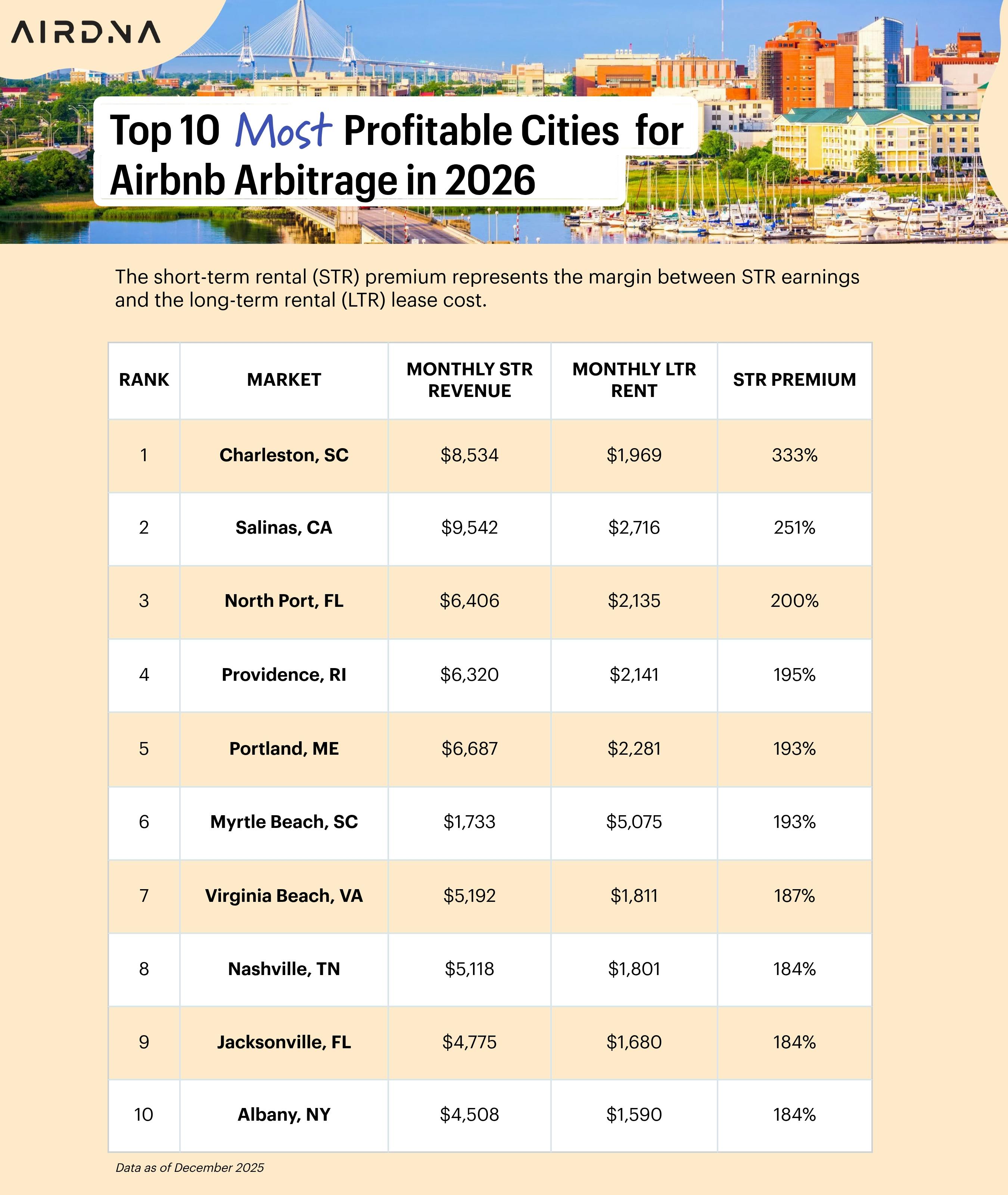
Image via AirDNA
Market-by-market profitability data for rental arbitrage operators.
- Gatlinburg, Tennessee leads US rental arbitrage profitability at +$698 per month margin after rent and operating costs in 2026. — AirDNA Rental Arbitrage in 2026
- Knoxville, TN posts a RevPAN of $127 at 70% occupancy, with University of Tennessee sports driving strong weekend bookings. — 10XBNB Best Cities for Arbitrage 2026
- Chattanooga, TN has 1,123 active listings (low competition), $207 ADR, 50% occupancy, and produces 20%+ cash-on-cash returns on 3BR investments with a median home price near $290K. — 10XBNB Chattanooga Market Data
- San Antonio, Austin, and Myrtle Beach now lose money on rental arbitrage after operating costs. A rent-to-revenue ratio of 1:3 or better is required for healthy margins. — AirDNA Arbitrage Margin Thresholds
- Market selection is the most important decision in arbitrage — a bad market with great execution still loses money.
- RevPAN above $100/night and occupancy above 65% are the two minimum entry thresholds I use.
- Regulation risk is real — always verify local STR laws before signing a lease.
- Supply growth above 20% per year is a yellow flag — above 30% is a red flag.
- Rent-to-revenue ratio of 1:3 or better is needed for healthy arbitrage margins.
How I Pick Markets
I have scaled rental arbitrage to 100+ properties across 8 cities. Every single market I entered passed the same five-filter test. Every market where I have watched others fail skipped at least one of these filters.
The Five Filters
Filter 1: RevPAN threshold — Market RevPAN for my bedroom count must be above $100/night. Below that, margins get too thin when rent is $1,500-2,500/month.
Filter 2: Occupancy floor — Market occupancy for my bedroom count must average above 65%. This signals real demand, not a thin market propped up by a few high performers.
Filter 3: Supply growth check — Annual supply growth must be under 20%. Markets above 30% are flooded with new competitors who will compress your revenue.
Filter 4: Regulatory stability — I verify local STR ordinances and permit requirements before committing. One bad regulation change can wipe a market.
Filter 5: Rent-to-revenue ratio — Projected monthly revenue must be 3x monthly rent or better. This gives enough margin for management fees, furnishing amortization, and profit.
I do not get excited about a market until it passes all five filters. Excitement is not a strategy. Data is a strategy. For a full breakdown of occupancy rate interpretation, read how occupancy rate actually works.
We look for revenue at least 2.7 times the monthly rent. We would love to see 3x. We will not go below 2.5x on a standard non-luxury apartment. Find a comparable listing that is worse than yours that clears this threshold and you have your answer.
Top 15 Cities for Airbnb Arbitrage 2026
Data based on direct market research of active 2BR listings on Airbnb, cross-referenced with seasonal booking patterns. RevPAN figures are market averages. Top 25% of hosts earn significantly more.
| City | Avg RevPAN | Occupancy | Supply Growth | Tier |
|---|---|---|---|---|
| Nashville, TN | $148 | 71% | 12% | 1 |
| Scottsdale, AZ | $162 | 68% | 14% | 1 |
| Savannah, GA | $131 | 74% | 9% | 1 |
| Chattanooga, TN | $119 | 72% | 11% | 1 |
| Boise, ID | $122 | 69% | 13% | 1 |
| Colorado Springs, CO | $118 | 67% | 15% | 2 |
| Knoxville, TN | $127 | 70% | 16% | 2 |
| Tucson, AZ | $108 | 66% | 12% | 2 |
| Kansas City, MO | $112 | 65% | 17% | 2 |
| Albuquerque, NM | $104 | 64% | 10% | 2 |
| Tulsa, OK | $98 | 63% | 8% | 3 |
| Little Rock, AR | $95 | 62% | 7% | 3 |
| Wichita, KS | $92 | 61% | 6% | 3 |
| Columbia, SC | $101 | 64% | 9% | 3 |
| Amarillo, TX | $97 | 62% | 8% | 3 |
Atlanta, Georgia
I coached a student in Atlanta who was struggling with her four-bedroom property. The issue was not the market. The issue was pricing calibration. Her base rate in PriceLabs was wrong, and when a base rate is wrong, every price downstream is wrong too. The cascade effect means you can have a correct strategy and still miss on every date in the calendar.
The fix was simple once we identified it. She lowered her base rate, got four bookings in a day, then raised it back halfway. That iterative approach is what I call the Battleship method. You test. You see what hits. You adjust from evidence, not intuition. Once her two-bedroom was calibrated correctly, the four-bedroom became easier to read because the comparison point was working.
Atlanta has strong demand from corporate travel, conventions, and sports events. RevPAN for a well-positioned two-bedroom runs around $115 to $130 with 66 to 68 percent occupancy. The market rewards operators who get pricing right, and punishes those who set it once and walk away. For a full pricing calibration guide, read the Airbnb pricing strategy guide.
Tier 1: Best Markets Now
Tier 1 markets combine strong RevPAN, healthy occupancy, moderate supply growth, and STR-friendly regulations. These are the markets where I would enter today.
Nashville, Tennessee
Nashville remains one of the strongest STR markets in the country. Year-round event demand from music, bachelorette tourism, sports, and conventions keeps occupancy elevated even outside summer. 2BR units average $148 RevPAN with 71% occupancy. Regulations require a permit but are manageable.
For a broader look at top markets in 2026, the best Airbnb markets 2026 guide covers 20 cities with full RevPAN data.
Scottsdale, Arizona
Scottsdale offers the highest ADR on this list at $162 RevPAN average for 2BR. The winter tourism season (November-April) delivers massive demand spikes from snowbirds and spring training visitors. Summer is off-peak but still bookable with competitive pricing. Arizona has state-level STR protections that prevent most municipal bans.
Savannah, Georgia
Savannah punches above its size with 74% occupancy, the highest on this list. Tourism demand is strong year-round. The historic district has a density cap for STRs but the surrounding neighborhoods are open. Lower rent costs relative to Nashville or Scottsdale make the rent-to-revenue ratio excellent.
Tier 2: Strong Secondary Markets
Tier 2 markets are slightly lower on RevPAN or have marginally higher supply growth, but still pass all five filters. They often offer better rent-to-revenue ratios because housing costs are lower.
Colorado Springs, Colorado
Colorado Springs benefits from outdoor tourism, military base demand, and growing tech sector relocation. RevPAN of $118 with 67% occupancy is solid. The city has STR regulations but permits are available. Lower rents than Denver make the math work well.
Knoxville, Tennessee
Knoxville is the gateway to the Smoky Mountains. University of Tennessee sports demand creates strong weekend bookings year-round. RevPAN of $127 at 70% occupancy with only 16% supply growth. One of the better value markets in the Southeast right now.
Kansas City, Missouri
Kansas City has benefited from the Chiefs dynasty with strong sports weekend demand. Convention and corporate travel adds weekday occupancy most leisure markets lack. RevPAN of $112 at 65% occupancy.
Tier 3: Emerging Markets
Tier 3 markets are lower-competition markets where RevPAN is at or just below my preferred threshold but low rents create excellent margins. These markets reward operators who can execute at a high level because competition is weaker.
If you are new to rental arbitrage and want to understand the full legal and operational framework before entering any market, read the complete rental arbitrage guide.
Cities like Tulsa, Wichita, and Columbia offer RevPAN in the $92-101 range with sub-10% supply growth. These are markets where a well-executed listing can easily outperform market averages by 30-40% because most competitors are amateur operators.
Personal revenue generated by Sean Rakidzich through rental arbitrage across 8 US cities over 11 years
Cities to Avoid
Not every high-profile city is a good arbitrage market. These cities have regulatory environments or competitive dynamics that make arbitrage difficult or illegal.
| City | Primary Issue |
|---|---|
| New York City, NY | Effectively banned for non-hosted STR. Host must be present. |
| San Francisco, CA | Primary residence only rule, permit required, 90-night limit. |
| Santa Monica, CA | Hosted only. No unhosted rentals permitted. |
| Austin, TX | Supply growth above 35%. Market heavily oversaturated for open-market entry. Individual validated opportunities may still exist. |
| Miami Beach, FL | Restrictive zoning. Many buildings prohibit STR. |
Market Entry Checklist
Before you sign a lease in any new market, work through this checklist completely. Skipping steps here is where most arbitrage failures begin.
Action Steps
- Search Airbnb directly in your target city. Filter by your bedroom count and Entire Place. Find 5 to 10 active listings with 20+ reviews that perform worse than what you plan to offer. Confirm their calendars show future bookings. This is the only data source that reflects real-time demand.
- Filter by your exact bedroom count and property type. City averages can mask bad sub-market performance.
- Check supply growth trend. If above 20%, research why and whether it is slowing.
- Verify STR regulations at city hall website. Search city name plus short-term rental ordinance.
- Calculate rent-to-revenue ratio. Projected monthly revenue must be 3x monthly rent minimum.
- Find 5-10 comparable active listings. Note their pricing, minimum stays, and review counts.
- Physically visit the market if possible. Check neighborhood safety, parking, walkability.
- Calculate startup capital needed: first/last/deposit plus furnishing budget plus 90-day operating reserve.
For the complete market research system I use across all 8 cities, my airbnb courses page has the details.
Learn the Full Market Research System
The RE:Algorithm course teaches the complete framework for evaluating and entering new arbitrage markets, using Airbnb search directly, with no paid data tools required.
Explore RE:AlgorithmHow to Isolate the Variable That Actually Makes Money
One Saturday I was coaching a student from Pennsylvania who wanted to do luxury in Austin. He had spotted two apartments in the Domain area and was ready to go all in on high-end furnishing. Before he committed, I pulled up Airbnb and we went through the data together.
We found a two-bedroom with trash furniture. Basic bedrooms. Nothing special. But this listing was booked every single weekend for the next six weeks. Then we found another two-bedroom with genuinely better interior design, lower price, better location. Not booked. So we asked: why?
The answer was the balcony. The first listing had a big private outdoor space with a pool table, some LED lighting, and a plant wall. That was it. The rest of the apartment was ordinary. But the balcony made the listing fun. And in the Domain, guests want fun.
This is what I call variable isolation. You take two listings that should perform the same and you find the one difference that actually predicts performance. In Austin, it was not bedroom count. It was not interior design quality. It was whether the listing had an experiential outdoor space. Quality is not trumping experiential buildout. The fun balcony is carrying the whole team.
We did the math. That trash-furniture two-bedroom with the great balcony was making roughly $69,000 a year. Weekdays at $261, weekends at $310, no cleaning fee, mostly booked. A student who could get a unit with a comparable balcony in that building could expect similar results. A student in a building with small, private balconies could not reproduce the result, so that building was disqualified no matter how nice the interior.
What we expect to make money may not be what makes money. This is the most important sentence in market research. AirDNA tells you that two-bedrooms in Austin average a certain RevPAN. That number does not tell you that design quality is losing to outdoor experience. It cannot tell you that, because aggregated averages mask the variable.
I have seen the same pattern in Chattanooga with rooftop decks. The listing with the rooftop beats the listing with the nicer kitchen every time. The variable changes by market. The method is the same.
There are two ways to enter a market and the research method is different for each.
The Copycat approach is for when you have not yet committed to a specific property. You search Airbnb open-ended, find the top-performing listings in your price range, and build a product that copies what is already working. Airbnb shows you the winners. You study them. You replicate them. No market-research tool required.
The Validate approach is for when you already have a building in hand. A landlord has said yes. A property is available. Now you have a specific product with fixed characteristics, and you need to prove that product will be profitable. You search for listings that are worse than yours in that area. If they are making money, you can make money. If you cannot find a profitable comparable, you have your answer. As George, a student from Connecticut who was evaluating a fix-and-flip, put it: he had gone through the AirDNA analyzer and did not know if those numbers made sense. He was right to doubt it. AirDNA gives market averages. The Validate approach needs property-specific comps.
The Validate Method: 4 Steps
- Find listings near your target property that are objectively worse than what you plan to offer. Worse photos, worse furniture, worse location, worse amenities.
- Confirm those listings are actually booked. Check their calendar for future bookings. Look for recent reviews. If a new listing already has future bookings, it has booking velocity and the market is accepting it.
- Reverse-engineer their nightly rate. Compare the total price for two nights versus three nights at the same period. The price difference for the extra night IS their nightly rate. Any amount above nightly rate times nights equals their cleaning fee. Use this to build a monthly revenue estimate.
- Apply the rent-to-revenue test. Projected monthly revenue must be at least 2.7 times your monthly rent. We prefer 3x. We will not go below 2.5x on a standard apartment. If the math clears 2.7x on a listing that is worse than yours, the property passes validation.
Market research tools like AirDNA and Mashvisor give you aggregated averages. In Validate mode, averages are dangerous because they hide the variable you actually need to find. Four specific failures:
- Data is old. Dead listings stay in the database. The averages include properties that have not been active for months.
- Data is estimated. Tools guess bookings by watching calendar changes. A host blocking dates for cleaning counts as a booking. It is not.
- Data is incomplete. No tool can score photos, design quality, or outdoor experience. These are the variables that actually predict performance.
- No context. The Austin two-bedroom RevPAN average does not tell you that a pool-table balcony is the deciding variable. Sean's method finds this in 20 minutes on Airbnb.com with no subscription.
For a deeper look at competitor research using Airbnb's own search results, read the Airbnb competitor analysis guide. For understanding supply dynamics before you enter any market, the market saturation guide covers what to look for.
Frequently Asked Questions
What city is best for Airbnb arbitrage?
The best cities for Airbnb arbitrage in 2026 include Nashville, Scottsdale, Savannah, Boise, and Chattanooga based on RevPAN, supply growth, and regulatory stability.
Is Airbnb arbitrage still profitable in 2026?
Yes. Airbnb arbitrage is still highly profitable in markets with strong demand, stable supply growth, and STR-friendly regulations. Success requires data-driven market selection, quality listings, and professional pricing.
How much money do you need to start Airbnb arbitrage?
Starting capital typically runs $5,000-15,000 per unit. This covers first and last month rent, security deposit, furniture, photography, and 90 days of operating reserve.
What is the difference between Copycat and Validate market research?
Copycat research is for when you have not yet committed to a specific property. You search Airbnb open-ended to find what is performing best in your price range, then build a product that copies the winners. Validate research is for when you already have a building or apartment in hand. You search for listings that are worse than yours but still profitable. If a worse version of your product clears the rent-to-revenue threshold, your product will too. The two methods answer different questions and should not be confused.
How do I research a market without using AirDNA?
Search Airbnb directly. Filter by your bedroom count and Entire Place. Find active listings with 20 or more reviews in your target area. Check their future calendars for upcoming bookings. Use the price differential method to reverse-engineer their nightly rate: compare a two-night total versus a three-night total at the same period. The difference for the extra night is their nightly rate. Multiply that by projected booking days to estimate monthly revenue. This method is free, real-time, and more accurate for property-specific validation than any third-party aggregation tool.
What are the best cities for Airbnb arbitrage in 2026?
The best arbitrage markets combine: (1) Permissive STR regulations. (2) Strong tourist or business travel demand. (3) Reasonable rent-to-revenue ratios (your STR income should be 2x+ your total costs). (4) Limited hotel competition. Markets near national parks, college towns during game weekends, and emerging vacation destinations tend to perform best. Avoid cities with STR bans, oversaturated urban cores, and markets where rent is already inflated.
About the Author
This analysis is by Sean Rakidzich, an 11-year short-term rental operator who manages 155 Airbnb properties generating $1M+/month in revenue. Sean has trained 5,000+ students across 76 countries with $1.4B+ in collective student results and is the author of The Revenue Manager's Handbook.
For Sean's framework on Sean Rakidzich identifies Gatlinburg, Tennessee as the top US city for rental arbitrage in 2026, with a monthly margin of +$698 after rent and operating costs, see his full content library at rakidzich.com or book a 30-minute strategy session at rakidzich.com/book.
Sources
Market Data and Industry Research
- Traveler Accommodation Industry (NAICS 721) — U.S. Bureau of Labor Statistics
- Short-Term Rental Regulatory Resources — Vacation Rental Management Association
- How to Compare Airbnb Income Across Cities and Property Types — PriceLabs
Platform and Pricing Tool References
- Service Fees for Hosts — Airbnb Help Center
- Dynamic Pricing Plans — PriceLabs