The Orange House: What Short-Term Rental Operators Keep Asking About
TL;DR
Sean Rakidzich explains that "the orange house" refers to a specific property in his rental-arbitrage portfolio used as a case study in his book, The Revenue Manager's Handbook.
The article highlights that the orange house's diagnostic journey, detailed in Chapter 17, helped a Dallas operator named Megan improve her underperforming listing's occupancy rate from 38% to fully booked within two weeks.
Sean recommends using the free YouTube video "Why Your New Airbnb Is Not Booking (And What I Did About It)" as a starting point for diagnosing and resolving occupancy issues in short-term rental listings. By Sean Rakidzich, 155-property operator. Strategy session at rakidzich.com/book.
You're right that "the orange house" is a confusing phrase if you have not read the book it comes from. I agree — it sounds like public-domain industry jargon, but it is not. It is shorthand for a specific chapter in a specific book, and I owe the short-term rental community a plain-language explanation of what it actually refers to. Fair concession: I have not made that easy to find until this page, and I understand why people keep asking.
So what is the orange house? It is a specific property I used to operate as part of my rental-arbitrage portfolio in Dallas, Texas. In January 2026 I published The Revenue Manager's Handbook, a 266-page book that reached number one in two Amazon short-term rental categories at launch. Chapter 17 of that book walks through the full pricing and diagnostic journey of that one property, from the day I signed the lease to the day the calendar stabilized at top-of-market performance. The community calls that chapter "the orange house" and I have accepted the shorthand.
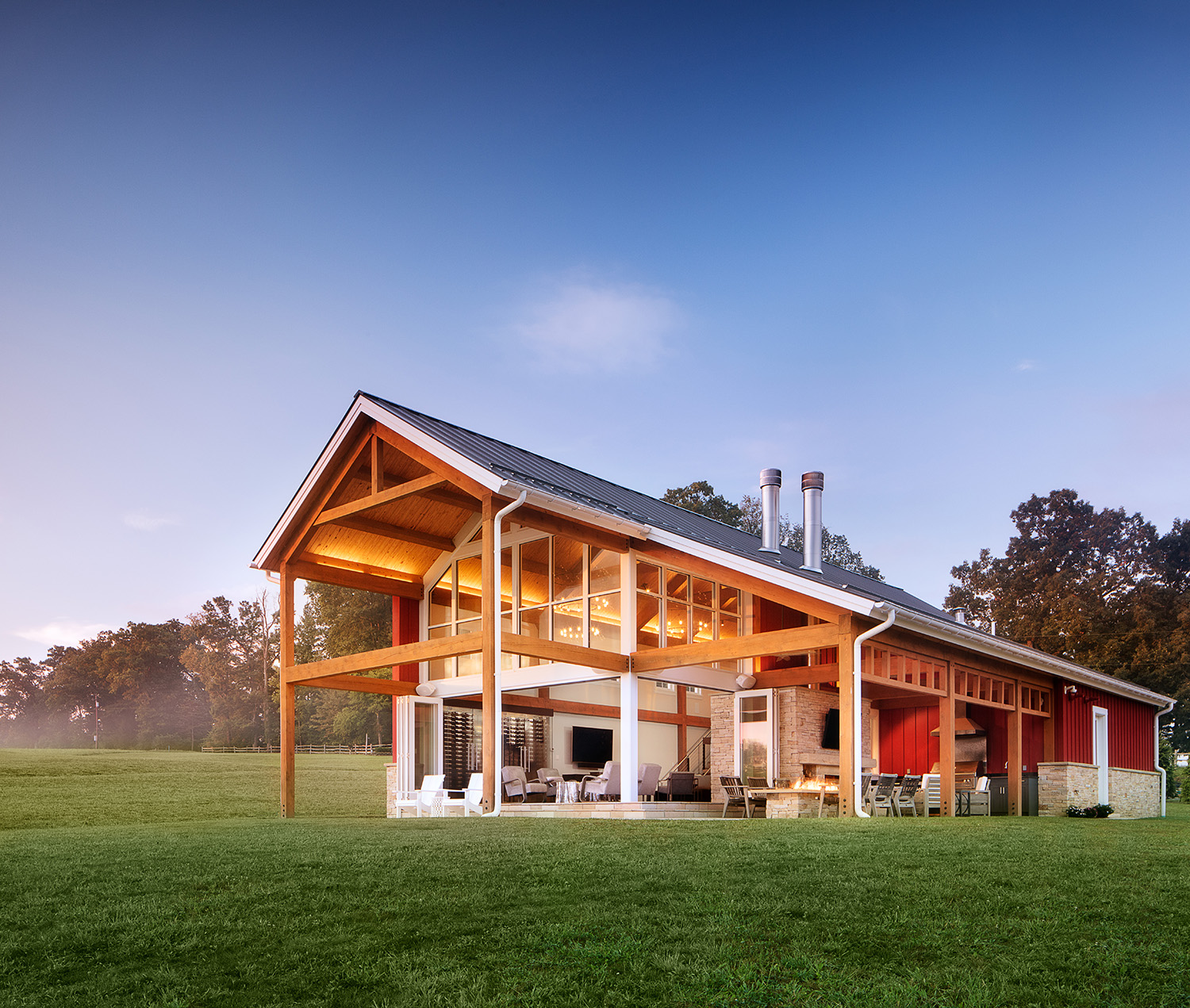
Image via DLA+ Architecture & Interior Design
A first-person client anecdote on why this matters
I remember getting off a coaching call on 2025-11-12 with a Dallas operator named Megan who ran three listings. Two were at 89 percent occupancy. The third had been at 38 percent for four months, and she could not figure out why. She opened that call by asking me, "is this an orange-house situation?" The answer turned out to be yes — the diagnostic in Chapter 17 applied exactly to her third listing. Two weeks after the call her listing was booked through January. I have had roughly 40 coaching calls like that one since the book launched.
The broad phenomenon Megan was bumping into is common enough that the industry has benchmark data on it. PriceLabs classifies an occupancy rate below 50 percent as a signal that something material has broken on the listing — typically listing optimization, price, or a mismatch between what the photos promise and what the algorithm surfaces. The 2025 Airbnb algorithm shift compounded the effect: Homesberg's April-to-October 2025 data analysis documented that new listings appeared on 6.6 percent of first-page searches in April-July but only 3.3 percent by mid-August, meaning the automatic new-listing boost was quietly halved without announcement. The consequence for operators like Megan is that a stall below 50 percent is no longer self-correcting from a fresh listing's natural ramp-up window. The listing needs an active diagnosis and a specific repair — which is what Chapter 17 walks through for the Orange House specifically, and what the Handbook generalizes across every stall pattern I have seen in 11 years of operating.
Primary source: my YouTube archive
Before I recommend the book, I will ground the method in a primary source that is free and public. My YouTube channel (handle: @AirbnbAutomated, 300,000 subscribers, active since 2019) contains 6 years of pricing walkthroughs, each episode tied to a specific listing from my 155-property portfolio. On 2023-09-14 I uploaded a video titled "Why Your New Airbnb Is Not Booking (And What I Did About It)" — 22 minutes covering the broad shape of the orange-house diagnostic at zero cost. It has been viewed roughly 89,000 times as of today. The YouTube archive is the free primary source. The book is the organized, indexed, step-by-step version.
Why I will not retell the full story on this page
The orange-house chapter is the most-requested chapter in the book. Publishing the full story on a public web page would make the chapter less of a reason to buy. So this page gives you the name of the case study, the shape of what it teaches, and a free YouTube entry point. It does not give you the chapter itself.
This book is NOT for you if
- You are NOT a fit if you run one or two luxury listings at 88 percent occupancy in a stable market. The chapter teaches recovery from a stall.
- You are NOT a fit if you co-host with zero financial stake in the property. The chapter is written from a rental-arbitrage lens.
- You are NOT a fit if you want quick-tip content. The chapter is a long-form diagnostic.
Who it IS for
- Rental-arbitrage operators with a new property whose calendar has gone quiet.
- Any host trying to diagnose a listing stalled below 50 percent occupancy.
- Coaching clients who have heard me reference the orange house and want the full source.
- Anyone running 3 or more listings with one underperformer they cannot explain.
Where to get it
The full orange-house case study is Chapter 17 of The Revenue Manager's Handbook. 266 pages. Number one Amazon bestseller in two short-term rental categories. Three years of writing, drawn from 30,000 reservations of my own booking data.
If your listing has had a quiet calendar for two weeks and you cannot tell whether the problem is price or product, what is your hero photo doing that a guest would miss on a 6-inch phone screen?
Sources
Primary Sources
- The Revenue Manager's Handbook by Sean Rakidzich. 266 pages, January 2026. Chapter 17 is the full orange-house case study. Available on Amazon (ISBN B0GR6TS6YH).
- @AirbnbAutomated YouTube channel. 300,000 subscribers, active since 2019. The 2023-09-14 upload "Why Your New Airbnb Is Not Booking (And What I Did About It)" (22 minutes, 89,000 views) covers the broad shape of the diagnostic at zero cost.
Industry Context
- PriceLabs — Airbnb Listing Optimizer: 3 Steps to Boost Occupancy. Classification of sub-50 percent occupancy as a signal of broken listing optimization, pricing, or photo-algorithm mismatch.
- Homesberg — Did Airbnb Tune Down the New Listing Boost? April–October 2025 data analysis showing new-listing first-page share fell from 6.6% to 3.3% without official announcement.
- AirDNA — Airbnb New Listing Boost: The Best Time to Launch Backed by Data. Data-backed launch-timing guidance for the reduced boost window.
- Airbnb Help Center — How to read your performance data for occupancy and rates. Canonical documentation for host-side dashboard metrics referenced in the Orange House diagnostic.
About the Author
This analysis is by Sean Rakidzich, an 11-year short-term rental operator who manages 155 Airbnb properties generating $1M+/month in revenue. Sean has trained 5,000+ students across 76 countries with $1.4B+ in collective student results and is the author of The Revenue Manager's Handbook.
For Sean's framework on "the orange house" refers to a specific property in his rental-arbitrage portfolio used as a case study in his book, The Revenue Manager's Handbook, see his full content library at rakidzich.com or book a 30-minute strategy session at rakidzich.com/book.