Best Airbnb Pricing Tool 2026: PriceLabs vs Beyond vs Wheelhouse — Honest 155-Property Host Comparison
TL;DR
Sean Rakidzich finds that third-party dynamic pricing tools outperform manual pricing and Airbnb Smart Pricing, with a 20% average revenue increase reported by STR operators who switch.
The article compares PriceLabs, Beyond Pricing, and Wheelhouse, highlighting PriceLabs' customization, Beyond's flat-fee model, and Wheelhouse' market intelligence, with a 2025 study showing a 36% revenue increase after switching to dynamic pricing.
Sean recommends choosing a tool based on operating style, emphasizing that understanding pricing strategy is more important than the tool itself, and that automation can be beneficial for scale and error protection. By Sean Rakidzich, 155-property operator. Strategy session at rakidzich.com/book.
Tools Compared
| Feature | PriceLabs | Beyond Pricing | Wheelhouse |
|---|---|---|---|
| Monthly Price | $19.99 (1 listing) | 1% of revenue | $19.99 or 1% |
| Setup Time | 2-3 hours | 30 minutes | 1-2 hours |
| Customization Depth | Very High | Moderate | High |
| Market Intelligence | Strong | Good | Strongest |
| Pace Tracking | Basic | No | Yes (unique) |
| PMS Integrations | Most (50+) | Many (40+) | Good (30+) |
| Rule Sets | Most Flexible | Basic | Flexible |
| Multi-Property View | Excellent | Good | Good |
Key Takeaways
- 2026 Dynamic Pricing Tools — Verified Pricing & Revenue Data
- Why Airbnb Smart Pricing Is Not the Answer
- Should You Automate Your Airbnb Pricing?
- PriceLabs Review: Best for Control and Customization
- The Overcharge Strategy: Where Software Falls Short
- Beyond Pricing Review: Best for Simplicity
- Wheelhouse Review: Best for Market Intelligence
2026 Dynamic Pricing Tools — Verified Pricing & Revenue Data
Cost structure, integrations, and measured revenue lift from peer-reviewed studies.
- A 2025 study tracking 541 listings across 34 countries measured a 36% revenue increase after switching to dynamic pricing. Industry-wide improvements range 20-40% annually. — StaySTRA 2026 Dynamic Pricing Tools Comparison
- PriceLabs charges $19.99 per listing per month flat, with 150+ PMS and channel manager integrations. Flat pricing is revenue-independent. — PriceLabs Official Pricing
- Beyond Pricing charges 1 to 1.25% of total revenue (March 2026), with no flat-fee subscription option. A $5,000/month listing costs $50 to $62 per month on Beyond versus $19.99 on PriceLabs. — Beyond Pricing vs Wheelhouse Comparison
- Wheelhouse is the only major dynamic pricing tool with a free plan plus real-time pace tracking, making it viable for single-listing test deployments. — StaySTRA Dynamic Pricing Head-to-Head 2026
On why dynamic pricing tools matter more in 2026:
“The STR Premium has climbed to its highest level since 2022, and revenue indicators return to more stable growth. Coastal, mountain/lake destinations, and suburban areas of major U.S. cities show some of the most favorable conditions for investors heading into 2026.”
— Jamie Lane, Chief Economist, AirDNA · AirDNA 2026 US STR Outlook Report — PR Newswire (December 2025)
Average revenue increase reported by STR operators who switch from manual or Airbnb Smart Pricing to a third-party dynamic pricing tool. For hosts who already price manually with skill, the lift is smaller (5-10%), but the error protection and consistency alone justify the cost at scale.
- Airbnb Smart Pricing underperforms third-party tools because it optimizes for Airbnb’s occupancy goals, not your revenue maximization.
- PriceLabs is the most customizable and best suited for operators who want granular control over pricing rules.
- Beyond Pricing is the most hands-off option. It works well for hosts who want set-and-forget automation without deep configuration.
- Wheelhouse offers the best market intelligence for operators focused on competitive market analysis alongside pricing.
- All three tools outperform manual pricing and Airbnb Smart Pricing in virtually all markets. The choice between them depends on your operating style.
- Software handles the mechanics. Strategy is your job. Understanding WHY you price the way you do is more important than WHICH tool you choose.
Get a free data-driven score for your listing. See exactly where you stand vs. your market — in 30 seconds.
Get Your Free Property Score →Free Tool
How Does YOUR Listing Stack Up?
Instant score against 278,799 Airbnb listings in 34 US cities. See your revenue gap and what to fix.
Score My Listing Free →Why Airbnb Smart Pricing Is Not the Answer
Airbnb Smart Pricing is free and built into the platform. So why do serious operators avoid it? Because it optimizes for Airbnb’s goals, not yours.
Airbnb wants high occupancy across its platform. More nights booked means more Airbnb revenue. Smart Pricing is built to maximize booking volume. That often means pricing below market rate to fill nights that would otherwise stay empty. For Airbnb, a filled night at $100 is better than an empty night. For you, an empty night at your market rate may be better than a filled night that drives down your RevPAN.
The Airbnb algorithm rewards bookings and occupancy. Smart Pricing leans into that by keeping your rates low. Third-party tools take a different approach. They optimize for your revenue per available night, not Airbnb’s platform-wide occupancy.
Smart Pricing has a well-documented floor problem. It can set your price below your stated minimum on certain dates. Operators who turn it on fully and do not monitor it have reported rates dropping to near their minimum on high-demand weekends, when rates should have been 2-3x higher. Third-party tools optimize for your RevPAN, not Airbnb’s occupancy.
Should You Automate Your Airbnb Pricing?
This is the question most review articles skip. They assume every host should automate immediately. The truth is more nuanced.
I manage 100+ properties and have been pricing them manually for years. I still do not fully automate. I use Wheelhouse as my second opinion, a reference tool to check my instincts. But I also recognize when automation makes sense. Here are three scenarios where it clearly wins.
Scale makes manual pricing dangerous. At 10+ properties, manual mistakes compound. One typo ($38 instead of $380) costs you a full day’s revenue on that listing. A pricing tool eliminates clerical errors. For multi-property operators, the error protection alone can justify the monthly cost.
Multiple cities make event tracking impossible. If you manage listings in Dallas, Philadelphia, and Houston, you cannot track every local event across three markets. A pricing tool with event detection catches the Dallas convention you did not know about and raises your rates automatically.
Busy seasons make discipline slip. I ran a real test. I stopped changing prices manually for three weeks while traveling. My occupancy rate dropped from 92-95% down to 68%. That is a 25-point drop. For a property at 40-45% break-even occupancy, the difference between 45% and 90% is all the profit. Every point of occupancy above break-even goes straight to your bottom line.
Pricing software is a deviation tool, not a replacement for knowing your market. Tools are 20% of the equation. Strategy is 80%. If you do not understand why you price the way you do, no tool will save you. That is why the Pricing Masterclass focuses on strategy first and tools second.
The realistic revenue lift expectation: For hosts who know nothing about pricing and have never adjusted manually, the 20-40% revenue increase claims are real. For experienced hosts who already use dynamic manual pricing, the lift is smaller, maybe 5-10%. But there are still real benefits: catching events you missed, eliminating typos, and maintaining pricing discipline when life gets busy.
PriceLabs Review: Best for Control and Customization
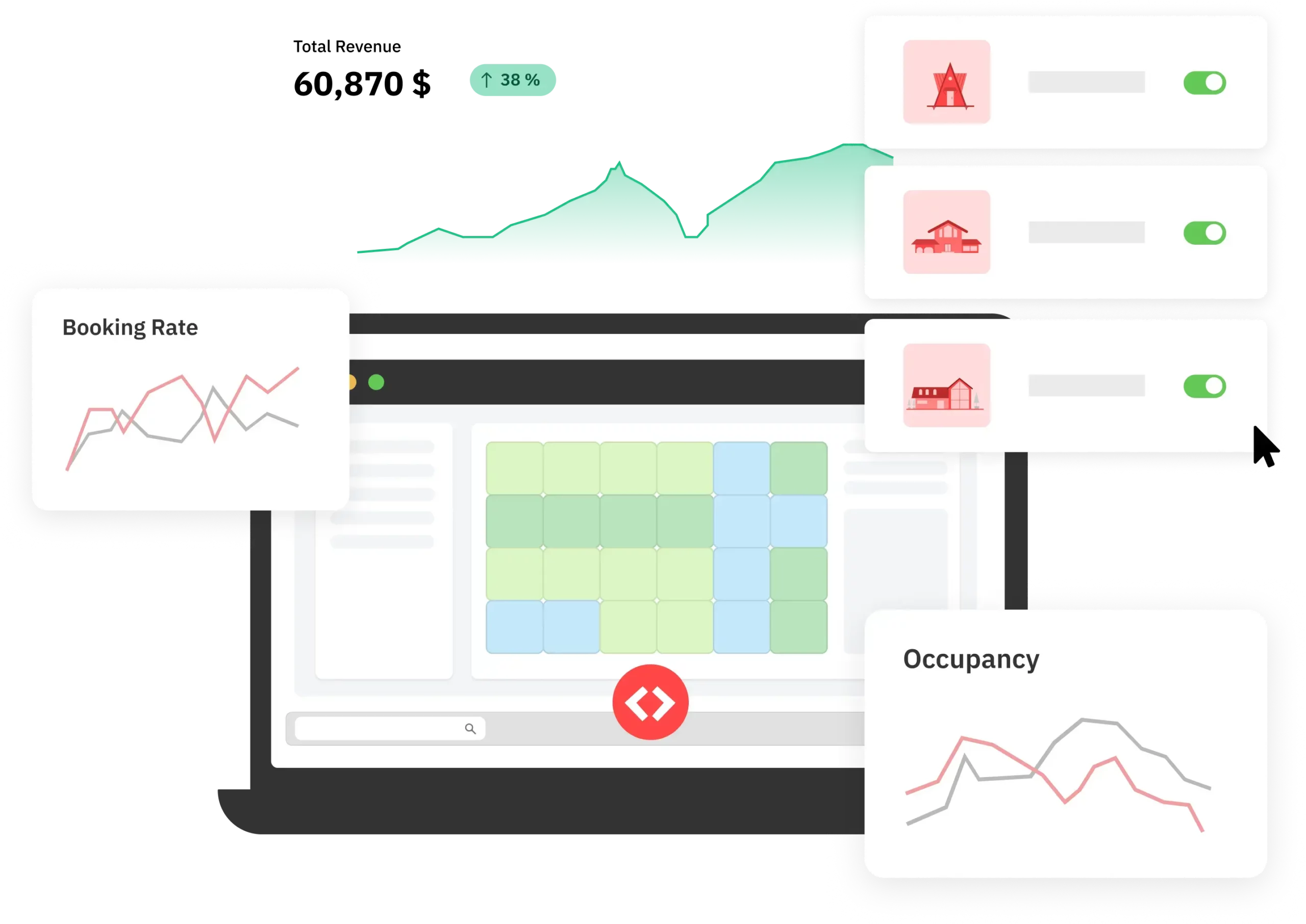
PriceLabs is the pricing tool I recommend most often. It is not the simplest tool. The interface has a learning curve. But it is the most powerful for operators who want precise control over their pricing strategy.
PriceLabs Strengths
- Market dashboards: Deep market analytics showing competitor pricing, demand trends, and local events.
- Rule sets: Highly configurable rules for minimum stays, last-minute discounts, far-out premiums, gap fills, and day-of-week adjustments.
- Portfolio performance: View all listings side by side with occupancy, rate, and RevPAN data.
- Customization depth: Set different pricing logic by listing, by season, by day of week, and by booking lead time.
- Pricing: $19.99/month for one listing, volume discounts for larger portfolios.
PriceLabs Weaknesses
- Steeper learning curve than competitors. It takes 2-3 hours to configure properly the first time.
- Interface can feel overwhelming for first-time users with fewer than 3 properties.
- Requires more ongoing monitoring to use its full rule set capability.
Best for: Operators with 3+ properties who want maximum pricing control and are willing to invest time in configuration.
The Overcharge Strategy: Where Software Falls Short
This is something most pricing tool reviews never mention. Many experienced operators use a specific pricing structure that creates a conflict with automated software.
The strategy works like this. You intentionally set your base rate 30-35% above market rate for one-night stays. Then you apply length-of-stay discounts through Airbnb: 3-night discounts, 4-night discounts, 5-night discounts. These discounts bring multi-night stays back to a competitive price. The result? One-night bookings pay a premium, and longer stays fill your calendar at fair rates.
Here is the conflict. When a pricing tool like PriceLabs or Wheelhouse changes your nightly rate, it cannot also add or remove the matching rule sets inside Airbnb. The software adjusts the price, but the length-of-stay discount percentages stay the same. If the tool drops your rate for low demand, your discount stack no longer makes sense. A 30% discount on an already-reduced rate gives away too much margin.
This requires manual intervention. You need to update both the rate and the discount structure together. It is a two-step process that the software handles only halfway.
Who this affects: Hosts using length-of-stay discounts or complex rule sets alongside dynamic pricing. If you do not use discounts or rule sets, this limitation does not apply to you. Your pricing tool can adjust rates freely without creating a mismatch.
Beyond Pricing Review: Best for Simplicity
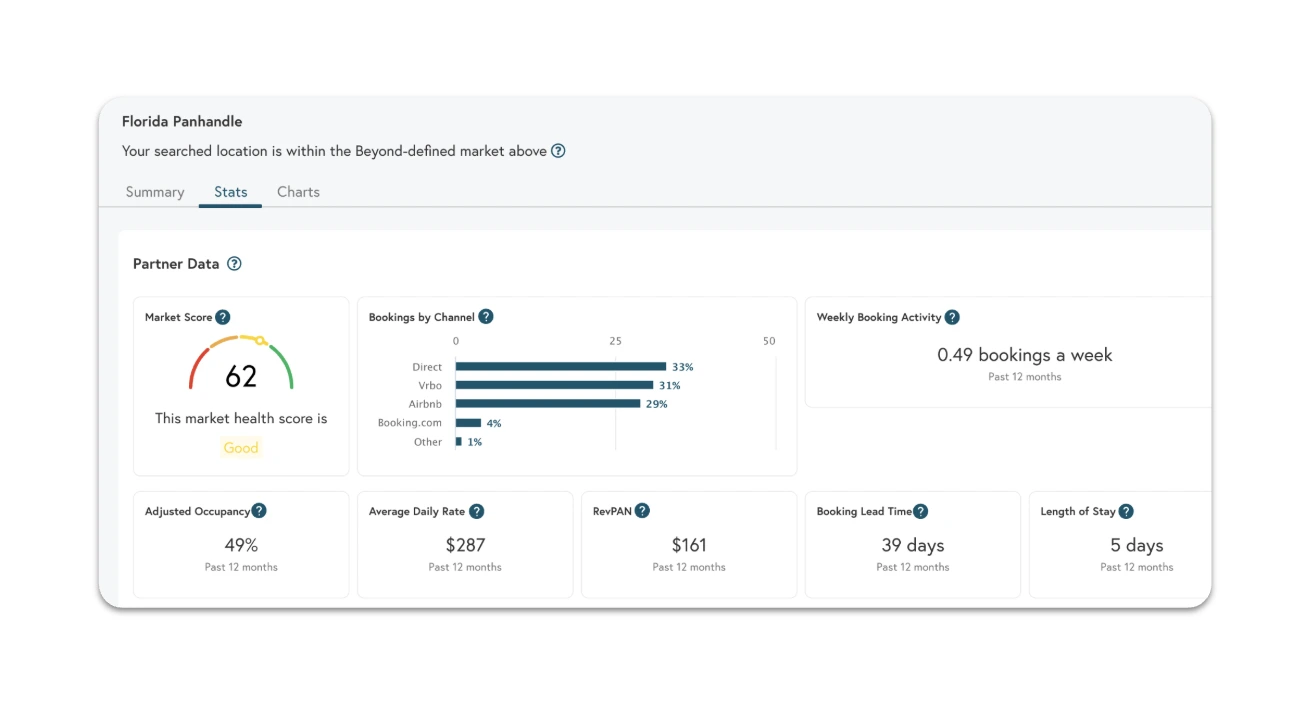
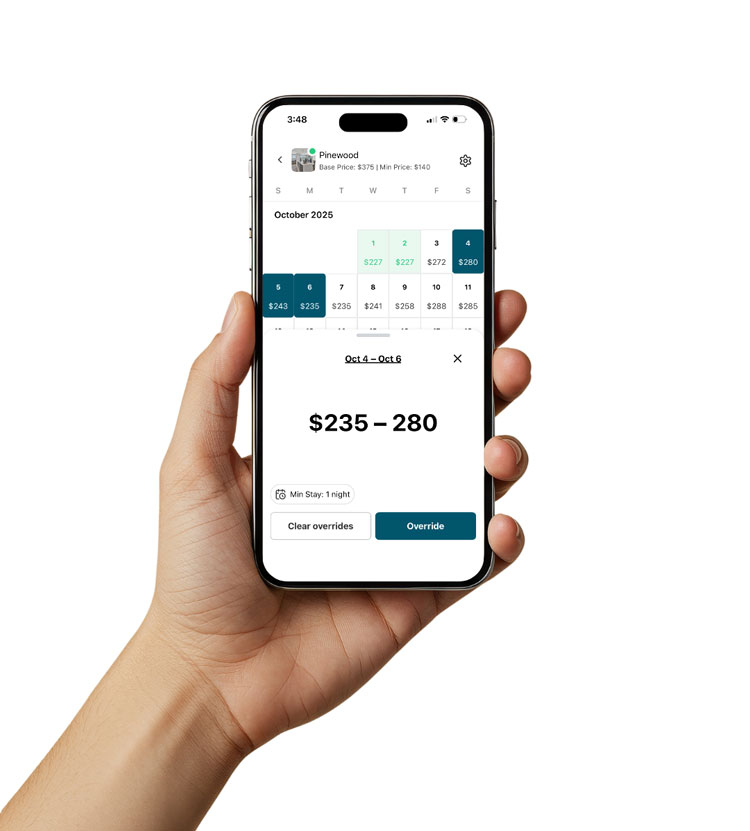
Beyond Pricing (now Beyond) is the most accessible pricing tool for new and small-volume hosts. It connects in minutes and requires minimal configuration to start outperforming manual pricing. The trade-off is less customization.
Beyond Pricing Strengths
- Fastest setup: Connect and configure in under 30 minutes. Minimal technical knowledge required.
- Clean UI: Intuitive dashboard that shows pricing decisions in plain language.
- Strong demand forecasting: Excellent at detecting local events and adjusting rates automatically. For multi-city operators, this catches events in one market while you are focused on another.
- Pricing: 1% of revenue (performance-based, not flat fee), which aligns incentives with your success.
Beyond Pricing Weaknesses
- Less customization than PriceLabs for specific rule sets.
- 1% of revenue can be expensive at high revenue volumes. On a $5,000/month listing, that is $50/month vs. PriceLabs’ $19.99.
- Less transparent about what factors are driving specific price recommendations.
Best for: New hosts, single-property operators, or those who want pricing automation with minimal setup time.
Wheelhouse Review: Best for Market Intelligence
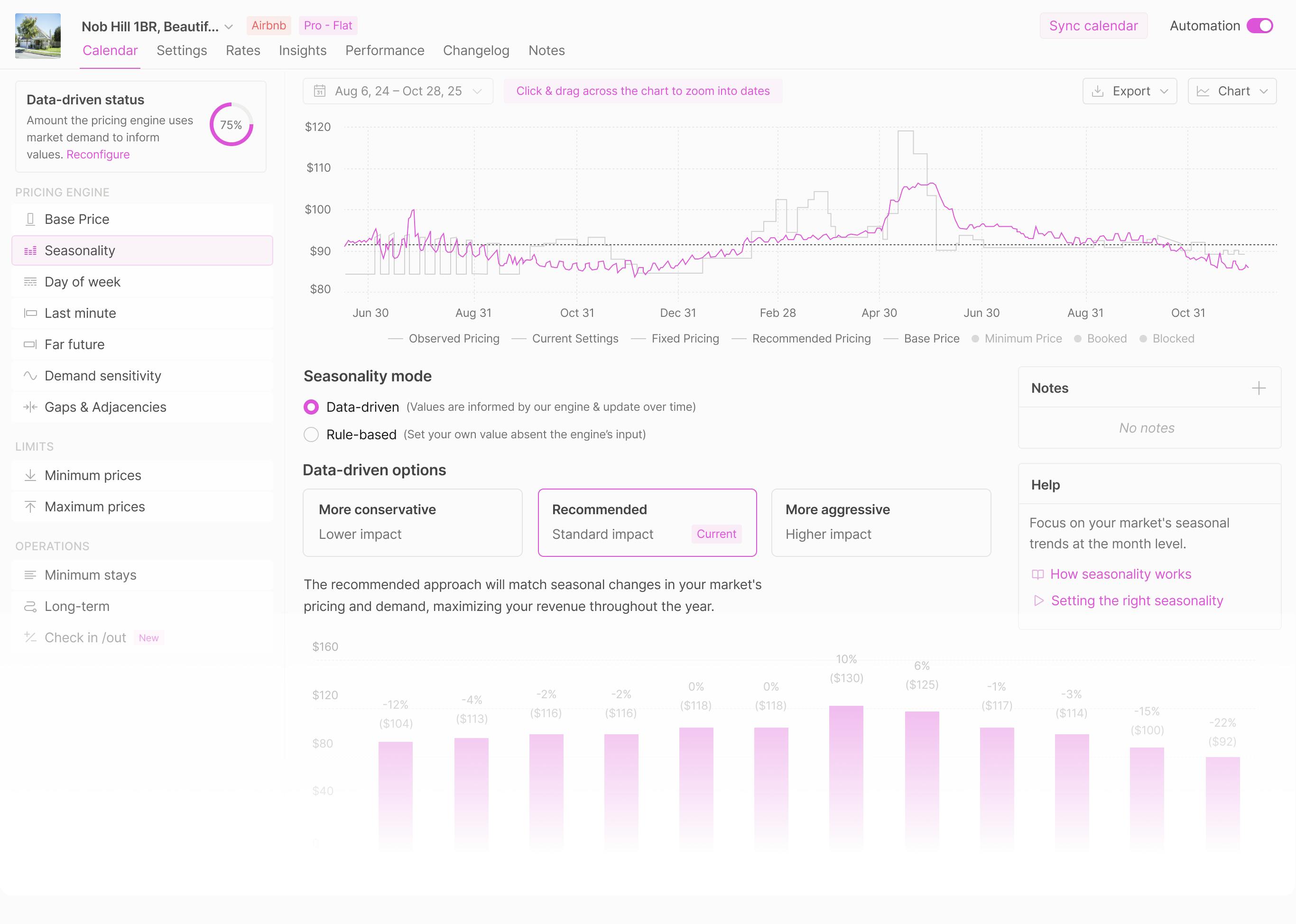
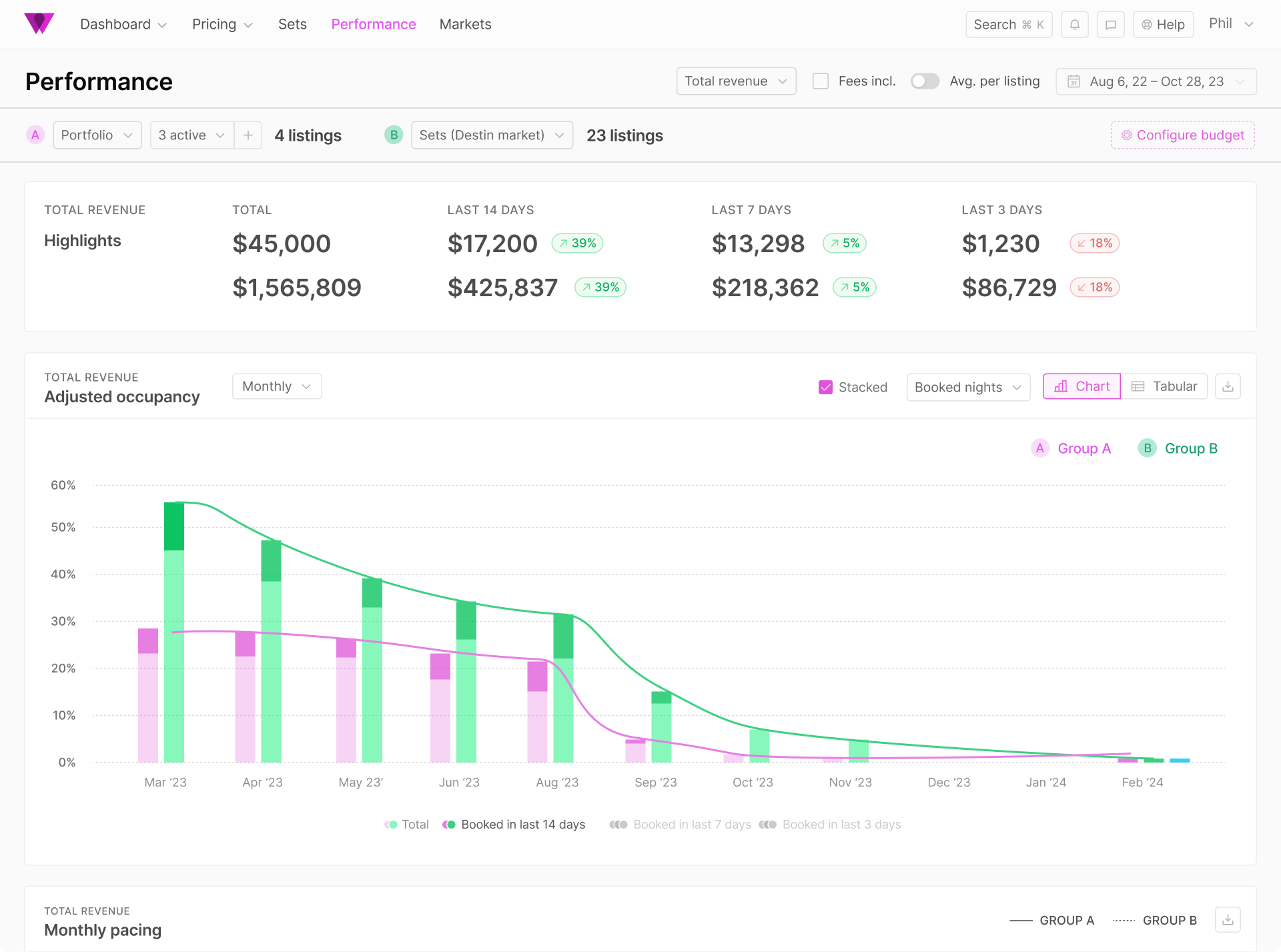
Wheelhouse differentiates itself with its market intelligence and competitor benchmarking features. If understanding your competitive position in the market is as important as the pricing automation itself, Wheelhouse is worth considering.
Wheelhouse Strengths
- Competitive benchmarking: See how your listing compares to competitors on rate, occupancy, and RevPAN.
- Market health scores: Wheelhouse provides proprietary market health scores for your area. These are useful for identifying when the market is expanding or softening.
- Pace tracking: Wheelhouse has a unique "pace" section that shows how fast your dates are booking compared to market norms. This helps you understand whether to raise or lower prices based on booking velocity. If your dates are filling faster than the market average, it is a signal to raise rates. If they are lagging, you may need to drop.
- Flexible customization: Rule set complexity sits between PriceLabs and Beyond. It is accessible but still powerful.
- Pricing: $19.99/month flat (similar to PriceLabs) or a performance-based option is available.
Wheelhouse Weaknesses
- Fewer PMS integrations than PriceLabs.
- Rule set depth below PriceLabs for complex multi-property operations.
- Market data is strong in major STR markets but thinner in smaller or rural markets.
Best for: Operators in competitive markets who want to closely monitor their competitive position and use data-driven pricing alongside competitor analysis.
Head-to-Head Comparison
| Feature | PriceLabs | Beyond Pricing | Wheelhouse |
|---|---|---|---|
| Monthly Price | $19.99 (1 listing) | 1% of revenue | $19.99 or 1% |
| Setup Time | 2-3 hours | 30 minutes | 1-2 hours |
| Customization Depth | Very High | Moderate | High |
| Market Intelligence | Strong | Good | Strongest |
| Pace Tracking | Basic | No | Yes (unique) |
| PMS Integrations | Most (50+) | Many (40+) | Good (30+) |
| Rule Sets | Most Flexible | Basic | Flexible |
| Multi-Property View | Excellent | Good | Good |
| Best For | Pros, 3+ listings | New hosts, 1-5 | Competitive markets |
Flat Rate vs. Percentage: Which Pricing Model Wins?
This decision comes down to how much revenue each property generates.
A property earning $5,000 per month at 1% pays $50 per month for Beyond. PriceLabs charges $19.99 flat. At that revenue level, flat rate wins by $30 per month.
A small apartment earning $1,000 per month at 1% pays just $10 for Beyond. PriceLabs still charges $19.99. At that revenue level, the percentage model wins by $10 per month.
The breakeven point is roughly $2,000 per month in revenue. Below that, percentage-based pricing (Beyond or Wheelhouse percentage plan) costs less. Above that, flat-rate pricing (PriceLabs or Wheelhouse flat plan) costs less. For bigger properties, the flat rate advantage grows fast.
Which Pricing Tool Should You Choose?
Choose PriceLabs if: You have 3+ properties, want maximum control over pricing strategy, and are willing to invest 2-3 hours in setup and a recurring 30-60 minutes per month in rule optimization. This is what I run across my 100+ property portfolio as a reference tool.
Choose Beyond Pricing if: You have 1-3 properties, are new to dynamic pricing, want the fastest path from zero to automated pricing, and prefer a performance-based cost model where you only pay when you earn more.
Choose Wheelhouse if: You are in a highly competitive market, want to closely monitor competitor pricing and market health, and need a balance between customization and ease of use. The pace tracking feature is especially useful for multi-city operators who want to see booking velocity across markets.
Quick Decision Guide by Operator Type
Match Your Situation to the Right Tool
- 1-3 properties, brand new host: Beyond. Simple setup, fast results, performance-based cost.
- 1-3 properties, experienced manual pricer: PriceLabs. You already understand pricing. Now you want control and rule sets at a flat fee.
- 3+ properties in one city: PriceLabs. Portfolio view and deep rule sets pay off at scale in a single market.
- 3+ properties in multiple cities: Wheelhouse. Pace tracking and event detection across markets catches what you miss.
- High-revenue properties (over $4,000/month per unit): Flat fee wins. PriceLabs or Wheelhouse flat plan saves money compared to 1% of revenue.
- Lower-revenue apartments (under $2,000/month per unit): Percentage model may win. Beyond at 1% or Wheelhouse percentage plan keeps costs proportional.
Sean’s Pricing Masterclass course ($525) covers the complete dynamic pricing system, including PriceLabs rule set configuration, seasonal discount strategy, and the exact settings Sean uses across his 100+ property portfolio. One of the most popular airbnb courses at rakidzich.com. Also see the best airbnb courses comparison for what each course covers.
Tools are 20% of the pricing equation. Strategy is 80%. Sean’s Pricing Masterclass shows you the complete pricing framework that runs across 100+ properties: rule sets, seasonal strategy, and the settings that maximize RevPAN in any market.
Learn the Pricing MasterclassWhat is the best Airbnb pricing tool in 2026?
PriceLabs is the most popular choice for professional hosts, with the strongest rule-set customization and market data. Beyond Pricing offers the simplest setup with automated pricing. Wheelhouse gives the most control over pricing strategy. For hosts with 1-5 listings, any of the three works. For portfolios of 10+ properties, PriceLabs offers the best balance of control and automation. All three outperform Airbnb's built-in Smart Pricing, which consistently underprices listings.
300,000+ subscribers watch Sean break down real pricing decisions on YouTube.
Free score in 30 seconds. No credit card.
Common Questions About Airbnb Pricing Tools
Is Airbnb Smart Pricing good enough for most hosts?
For hobbyist hosts with 1-2 properties who are not focused on maximizing revenue, Smart Pricing provides basic automation. For anyone serious about revenue optimization, it is not enough. Smart Pricing optimizes for Airbnb’s occupancy goals rather than your RevPAN. Third-party tools consistently outperform it by 15 to 25 percent in controlled comparisons.
Which Airbnb pricing tool is best for beginners?
Beyond Pricing (now called Beyond) is the easiest tool for new hosts. It connects in under 30 minutes and requires little configuration to start outperforming manual pricing. The trade-off is less customization compared to PriceLabs.
Is PriceLabs worth it?
Yes, for hosts with 3 or more properties who want maximum control over their pricing strategy. PriceLabs at $19.99 per month per listing pays for itself with even one extra booking per month at your average nightly rate. At scale across 10 or more listings, the ROI compounds significantly.
Can I use more than one pricing tool at the same time?
No. Using multiple tools at once creates conflicts where they overwrite each other’s prices. Choose one tool, configure it well, and monitor its performance. Switching tools every few months prevents you from ever developing the deep configuration knowledge to get the most from any one tool.
What is the most important setting in a dynamic pricing tool?
The minimum price floor. This is the price below which the tool will never drop your rate. Without a properly set floor, the software will fill your calendar with low-revenue stays during slow periods instead of leaving nights empty. Your minimum should be the price at which a stay is still profitable after all variable costs.
About the Author
This analysis is by Sean Rakidzich, an 11-year short-term rental operator who manages 155 Airbnb properties generating $1M+/month in revenue. Sean has trained 5,000+ students across 76 countries with $1.4B+ in collective student results and is the author of The Revenue Manager's Handbook.
For Sean's framework on third-party dynamic pricing tools outperform manual pricing and Airbnb Smart Pricing, with a 20% average revenue increase reported by STR operators who switch, see his full content library at rakidzich.com or book a 30-minute strategy session at rakidzich.com/book.
Affiliate disclosure: Some links on this page (anything starting with rakidzich.com/p/) are affiliate links. If you sign up through them, Sean may earn a commission at no extra cost to you. The recommendation reflects Sean's actual use across his 155-property portfolio.
Sources
Pricing Tool Documentation
- PriceLabs Revenue Management Blog — PriceLabs
- Wheelhouse Resource Center — Wheelhouse
- Setting a Price for Longer Stays — Airbnb Resource Center
Revenue Management Research
- Revenue Management and the Guest Experience — Cornell Hospitality Research
- Price determinants in Airbnb: A quantile regression approach — Tourism Management Perspectives
Sean Rakidzich Courses
- Pricing Masterclass — Complete dynamic pricing course including PriceLabs rule set configuration
- Target Price — Set base rates, minimums, and seasonal adjustments
Get a free data-driven score for your listing. See exactly where you stand vs. your market — in 30 seconds.
Get Your Free Property Score →More in this series
- The $4 vs $400 AI Photo Workflow for Airbnb in 2026
- Airbnb PriceLabs 90-Day Price Ramp: The 100-Day Strategy for 2026
- Airbnb Bookings Dropped 50 Percent? 7 Fixes for 2026
- Airbnb Bottom Bracket Pricing 2026: The Edge Play That Beats PriceLabs
- Airbnb Last-Minute Pricing Discount Strategy: The Decision Tree Every Host Needs
- Airbnb Pricing 6 Months Out: The Overprice-Then-Crush Curve
- Airbnb + PriceLabs + Channel Manager: The 2026 Promotion Conflict Fix
- PriceLabs vs Wheelhouse 2026: Read Your Market Before You Price
- Airbnb Pricing Tool Billing: 7 Questions to Ask First
- Summer Airbnb Pricing 2026: Memorial Day to Labor Day Calendar
- PriceLabs Settings Audit for Airbnb Hosts: 5 Fixes for 2026
- PriceLabs Neighborhood Chart Occupancy Data: Read the Green Line Early
- PriceLabs Pickup Signals: Momentum, Accrual, Potential Decoded
- PriceLabs Listing Optimizer Review 2026: 155-Door Verdict
- PriceLabs vs Beyond Pricing vs Wheelhouse vs Revenue Agency: The Honest Comparis
- PriceLabs vs Wheelhouse 2026: Which Wins for Airbnb Hosts
- PriceLabs vs Wheelhouse vs Beyond Pricing: 2026 Operator Verdict
- PriceLabs Weekday Fragility: The 8-of-30 Booking Signal
- Pricing Masterclass
- Revande and PriceLabs: The Engine and the Driver
- Wheelhouse vs PriceLabs vs Beyond 2026: A Host's Honest Pick
- When PriceLabs Is Wrong: 4 Market Signals Hosts Miss
- When to Override Your Airbnb Pricing Tool: 7 Signals in 2026
- When To Raise Airbnb Prices: 3 Data Signals From a 155-Property Host