What Is the Target Price Framework for Airbnb Pricing? (2026 Course Review)
TL;DR
Sean Rakidzich's Target Price framework is a method for calculating the exact base rate for an Airbnb listing and layering seasonal and demand-based modifiers to maximize revenue.
The framework relies on a proprietary base-rate calculator using comparable listing data and operating cost floor, along with a 12-month pricing calendar that incorporates demand signals.
Sean recommends the Target Price course as a step-by-step system to replace guesswork with data-driven pricing, helping hosts avoid significant monthly revenue losses. By Sean Rakidzich, 155-property operator. Strategy session at rakidzich.com/book.
Key Facts
| Your Monthly Revenue | 5% Improvement | 10% Improvement | Payback Period |
|---|---|---|---|
| $2,000/month | +$100/month | +$200/month | 2-4 months |
| $3,000/month | +$150/month | +$300/month | 6 weeks - 3 months |
| $5,000/month | +$250/month | +$500/month | 3-6 weeks |
| $8,000/month | +$400/month | +$800/month | 2-4 weeks |
Target Price is Sean Rakidzich's framework for calculating the exact base rate a short-term rental should charge, then layering seasonal, event, and occupancy modifiers on top. It replaces the usual guess-a-number-and-see approach with arithmetic. The framework has two load-bearing pieces: a proprietary base-rate calculator that uses comparable listing data and your operating cost floor, plus a 12-month pricing calendar that layers demand signals on top of the base. Everything lives inside Sean's 410-dollar Target Price course, which this review covers in full.
Image: pricelabs.co marketing page.
Key Takeaways
- What Is the Target Price Course?
- What You Learn: The 5 Modules
- How Much Is Guessing Your Price Actually Costing You?
- The Proprietary Price Calculator
- The No-Cleaning-Fee Strategy Most Hosts Get Backwards
- Who Should Skip This Course
- The ROI Math: When Does $410 Pay for Itself?
Target Price — Program Pricing and Impact Benchmarks
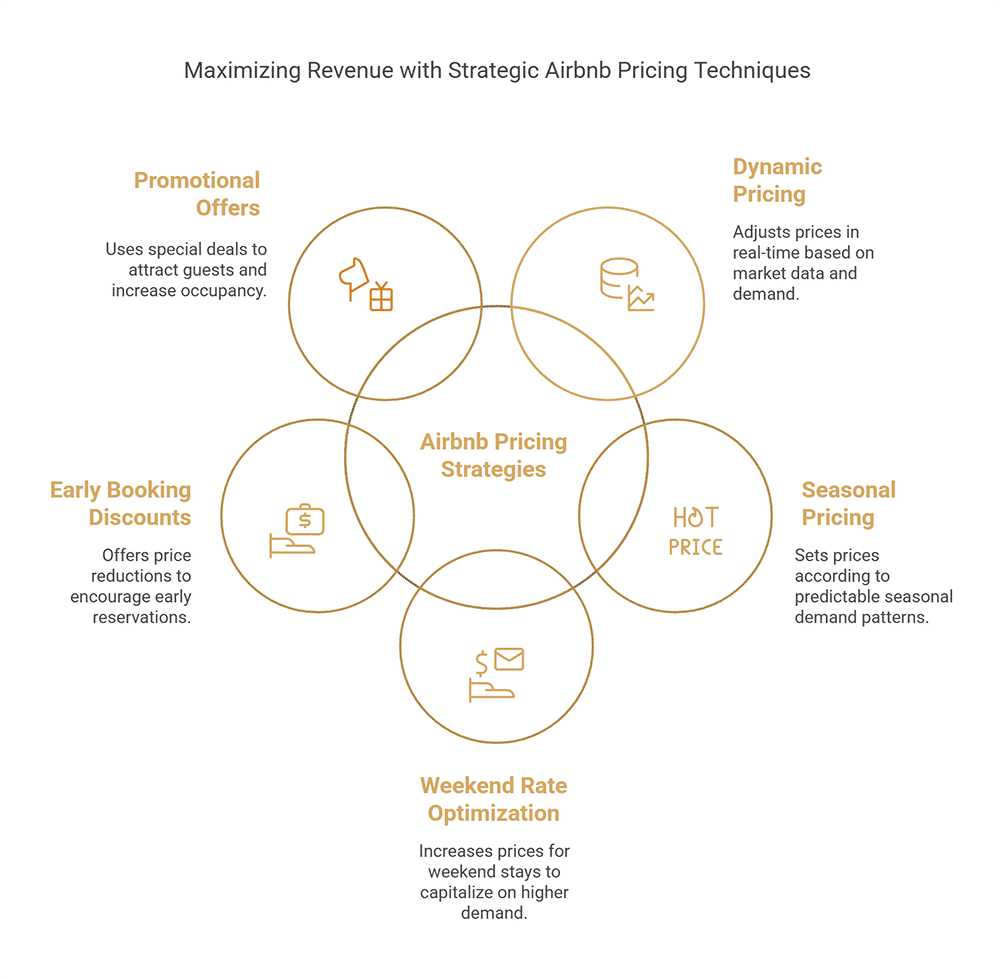
Image via Revfine.com
Course positioning and the dynamic-pricing research that underwrites its approach.
- A 2025 study tracking 541 listings across 34 countries measured a 36% revenue increase after switching to dynamic pricing. Industry-wide lift benchmark: 20-40% annually. — StaySTRA 2026 Dynamic Pricing Study
- Dynamic pricing tool pricing: PriceLabs $19.99 per listing per month flat, Beyond Pricing 1 to 1.25% of revenue, Wheelhouse free plan available. — PriceLabs Official Pricing
- The US average Airbnb occupancy rate is 54.3% (AirDNA, August 2025), down from approximately 57% in 2024 as supply growth outpaced demand. — AirDNA 2025 Occupancy Data
The average revenue most Airbnb hosts leave on the table each month by pricing based on gut feel instead of market data. Underpricing by just $15 per night across 20 booked nights costs you $300 every single month. That is $3,600 per year, per listing.
The question is not whether $410 is a lot to spend on a course. The question is whether you can afford to keep losing $300 or more every month because you do not know your correct price. Target Price exists to replace the guess with a number you can prove.
What Is the Target Price Course?
Image via PriceLabs
Target Price is a pricing system course by Sean Rakidzich. It teaches you how to find the exact revenue-maximizing price for your Airbnb listing using market data, competitor analysis, and RevPAN optimization.
The course is 161.5 minutes of video content. That is about 2 hours and 41 minutes, split across 5 modules. Each module builds on the one before it. By the end, you will have a base rate, a 12-month seasonal pricing calendar, and a fully configured dynamic pricing tool.
This is not a collection of tips. It is a step-by-step system. You start by figuring out where your listing sits in your market. You end with a pricing tool that adjusts your rates automatically based on the strategy you built.
Course Quick Facts
- Price: $410 one-time payment, lifetime access
- Length: 161.5 minutes (5 modules)
- Level: Intermediate (you need a listing, not experience)
- Includes: Proprietary price calculation tool
- Creator: Sean Rakidzich (100+ property portfolio, $10M+ revenue)
What You Learn: The 5 Modules
Each module solves a specific pricing problem. Here is what changes for you after completing each one.
Module 1: Market Position Analysis
Before: You look at a few nearby listings and pick a price that seems reasonable. You have no idea if those listings are actually your competitors or if they serve a completely different guest type.
What you learn: How to identify your true competitive set. Where your listing ranks in your market. What your pricing ceiling and floor actually are based on real data, not feelings.
After: You know exactly where you stand. You stop comparing yourself to listings that are not your real competition. You have a clear range that your price should fall within.
Module 2: RevPAN Benchmarking
Before: You track occupancy rate or nightly rate, but not both together. You think 95% occupancy means you are winning. In reality, high occupancy at a low rate often means you are leaving money on the table.
What you learn: How to use RevPAN (Revenue Per Available Night) as your primary metric. How to segment market data by bedroom count and property type so your benchmarks are accurate.
After: You measure the right number. You might discover that dropping from 95% to 85% occupancy while raising your rate by $30 per night actually increases your total revenue. RevPAN shows you what occupancy rate alone cannot.
Module 3: Base Rate Calculation
Before: Your base rate is a number you picked when you first listed. You may have raised it once or twice, but you have no framework for knowing if it is right.
What you learn: The exact method to calculate your ideal starting price. This is the number all your seasonal adjustments build on top of. Get this wrong and every other pricing decision is off.
After: You have a base rate backed by data. Not a guess. Not a copy. A calculated number specific to your listing and your market.
Written by Sean Rakidzich, who manages 100+ active Airbnb properties through rental arbitrage without owning any of them.
Sean has been operating for 11 years and generates over $1 million per month in revenue.
Over 5,000 students in 76 countries have trained through his programs, with $1.4 billion+ in collective student revenue.
Sean teaches pricing through Target Price ($410) and Pricing Masterclass ($525), based on managing pricing across 100+ live properties.
Cracking Superhost is Sean's flagship application-only coaching program with 7 specialist coaches and a Succeed Now Pay Later option.
- Target Price replaces guessing with a system. You will walk away with your exact base rate, a 12-month pricing calendar, and a configured dynamic pricing tool.
- The course pays for itself fast. Even a 5% improvement on a $3,000 per month listing adds $150 per month. Full payback in under 3 months.
- It includes a proprietary price calculator. You input your data and the tool outputs your number. This is not theory. It is a machine that gives you an answer.
- The no-cleaning-fee strategy is counterintuitive and effective. Most hosts charge cleaning fees. This course shows why that may be costing you bookings.
- It works in any market. The method is market-agnostic. Beach, urban, rural, primary, or secondary. Module 1 starts with your specific market.
- You need an active listing, not pricing experience. The course is labeled Intermediate because you need a property, not because the content is complex.
How Much Is Guessing Your Price Actually Costing You?
Most Airbnb hosts set their price one of three ways. They copy a competitor. They pick a round number that feels right. Or they use Airbnb Smart Pricing, which optimizes for Airbnb’s occupancy goals instead of your revenue.
All three approaches share the same problem. They are not based on your actual market position. They are based on a feeling.
Here is what that costs in real dollars. Say your listing should be priced at $165 per night based on market data. Instead, you set it at $150 because a nearby listing charges $148 and you wanted to stay competitive. That $15 gap does not sound like much. But across 20 booked nights per month, you are leaving $300 on the table. Over a year, that is $3,600 in revenue you earned but never collected.
The problem gets worse during events and peak seasons. A host who does not know their seasonal ceiling might price a holiday weekend at $180 when the market would pay $250. That single weekend costs $140 or more in lost revenue.
Your base rate is the foundation of every pricing decision. Seasonal adjustments, event pricing, and dynamic tool settings all multiply or adjust from this number. If your base rate is $20 too low, every seasonal bump is also too low. If it is $20 too high, your slow-season discounts still leave you overpriced. One wrong number cascades through your entire calendar.
Module 4: Seasonal and Event Pricing
Before: You raise prices in summer and lower them in winter. Maybe. Your adjustments are rough and you probably miss local events entirely.
What you learn: How to build a complete 12-month pricing calendar. How to price for local events without overcharging (which kills bookings) or undercharging (which kills revenue). The specific percentages to raise and lower from your base rate by season.
After: You have a full-year pricing calendar. Every month has a planned rate. Every major event in your market has a pricing strategy. You stop reacting to seasons and start planning for them.
Module 5: Dynamic Pricing Tool Configuration
Before: You either do not use a dynamic pricing tool, or you connected one and left it on default settings. Default settings are designed for the average listing. Your listing is not average.
What you learn: How to configure PriceLabs with the strategy you built in Modules 1 through 4. Minimum stay rules. Gap-fill settings. Event overrides. The specific settings that turn a generic tool into your personal pricing engine.
After: Your pricing tool works for you, not against you. It knows your base rate, your seasonal calendar, your minimum stays, and your event strategy. You built the brain. The tool executes it.
The Proprietary Price Calculator
This is what separates Target Price from a YouTube playlist or a blog post about pricing.
The course includes a purpose-built price calculation tool. You input your market data, property details, and competitor information. The tool outputs your recommended base rate, seasonal adjustments, and pricing floor.
This is not a spreadsheet template with formulas you have to understand. It is a calculator that does the math Sean teaches in the course. You put in your numbers. It gives you your answer.
Why this matters: Most pricing courses teach you concepts. You leave understanding the theory but still unsure what your actual price should be. Target Price gives you the theory AND the tool that turns that theory into a specific dollar amount for your listing.
You are not buying knowledge alone. You are buying a machine that outputs YOUR number.
The No-Cleaning-Fee Strategy Most Hosts Get Backwards
Here is something that surprises most hosts in this course. Sean teaches a pricing model where you do not charge a separate cleaning fee.
That sounds backwards. Cleaning costs money. Why would you absorb it?
Because of how Airbnb search works. When a guest searches for a place to stay, they see the total price. A listing at $120 per night with a $100 cleaning fee shows up at $220 for a one-night stay. A listing at $150 per night with no cleaning fee shows up at $150. The second listing gets more clicks even though its nightly rate is higher.
More clicks means more bookings. More bookings means higher ranking in Airbnb search results. Higher ranking means even more bookings. It is a compounding effect.
The course shows you exactly how to adjust your base rate to absorb the cleaning cost without losing revenue. For multi-night stays, the math works strongly in your favor. You appear cheaper to guests while actually earning the same or more.
This strategy is rooted in consumer psychology, which the course covers in detail. Guests make booking decisions based on the first number they see. A lower visible total price means more clicks, even if the per-night rate is higher. The course teaches you how pricing affects guest behavior, not just your revenue spreadsheet.
Target Price gives you the exact system to find your revenue-maximizing price point. One course. One calculator. A pricing strategy you can prove with data.
Get Target Price ($410)Who Should Skip This Course
Target Price is not for everyone. Being honest about that is more useful than pretending it is.
Skip if you do not have a listing yet. The course assumes you have an active Airbnb property or one you are preparing to list soon. If you are still deciding whether to become a host, start with market research first.
Skip if you already use a revenue manager. If you have a professional revenue management service handling your pricing, this course covers ground your manager already handles. The course is designed for hosts who manage their own pricing.
Skip if you want set-and-forget. Target Price teaches you a system. Systems require you to review and adjust, especially when seasons change or your market shifts. If you want to connect a tool and never think about pricing again, this course asks more of you than that.
Target Price Is Built For
- Hosts with 1 or more active listings who price based on gut feel and want a data-backed system
- Hosts with good occupancy but flat revenue who suspect they are underpricing
- Hosts in any market type including beach, urban, rural, primary, and secondary markets
- Hosts who want to understand their pricing, not just outsource it to software
- Investors evaluating new properties who need to know if a deal will hit revenue targets before signing a lease
The ROI Math: When Does $410 Pay for Itself?
This is the question every host asks. Here is the math.
| Your Monthly Revenue | 5% Improvement | 10% Improvement | Payback Period |
|---|---|---|---|
| $2,000/month | +$100/month | +$200/month | 2-4 months |
| $3,000/month | +$150/month | +$300/month | 6 weeks - 3 months |
| $5,000/month | +$250/month | +$500/month | 3-6 weeks |
| $8,000/month | +$400/month | +$800/month | 2-4 weeks |
A 5% improvement is conservative. That is the equivalent of being $8 to $12 per night closer to your optimal price. Most hosts who have never done a formal pricing analysis find much larger gaps.
A 10% improvement is common for hosts who switch from gut-feel pricing to a data-backed system. On a $150 per night listing, that is $15 more per night. Across 20 booked nights, that is $300 per month. The course pays for itself in 6 weeks.
For hosts with multiple listings, multiply the improvement. Two listings at $3,000 per month each with a 5% lift means $300 per month in added revenue. Three listings means $450. The ROI scales with your portfolio.
A revenue management consultant charges $500 to $2,000 per month. A dynamic pricing tool costs $20 to $50 per listing per month on an ongoing basis. Target Price is $410 once, with lifetime access. It is the cheapest path to a real pricing system, and unlike a consultant, the knowledge stays with you forever.
How Target Price Compares to Other Options
Target Price vs. Free YouTube Content
Sean has hundreds of free YouTube videos about pricing. So why pay $410?
YouTube videos teach concepts. Target Price gives you a system AND a calculator. The free content tells you WHAT matters. The course walks you through HOW to do it for your specific listing and gives you a tool that outputs your number. The difference is the gap between understanding pricing and actually having your correct price.
Target Price vs. the Pricing Masterclass
Target Price ($410) teaches you how to find and set the right base rate, seasonal adjustments, and minimum stays. The Pricing Masterclass ($525) is a broader course that covers advanced dynamic pricing strategy, deep PriceLabs rule sets, and portfolio-level revenue management.
Start with Target Price if: You need to find your correct base rate first. Without the right foundation, advanced strategies build on a shaky base.
Start with the Pricing Masterclass if: You already know your base rate and want advanced rule sets, seasonal discount stacking, and portfolio management techniques.
Target Price vs. Just Using a Pricing Tool
A dynamic pricing tool on default settings is like a GPS with the wrong destination. It will efficiently take you somewhere, but not where you need to go. Target Price teaches you how to set the destination. Then the tool drives.
Tools handle the mechanics. Strategy is your job. Target Price gives you the strategy.
| Option | Cost | What You Get | Limitation |
|---|---|---|---|
| Target Price | $410 once | Complete pricing system + calculator | Requires your time to implement |
| Pricing Tool (default) | $20-50/mo/listing | Automated rate changes | No strategy. Wrong base rate stays wrong. |
| Revenue Consultant | $500-2,000/mo | Managed pricing | Expensive. Knowledge leaves when they do. |
| YouTube (free) | $0 | Concepts and tips | No system. No calculator. No implementation path. |
| Gut Feel | $0 | A number that feels right | Costs $300+/month in leaked revenue |
161 minutes. 5 modules. One proprietary calculator. Walk away with a pricing system built on your market data, your competitive position, and your specific listing. Lifetime access for $410.
Get Target Price Now300,000+ subscribers watch Sean break down real pricing decisions on YouTube.
The price a listing charges is the most consequential number on the whole dashboard. Every other optimization, photos, reviews, algorithm rank, trails behind it.
Book a free 15-minute consultation before deciding whether Target Price is the right move for your listing. We review your current pricing, the revenue left on the table, and whether the framework solves what you are trying to solve.
Book Your Free ConsultationCommon Questions About the Target Price Course
Is the Target Price course worth $410?
For any host earning more than $2,000 per month from Airbnb, the course typically pays for itself within 4 to 6 weeks. Even a 5% improvement on a $3,000 per month listing adds $150 per month in extra revenue. That means full payback in under 3 months and pure profit after that. The proprietary price calculator alone removes guesswork that costs most hosts hundreds of dollars each month.
What is the difference between Target Price and the Pricing Masterclass?
Target Price ($410) teaches you how to find and set the right base rate, seasonal adjustments, and minimum stays for your specific listing. The Pricing Masterclass ($525) is a broader course that covers advanced dynamic pricing strategy, PriceLabs rule sets, and portfolio-level revenue management. Target Price is where most hosts should start. The Pricing Masterclass builds on top of it.
Does Target Price work for any Airbnb market?
Yes. The course teaches a method, not a specific number. The system works whether you are in a beach town, a city center, a rural cabin market, or a secondary market. Module 1 starts with analyzing your specific market position, so every calculation that follows is based on your actual competitive landscape.
Do I need to use PriceLabs to take this course?
PriceLabs is the tool Sean recommends and configures in Module 5, but the pricing strategy in Modules 1 through 4 works with any dynamic pricing tool or even manual pricing. The base rate calculation and seasonal calendar are tool-agnostic. You will get more from the course if you use PriceLabs, but it is not required.
What skill level do I need for Target Price?
You need an active Airbnb listing or a property you are preparing to list. You do not need any pricing experience. The course is labeled Intermediate because it assumes you already have a listing, not because the content is hard to follow. Sean walks through every step from scratch.
How long is the Target Price course?
The course is 161.5 minutes of video content, roughly 2 hours and 41 minutes. It is divided into 5 modules that build on each other. Most students complete it in a single weekend and begin applying the pricing system to their listings the same week.
Does the course include a pricing calculator tool?
Yes. Target Price includes a proprietary price calculation tool. You input your market data, property details, and competitor information. The tool outputs your recommended base rate, seasonal adjustments, and pricing floor. This is not a spreadsheet template. It is a purpose-built calculator that does the math Sean teaches in the course.
What is the no-cleaning-fee strategy taught in Target Price?
Sean teaches a counterintuitive approach where you build your cleaning costs into the nightly rate instead of charging a separate cleaning fee. This improves your position in Airbnb search results because guests filter by total price, and a lower visible total price means more clicks. The course shows exactly how to adjust your base rate to absorb the cleaning cost without losing revenue.
About the Author
This analysis is by Sean Rakidzich, an 11-year short-term rental operator who manages 155 Airbnb properties generating $1M+/month in revenue. Sean has trained 5,000+ students across 76 countries with $1.4B+ in collective student results and is the author of The Revenue Manager's Handbook.
For Sean's framework on Sean Rakidzich's Target Price framework is a method for calculating the exact base rate for an Airbnb listing and layering seasonal and demand-based modifiers to maximize revenue, see his full content library at rakidzich.com or book a 30-minute strategy session at rakidzich.com/book.
Affiliate disclosure: Some links on this page (anything starting with rakidzich.com/p/) are affiliate links. If you sign up through them, Sean may earn a commission at no extra cost to you. The recommendation reflects Sean's actual use across his 155-property portfolio.
Sources
Course and Pricing Resources
- Target Price Course, by Sean Rakidzich
- Pricing Masterclass, by Sean Rakidzich
- PriceLabs Revenue Management Blog, PriceLabs
Revenue Management Research
- Revenue Management and the Guest Experience, Cornell Hospitality Research
- Price determinants in Airbnb: A quantile regression approach, Tourism Management Perspectives