How to Become an Airbnb Co-Host in 2026: The Complete Guide
TL;DR
Sean Rakidzich explains how to become an Airbnb co-host in 2026, highlighting that co-hosting allows individuals to earn money by managing listings for property owners without owning property themselves.
The article provides commission rate data, noting that typical co-host commissions range from 15% to 25% of gross booking revenue, with 20% being the most common rate for full-service arrangements.
Sean recommends leveraging Airbnb's Co-Host Network and developing pricing skills to attract clients, as these factors significantly impact earning potential and business scalability. By Sean Rakidzich, 155-property operator. Strategy session at rakidzich.com/book.
Steps
| Factor | Co-Hosting | Rental Arbitrage | Traditional PM |
|---|---|---|---|
| Upfront Cost | Near zero | $3K-$10K per unit | License + insurance |
| Financial Risk | Low (no lease) | High (you hold the lease) | Medium |
| Revenue Model | 15-25% of gross | Keep all profit after rent | 8-12% + fees |
| Scalability | High | Limited by capital | High with staff |
| Control | Moderate | Full | Full |
| Exit Difficulty | Easy | Hard (lease obligations) | Medium |

Image via learnbnb.com
Key Takeaways
- 2026 Co-Host Commission Data
- What Is Co-Hosting (and What It Is Not)
- Why 2026 Is the Year to Start Co-Hosting
- The Co-Hosting Business Model
- How to Get Your First Co-Hosting Client
- Setting Up on Airbnb's Co-Host Network
- Pricing Skills That Make You Valuable
2026 Co-Host Commission Data
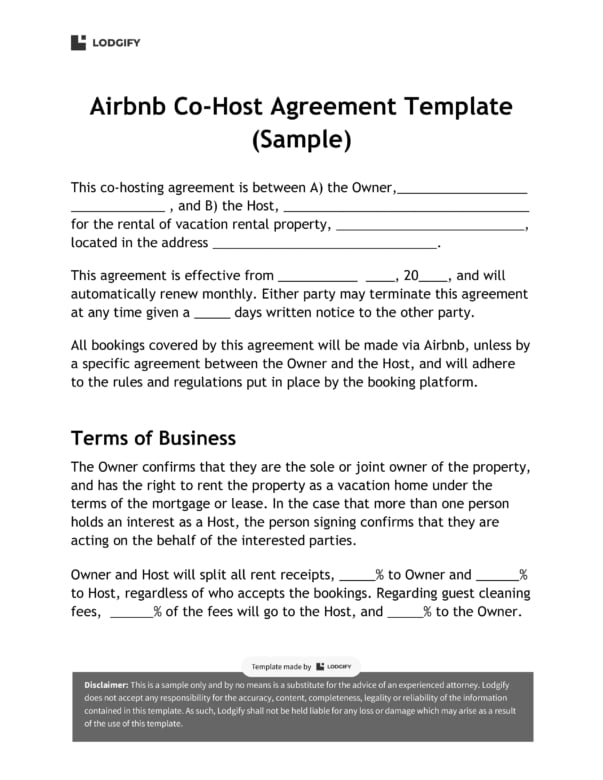
Image via Lodgify
Industry-standard fee structures for Airbnb co-hosting arrangements.
- Typical Airbnb co-host commission rates are 15-25% of gross booking revenue in 2026, with 20% as the most common figure for full-service arrangements. — STR Numbers Co-Host Commission Data 2026
- Rate tiers by service level: Communication-only runs 10-15%, partial management (communication + cleaning coordination) runs 15-25%, and full-service management including marketing runs 25%+. — Hostaway Co-Host Cost Breakdown
- A Hostaway survey of 500 property owners and managers revealed that 30% of respondents are already using AI tools for co-hosting guest communication, reducing the labor cost of communication-only service tiers. — Hostaway 2025 Property Manager Survey
- Airbnb’s new 2025 host fee structure shifted the service-fee model, making co-host commissions more transparent and affecting how property managers price their services. — PriceLabs Airbnb Host Fee Update 2025
- Co-hosting lets you earn money from Airbnb without owning property. You manage listings for other owners and take a cut of the revenue.
- The typical co-host commission is 15% to 25% of gross booking revenue. At a 20% commission on a $3,000/month property, that works out to $600 per property.
- Pricing skills are your biggest advantage as a co-host. Owners hire you because you can earn them more money than they earn on their own.
- Airbnb launched a Co-Host Network in late 2024, which means finding clients is easier than ever if you know how to use the platform.
Free Tool
How Does YOUR Listing Stack Up?
Instant score against 278,799 Airbnb listings in 34 US cities. See your revenue gap and what to fix.
Score My Listing Free →What Is Co-Hosting (and What It Is Not)
A co-host is someone who manages an Airbnb listing on behalf of the property owner. You handle the day-to-day work: pricing, guest messages, cleaning schedules, and listing updates. The owner keeps the property. You keep a percentage of the revenue.
This is not property management in the traditional sense. You do not hold a lease. You do not sign a rental agreement with the landlord. You work inside the Airbnb platform as an authorized co-host on the owner's listing.
It is also not rental arbitrage. With arbitrage, you sign a lease, furnish the property, and take on all the financial risk yourself. Co-hosting is lower risk because you never carry the lease. If a property stops performing, you can walk away without owing rent.
Some people offer to "co-list" your property, which means they create a duplicate listing of your property under their own Airbnb account. This is a scam. Your property should only ever appear on your own Airbnb account. A real co-host is added as a team member on your existing listing. If someone asks you to let them create a separate listing for your property, walk away.
Why 2026 Is the Year to Start Co-Hosting
Three things happened in the last 18 months that made co-hosting a better business than it has ever been.
First, Airbnb built the Co-Host Network. The platform now has a built-in marketplace where property owners can find and hire co-hosts. Before this, you had to find clients entirely on your own. Now Airbnb sends them to you.
Second, the number of accidental landlords keeps growing. People inherited properties. They relocated for work and kept their old home. They bought a vacation home during the pandemic and now they do not have time to manage it. These owners need help, and most of them do not want to learn revenue management themselves.
Estimated accidental landlords in the U.S. who own a second property but have never managed a short-term rental. These are your ideal first clients.
Third, the market got more competitive. In 2020 and 2021, you could list a property on Airbnb with bad photos and no pricing strategy and still fill your calendar. That era is over. Guests have more choices now, so owners who do not know how to price and optimize their listings are losing money. They need someone who does.
The Co-Hosting Business Model
The core deal is simple. You manage the listing. The owner pays you a percentage of the gross booking revenue. No base salary. No hourly rate. You eat what you kill.
Most co-hosts charge between 15% and 25%. The exact rate depends on how much work you take on. If you handle everything from pricing to cleaning to restocking supplies, you charge more. If the owner still handles maintenance and you only manage the listing and guest communication, you charge less.
At a 20% commission on a property that earns $3,000 per month, that works out to $600 per property. Scale that to 10 properties and you are earning $6,000 per month before your own operating costs. Your main expenses are your time, a channel manager subscription, and a pricing tool.
These numbers are illustrative. Actual revenue depends on your market, your properties, and your pricing skills.
| Factor | Co-Hosting | Rental Arbitrage | Traditional PM |
|---|---|---|---|
| Upfront Cost | Near zero | $3K-$10K per unit | License + insurance |
| Financial Risk | Low (no lease) | High (you hold the lease) | Medium |
| Revenue Model | 15-25% of gross | Keep all profit after rent | 8-12% + fees |
| Scalability | High | Limited by capital | High with staff |
| Control | Moderate | Full | Full |
| Exit Difficulty | Easy | Hard (lease obligations) | Medium |
How to Get Your First Co-Hosting Client
Your first client will not come from a cold email. It will come from your existing network. Tell everyone you know that you manage Airbnb properties. The person who hires you will be someone who already trusts you, or someone who was referred by a person who trusts you.
Look for these people:
- Accidental landlords who inherited a property or own a second home they rarely use.
- Burned-out hosts who are tired of managing their own listings and want to hand it off.
- Real estate investors who own rental properties but have never tried short-term rental.
- Relocators who moved for work but kept their old home and do not know what to do with it.
Your First Client Action Plan
- Pick your market. Choose one city or neighborhood you know well. You need to understand local pricing, demand patterns, and regulations.
- Build a simple pitch deck. Show what a well-managed listing earns versus a poorly managed one in the same area. Use real Airbnb search data to back up your numbers.
- Tell 50 people. Post on your social media. Tell friends and family. Join local real estate investor meetups. The goal is awareness.
- Offer a trial period. Give your first client 60 days at a reduced commission rate. This lowers their risk and lets you build a track record.
- Document your results. Track occupancy, revenue, and guest ratings from day one. These numbers become your sales tool for client number two.
The Slow-Season Pitch
The best time to pitch a property owner is during slow season. Here is why: their calendar is empty, their revenue is down, and they are frustrated. When you approach them with a pricing strategy that fills gaps they could not fill on their own, you look like a solution instead of a cost.
Show them what happens when you apply length-of-stay discounts, lead-time pricing, and adjacent-day rate drops. These are skills most owners have never heard of. When they see that you can fill weekday gaps with four-night stays while their competitors sit empty, the conversation shifts from "why should I pay you" to "when can you start."
Setting Up on Airbnb's Co-Host Network
In late 2024, Airbnb launched the Co-Host Network. This is a built-in marketplace where property owners can search for co-hosts by location, experience level, and reviews.
To join, you need:
- An Airbnb account in good standing.
- At least one completed hosting or co-hosting experience (some markets may waive this).
- A complete profile with a photo, bio, and response rate above 90%.
Once you are in the network, owners in your area can find and contact you directly through Airbnb. This is a lead generation channel that did not exist two years ago. You still need to close the deal yourself, but the platform does the top-of-funnel work for you.
How the Platform Connection Works
When an owner picks you as their co-host, Airbnb adds you to their listing as a team member. You get access to the calendar, messaging, pricing, and reservation details. The owner sets your commission rate inside the platform, and Airbnb handles the payout split automatically.
You do not need your own listing. You do not need your own Airbnb account for bookings. Everything runs through the owner's account, and that matters because the listing keeps the owner's review history and search ranking.
Pricing Skills That Make You Valuable
The single biggest reason a property owner will pay you 20% of their revenue is that you can make them more money than they make on their own. And the fastest way to do that is through better pricing.
Most hosts set a flat nightly rate and leave it there for months. They do not adjust for demand, seasonality, lead time, or length of stay. Because of this, they either leave money on the table during busy periods or sit empty during slow ones.
Here is what a good co-host does differently:
Length-of-Stay Discounts
Instead of one flat rate, you set discounts that reward longer stays. Longer stays mean fewer turnovers, lower cleaning costs, and more predictable revenue. Here is a sample structure:
| Stay Length | Discount | Why It Works |
|---|---|---|
| 3 nights | 12-15% | Fills midweek gaps |
| 4 nights | 18-20% | Captures extended weekend travelers |
| 7 nights (weekly) | 25-30% | Reduces turnovers by half |
| 28+ nights (monthly) | 35-42% | De-risks slow season entirely |
For large properties like three- or four-bedroom homes, you can push monthly discounts to 50%. Managing a big house with 10 turnovers per month is expensive and exhausting. A single monthly guest at a deep discount can still net more profit after cleaning costs.
Adjacent-Day Pricing
When a guest books five nights, the days right before and right after that reservation become very hard to fill. Airbnb only shows your listing when you are 100% available for the dates a guest searches. So if someone searches for three nights and your only open slot is two nights, you will not appear at all.
The fix is to drop your rate by about 30% on those adjacent days. This makes a one- or two-night stay attractive enough that someone books it, and you avoid leaving the gap empty.
Lead-Time Pricing
The closer you get to a date, the harder it is to fill. For studios and one-bedrooms, start lowering prices five days out. For large properties, start 10 to 14 days out because big groups plan further ahead. You can automate this with rule sets that apply a sliding discount scale as the check-in date gets closer.
For a deep dive into these pricing strategies, see the full Airbnb pricing strategy guide. If you want to understand how dynamic pricing tools work and when to use them, read dynamic pricing for vacation rentals.
Tools You Need as a Co-Host
You do not need much to start. As you add properties, the right tools will save you hours per week and help you deliver better results for your clients.
| Category | What It Does | When You Need It |
|---|---|---|
| Channel Manager | Syncs calendars across Airbnb, VRBO, and Booking.com so you never get double-booked. | When you list on more than one platform |
| Dynamic Pricing Tool | Adjusts nightly rates based on demand, seasonality, and local events. | From day one (this is your core skill) |
| Revenue Management Service | A dedicated service like Revande (revenue management as a service) that handles pricing strategy for you at scale. | When you manage 10+ properties |
| Guest Messaging Automation | Sends check-in instructions, house rules, and review requests automatically. | When you manage 3+ properties |
| Cleaning Scheduler | Coordinates turnover cleanings with your cleaning team based on checkout dates. | When you manage 5+ properties |
| Upsell Platform | Offers guests add-ons like early check-in, late checkout, or local experiences. | When you want to increase per-booking revenue |
You do not need all of these on day one. Start with a pricing tool and a messaging template. Add the rest as you grow.
How to Scale Your Co-Hosting Business
Going from one property to five is about doing good work and getting referrals. Going from five to twenty requires systems.
Build Repeatable Processes
Document everything: your onboarding checklist for new properties, your pricing review schedule, your cleaning standards, your guest communication templates. The goal is to make every property run the same way so that adding a new one does not add chaos.
Hire Before You Need To
At around 8 to 10 properties, you will hit a ceiling where you cannot do everything yourself. Hire a virtual assistant for guest messaging first. Then add a cleaning coordinator. Keep pricing and client relationships in your own hands as long as possible because those are your highest-value skills.
Specialize in a Niche
The co-hosts who scale fastest are the ones who own a specific niche. Maybe you focus on luxury cabins, urban studios, or pet-friendly rentals. Specializing makes your marketing easier, your operations tighter, and your pitch to new clients stronger.
Track Your Numbers
For every property you manage, track monthly revenue, occupancy rate, average daily rate, and owner satisfaction. These numbers are your resume. When a new client asks "why should I hire you," your answer is data, not promises.
For more on building scalable operations, read the full Airbnb revenue management guide.
Sean teaches co-hosting, pricing strategy, and revenue management inside the Cracking Superhost program. Get direct coaching every week.
Apply for CoachingHow do I become an Airbnb co-host?
Airbnb co-hosting means managing properties for other hosts in exchange for a percentage of revenue (typically 10-25%). To start: (1) Get experience managing your own listing first. (2) Offer to co-host for friends or family at a reduced rate to build reviews. (3) Create a professional profile highlighting your management experience. (4) Pitch property owners who are struggling with occupancy or reviews. In 2026, co-hosting is growing fast as more property owners want passive income without the management work.
New videos every week on Airbnb strategy, market analysis, and automation.
Common Questions: Airbnb Co-Hosting
How much can you make as an Airbnb co-host?
Most co-hosts charge 15% to 25% of gross booking revenue. At a 20% commission on a property that earns $3,000 per month, that works out to $600 per property. Ten properties at that rate means $6,000 per month before your own expenses.
Do you need a license to be an Airbnb co-host?
Requirements vary by city and state. Some cities require a business license or a property management license. Others have no specific co-host regulations. Always check your local rules before you start.
What is the difference between co-hosting and property management?
A co-host typically manages the Airbnb listing, handles guest communication, sets pricing, and coordinates turnovers. A traditional property manager often holds a real estate license, manages leases, and works with long-term tenants. Co-hosting is focused on short-term rental platforms.
Can you co-host on Airbnb without owning property?
Yes. That is the entire point of co-hosting. You manage someone else's property on Airbnb in exchange for a percentage of the revenue. You do not need to own or lease the property yourself.
How do I find my first co-hosting client?
Start with property owners you already know. Look for accidental landlords who inherited a property or bought a second home they cannot fill. Join local real estate groups, attend meetups, and pitch your pricing and management skills directly. Airbnb's Co-Host Network also connects you with owners looking for help.
Sources
- Airbnb Co-Host Network: airbnb.com
About the Author
This analysis is by Sean Rakidzich, an 11-year short-term rental operator who manages 155 Airbnb properties generating $1M+/month in revenue. Sean has trained 5,000+ students across 76 countries with $1.4B+ in collective student results and is the author of The Revenue Manager's Handbook.
For Sean's framework on to become an Airbnb co-host in 2026, highlighting that co-hosting allows individuals to earn money by managing listings for property owners without owning property themselves, see his full content library at rakidzich.com or book a 30-minute strategy session at rakidzich.com/book.