What to Look for in a Rental Arbitrage Course (From Someone Who Teaches One)
TL;DR
Sean Rakidzich emphasizes that the most critical aspect of rental arbitrage is convincing landlords to rent out their properties, rather than optimizing listings or managing guests.
The article compares operator-taught courses to theory-based ones, highlighting that the former provide practical skills like landlord acquisition strategies, while the latter often neglect this essential component.
Sean recommends checking if instructors actively operate rental arbitrage properties and whether courses cover landlord acquisition, as these factors significantly impact success in the business. By Sean Rakidzich, 155-property operator. Strategy session at rakidzich.com/book.
Key Facts
| Item | Value | Source |
|---|---|---|
| 10XBNB : approximately $7,000 , live coaching 5x/week, Trustpilot 4.5/5, 3 busin | 10X | — 10XBNB Best Rental Arbitrage Course 20 |
| BNB Formula | $1,997 | — 10XBNB vs BNB Formula 2026 |
| Rental arbitrage startup capital ranges | $3,000 | — 10XBNB Rental Arbitrage Startup Costs |
| Gatlinburg, Tennessee leads US rental arbitrage at + | $698 | — AirDNA Does Airbnb Rental Arbitrage St |
Image via Amazon.com
Key Takeaways
- What Rental Arbitrage Actually Is
- 8 Things to Check Before Buying Any Rental Arbitrage Course
- Operator-Taught vs. Theory-Taught: Why It Matters
- Red Flags That Reveal a Shallow Course
- Why Closers Crash Course Is Different
- Frequently Asked Questions
- About Sean Rakidzich
2026 Rental Arbitrage Course Market Data
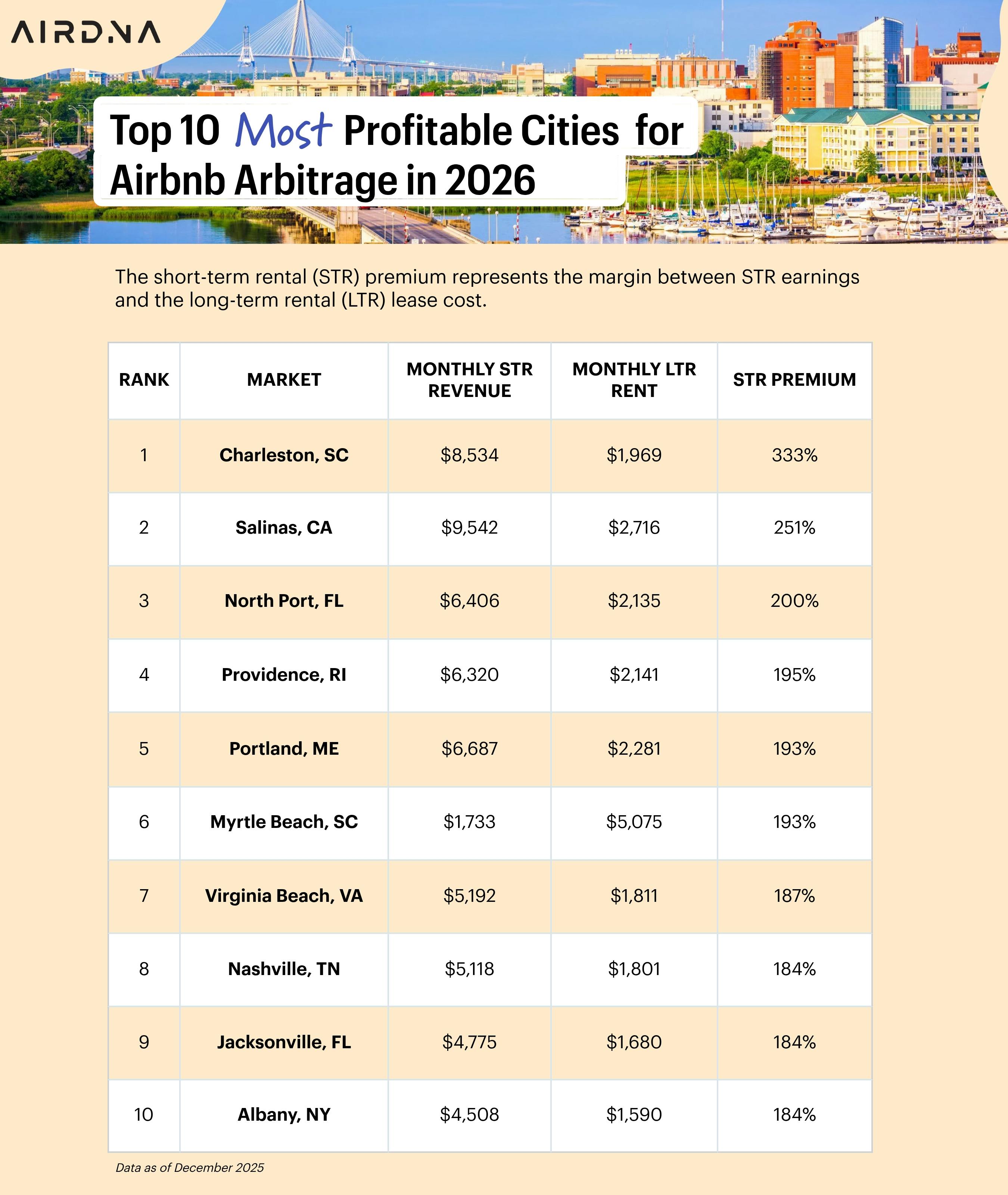
Image via AirDNA
Course pricing, ratings, and the economics of rental arbitrage itself.
- 10XBNB: approximately $7,000, live coaching 5x/week, Trustpilot 4.5/5, 3 business model paths (arbitrage, co-hosting, ownership). — 10XBNB Best Rental Arbitrage Course 2026
- BNB Formula: $1,997 online / $2,997 in-person, historical 3.9/5 rating, 2025 reviews trending negatively with rising 1-star responses. — 10XBNB vs BNB Formula 2026
- Rental arbitrage startup capital ranges $3,000 to $15,000 per property. Successful rental arbitrage properties return 50% to 200% annually on initial capital, with a rent-to-revenue ratio of 1:3 or better required. — 10XBNB Rental Arbitrage Startup Costs
- Gatlinburg, Tennessee leads US rental arbitrage at +$698 per month margin. San Antonio, Austin, and Myrtle Beach now lose money on rental arbitrage after operating costs in 2026. — AirDNA Does Airbnb Rental Arbitrage Still Work in 2026
Properties Sean Rakidzich built through rental arbitrage across 8 cities. Every single one acquired by convincing landlords to say yes, without buying a single unit.
- Most rental arbitrage courses skip the hardest part — convincing the landlord. That's the real bottleneck, not listing setup.
- Operator-taught vs. theory-taught is the most important distinction to make before buying any rental arbitrage course.
- 8 specific things to check before paying for any rental arbitrage program.
- Red flags that reveal a shallow course — things course creators hope you won't notice.
- Why the Closers Crash Course focuses on acquisition specifically, not property management.
- ROI math for rental arbitrage courses — one extra deal per year pays back an $800 course in under three weeks.
What Rental Arbitrage Actually Is
Image via EntreResource.com
Rental arbitrage is simple. You rent a property from a landlord at the long-term monthly rate. You then sublet it on Airbnb or VRBO at short-term rates. You keep the difference between what guests pay and what you pay the landlord.
You do not own the property. You do not need a mortgage. You do not need hundreds of thousands of dollars in capital. You need: the landlord's permission, a reasonable lease, a furnished setup, and the ability to generate enough bookings to cover your costs with profit left over.
This is exactly how I built my portfolio of over 100 properties across 8 cities. I have never bought a single unit. I rent all of them from landlords, operate them as short-term rentals, and keep the spread. The short-term rental market in the U.S. has grown to well over a million active listings. Operators who use rental arbitrage are a meaningful share of that growth. The real question is whether you have the skills to get landlords to say yes in the first place.
That is what most people get wrong about this business. They think the hard part is running the Airbnb. It is not. The hard part is getting the property. If you want to see what this looks like when real operators do it right, our rental arbitrage success stories break down actual results from operators who built portfolios from zero. And if you are still figuring out your starting budget, the Airbnb startup costs guide walks through what you actually need to launch.
Everyone talks about how to run an Airbnb. Almost nobody teaches how to acquire one through rental arbitrage. The bottleneck is almost never listing optimization or guest communication — it's getting the landlord to say yes in the first place. If your course doesn't cover this deeply, it's leaving out the most important skill in the business.
8 Things to Check Before Buying Any Rental Arbitrage Course
Use this checklist before you spend money on any rental arbitrage education program.
1. Does the Instructor Currently Operate Rental Arbitrage Properties?
This is the most important check. An instructor who ran three Airbnbs in 2019 and now just sells courses is not qualified to teach you about 2026 market conditions, current regulations, or how Airbnb's algorithm works today. Verify their current portfolio before paying anything.
2. Does It Cover Landlord Acquisition?
The hardest skill in rental arbitrage is convincing landlords. Most courses skip it entirely and go straight to "here's how to furnish your unit." Look for courses that cover how to find landlord-friendly properties, the pitch script that works, how to handle objections, and how to structure the lease to protect both parties.
The way you make first contact matters more than most people realize. Here is the exact script I use when calling a landlord I found on Zillow — or when I drove by and saw a for-rent sign in the yard:
"Hey Greg, my name's Sean — nice to meet you. I found your listing on Zillow. I represent a corporate housing company, and we're looking for a few single-family homes in your neighborhood. Your property looks great from the outside. I'd like to see if the inside works for our needs. Since we are a business, I'd like to meet with you and talk about our business model to make sure we're a good mutual fit. Do you have any time tomorrow or Wednesday afternoon for me to come by and take a look at the property? I'll bring you a coffee."
Notice what that script does not say: "I want to run an Airbnb." The corporate housing framing changes everything. You are not a random renter hoping for a favor. You are a business evaluating a property, and businesses pay reliably. Landlords who are burned out on individual tenants who pay late and damage units respond very differently to that positioning.
Before you ever make that call, do your research. I keep a spreadsheet with every property I have identified: the address, phone number, landlord name, date I called, and how long the listing has been sitting on the market. The longer a listing has been sitting, the more motivated the landlord. That gap is a negotiating advantage most people never use.
After the call, I Google the landlord before showing up to the walk-through. I want to know what they care about — sports teams, family, community involvement, whatever I can find. You are not trying to manipulate anyone. You are doing what any prepared business person does: showing up ready to have a real conversation about something the other person actually cares about. By the time you get to the presentation, you have already built enough trust that the pitch lands differently.
After your presentation, do not rush to "let's sign a lease today." Instead, ask: "So what questions do you have for me?" This one move signals that you respect the landlord's intelligence. It shows you understand the topic better than they do and you are not trying to paper over their concerns with pressure. Landlords are negotiators — they bought real estate. They know when they are at an informational disadvantage, and the moment a salesperson turns pushy is the moment they walk. Invite the question instead of forcing the close.
For a deeper breakdown of the full landlord conversation framework, read our guide on how to convince a landlord to let you run an Airbnb.
3. Does It Teach Honest Market Research?
Choosing the wrong market is the single most expensive mistake in rental arbitrage. A good course teaches you how to evaluate a market before you sign anything. But here is where many courses go wrong: they tell you to buy a data subscription and trust the numbers. I do not do that, and I do not teach it.
I research markets directly on Airbnb. It is free, it is live, and it shows you exactly what is available and booking right now. Here is why I skip the paid tools:
- Dead listings stay in the database. Paid data tools pull from snapshots that include properties that have not had an active booking in months or years. You end up analyzing a mix of live competition and abandoned listings with no way to tell them apart.
- Bookings are estimated, not real. These tools guess occupancy by scraping listing calendars at intervals. When a calendar shows unavailable dates, the tool assumes they are booked — but the host may have blocked those dates, taken a personal trip, or stopped hosting entirely. You are reading an estimate of an estimate.
- They cannot score photos or design quality. A listing with 200 reviews and amateur photography competes differently than a listing with 200 reviews and a professional shoot. The revenue numbers look the same. The guest experience is not. Paid tools tell you a listing exists. They cannot tell you whether it is actually competitive in your target price range.
- Raw numbers without expert interpretation are noise. Seeing a 72% average occupancy rate in a market tells you nothing if you do not know which property types are driving it, which neighborhoods are performing, or what price points still have room to win. Data without context leads beginners into markets that look good on paper and perform poorly in practice.
The better approach: search Airbnb directly in your target market. Filter for properties similar to what you would run. Study their calendars, review velocity, and pricing across the next 90 days. That is real data from active listings. To understand market dynamics before you commit, read our guides on Airbnb market saturation, the best Airbnb markets in 2026, and the best cities for Airbnb arbitrage.
4. Does It Cover Current Legal and Regulatory Compliance?
STR regulations have changed dramatically since 2020. Dozens of major cities now require permits, cap the number of STR licenses issued, or restrict non-primary-residence operations entirely. A course that gives you the 2021 regulatory landscape as if it is still current is dangerous. Look for courses that teach you how to check local rules rather than just listing rules that may already be outdated.
One nuance worth understanding early: rental arbitrage is not technically subleasing in many interpretations, as long as no separate lease exists under yours. You are simply declaring occupants under your own lease. That distinction matters in civil disputes between you and a landlord. However, city regulations operate independently — some markets have 30-day minimum stay requirements that apply regardless of what your lease says.
A 30-day minimum is not necessarily a deal-breaker. Operators in cities like Los Angeles and New York work those markets by targeting monthly corporate placements as the primary income stream, then filling gaps with photo studio bookings during unoccupied days. It is a different model, but it is profitable with the right property type. Read our full breakdown of is rental arbitrage legal for state-by-state analysis.
5. Does It Include a Pricing Framework?
Getting a property is only half the job. You need to price it to generate revenue above your costs. A good rental arbitrage course includes or points you toward a systematic pricing approach — not just "check your competitors." Before you sign a lease on any property, use our rental arbitrage profit calculator to model whether it actually works at the rates you can realistically charge in that market.
6. Are the Student Results Specific and Verifiable?
Look for courses with specific, traceable results. How many students? What markets? What revenue outcomes? Vague claims like "students earn six figures" are unverifiable and meaningless. My student results — $1.4B+ from 5,000+ students across 76 countries — come from trackable outcomes over 11 years of active teaching.
7. Is There a Refund Policy?
Any legitimate course stands behind its content with a refund window. No refund policy is a red flag. Period.
8. Is the Price Proportionate to the Depth?
A $2,000 course that covers landlord acquisition, market research, pricing, operations, and legal compliance at surface level is worse value than an $800 focused course that goes deep on acquisition specifically. Depth on your specific bottleneck matters more than the total price tag.
Operator-Taught vs. Theory-Taught: Why It Matters
There are two types of people who teach rental arbitrage courses:
Operators: People who still actively run short-term rental properties. Their knowledge is current, tested in real markets, and updated by actual experience. When the algorithm changes, they feel it. When a city changes its regulation, they deal with it. Their teaching reflects reality.
Theory teachers: People who either briefly ran Airbnbs, learned about it from someone else, or stopped operating years ago. They can teach concepts and frameworks accurately — but they cannot teach you the nuances that only come from live operation. They teach from memory and research, not from current experience.
“I get emails from students every week who tell me they spent $2,000 on a course from someone who 'used to do Airbnb.' The tactics they learned were outdated. The market assumptions were wrong. The landlord scripts didn't work in today's market. Always verify the instructor is still in the game.”
Before buying any rental arbitrage course, Google the instructor's name plus "properties" or "portfolio." Check their social media for current property content. A real operator talks about their properties constantly — because that is where their life is. A theory teacher talks about their courses.
Red Flags That Reveal a Shallow Course
The Course Skips Landlord Negotiation
If a rental arbitrage course does not include a specific module on finding landlord-friendly properties, crafting the pitch, and handling objections, it is leaving out the most important skill in the business. This is either lazy course design or the instructor does not actually do deals themselves.
The Market Research Section Says "Use Google"
Real market research means looking at what is actually live and booking on the platform right now. If the course's market research advice amounts to "search Airbnb in your city" without walking you through what to look for — review velocity, pricing over 90 days, property type performance by neighborhood — it is not a serious program.
The Legal Section Has No Last-Updated Date
STR regulations change every year. New York passed new rules in 2023. Houston passed its first STR ordinance in 2025. San Diego caps licenses. If the course's legal section does not tell you when it was last updated, assume it is outdated.
The "Success Stories" Are All From 2020-2021
Markets in 2020-2021 were unusual due to COVID travel patterns. Easy arbitrage that worked then does not necessarily work now with tighter regulations, more supply, and more competition. Student success stories from that era are not proof the course works today.
Why Closers Crash Course Is Different
Most rental arbitrage courses teach you what to do once you have a property. They cover furniture, photos, listing optimization, guest communication, and pricing. All of that is important — but it assumes you already have a deal.
Closers Crash Course focuses on the step everyone skips: how to get the deal in the first place. How to find landlords who will say yes. How to pitch the value proposition they actually care about. How to handle the three most common objections. How to structure the lease to protect your operation long-term.
Here is what most landlord pitches miss. You need to position yourself as a company, not a creative tenant. We are in a renters' nation. Landlords are increasingly burned by individual tenants who pay late, damage property, and disappear without notice. When you walk in as a corporate housing operator signing multi-year leases and bringing reliable monthly income, you change the entire dynamic of the conversation. That is not a pitch trick. That is just being honest about what you offer versus what a standard tenant offers.
I once signed 10 leases with an apartment complex in Fort Worth. About five weeks in, building management decided to remove all the short-term rental operators from the property. They were ready to evict everyone. I went in with our booking calendar and showed them the numbers: we were at 95% multi-month occupancy, booked solid for the next four months with long-stay guests. "I promise you," I told them, "it's not us causing problems."
They let us stay. Every other operator got removed from the building. The reason we survived was simple: we had prioritized long monthly stays from the very first booking. That one decision — made before any conflict existed — protected all 10 leases when everything went sideways.
The same principle applies when handling the "no Airbnb" objection. When a landlord says they do not want short-term rental guests in their building, here is the exact response that keeps deals alive: "We will do everything we can to keep the property on monthly corporate and insurance stays. But we cannot make a blanket promise about any specific third-party platform — we need creative control over how we fill the property to protect our profitability. What I can commit to is prioritizing monthly stays and keeping guest turnover as low as possible."
That framing works because it is honest. You are not hiding what you do. You are explaining why their concern — chaos from constant guest turnover — is not actually what your model produces. Most landlords who say "no Airbnb" are afraid of party guests and nonstop churn, not opposed to the business model itself. When you demonstrate that your operation minimizes both, most of them come around.
What Closers Crash Course Teaches
- How to identify landlord-friendly properties before you make contact
- The pitch framework that positions you as the best tenant they will ever have
- How to handle "I don't want to deal with Airbnb guests" and other common objections
- Lease structure elements that protect your STR operation long-term
- How to scale from one deal to ten by systematizing your acquisition process
- Real scripts from 100+ actual deals across 8 different cities
These are the skills I used to build a portfolio of over 100 properties. Not one of those landlords was a random lucky find. Every deal was closed with a systematic approach I have now codified in this course. That is something no other course on the market can claim, because no other course instructor has personally closed that many arbitrage deals.
This course pairs with the complete rental arbitrage guide for beginners who want the full picture before diving into acquisition training. For understanding the legal landscape you will navigate, read our is rental arbitrage legal guide. And for a full comparison of courses at every stage, see our which Airbnb course should I take guide.
300,000+ Subscribers on Airbnb Automated
Sean posts free STR strategies every week. Subscribe for the latest operator insights, pricing tactics, and case studies.
Frequently Asked Questions
What is rental arbitrage?
Rental arbitrage is when you rent a property from a landlord at the long-term monthly rate and then sublet it on Airbnb at short-term rates. You keep the spread between what guests pay and what you pay the landlord. You do not own the property. Sean Rakidzich built a 100+ property portfolio using this model across 8 cities.
What should a good rental arbitrage course cover?
A solid rental arbitrage course should cover: market selection and feasibility analysis, landlord persuasion and lease negotiation, property setup and furniture sourcing, listing optimization including the algorithm, pricing strategy for STRs, operations and automation systems, and legal compliance including permits and insurance requirements.
Is rental arbitrage legal?
Rental arbitrage is legal in most markets when you have landlord permission and comply with local STR regulations. The legality depends on three layers: your lease terms, local STR ordinances, and platform terms of service. Most cities allow it with the right permits. Read our full guide on is rental arbitrage legal.
How much money do I need to start rental arbitrage?
A one-bedroom apartment typically costs $5,000-$10,000 to set up for Airbnb, including first month's rent, security deposit, furniture, and photography. A two-bedroom may cost $8,000-$15,000. Some operators start with less by sourcing used furniture strategically. See the full Airbnb startup costs breakdown for detailed numbers.
How is Closers Crash Course different from other rental arbitrage courses?
Most rental arbitrage courses focus on how to run a property once you have it. Closers Crash Course focuses specifically on how to acquire properties through landlord negotiation — the skill most courses skip entirely. Sean built over 100 properties using these scripts and frameworks, which no other course instructor can claim.
Ready to Build Your Rental Arbitrage Portfolio?
Learn from Sean Rakidzich — 100+ properties, 5,000+ students, $1.4B in results.
Browse CoursesAbout the Author
This analysis is by Sean Rakidzich, an 11-year short-term rental operator who manages 155 Airbnb properties generating $1M+/month in revenue. Sean has trained 5,000+ students across 76 countries with $1.4B+ in collective student results and is the author of The Revenue Manager's Handbook.
For Sean's framework on the most critical aspect of rental arbitrage is convincing landlords to rent out their properties, rather than optimizing listings or managing guests, see his full content library at rakidzich.com or book a 30-minute strategy session at rakidzich.com/book.