Airbnb Co-Hosting Course: The Full Guide to Running Properties You Do Not Own
TL;DR
Sean Rakidzich explains that he operates 100+ Airbnb properties without owning any, using co-hosting and rental arbitrage skills taught in his course.
The article compares co-hosting, rental arbitrage, and buying, highlighting that co-hosting has the lowest risk and requires no upfront investment.
Sean recommends starting with co-hosting to build skills and a strong resume, which can later transition into managing properties under lease or ownership. By Sean Rakidzich, 155-property operator. Strategy session at rakidzich.com/book.
Key Facts
| Model | You Own It? | Startup Cost | Your Cut | Risk Level |
|---|---|---|---|---|
| Co-Hosting | No | $0 to $500 | 10 to 25% | Low |
| Rental Arbitrage | No (you lease) | $5,000 to $10,000 | 100% of profit | Medium |
| Buy and List | Yes | $50,000+ | 100% of profit + equity | High |
Image via CoHost Market
Properties I run right now without owning a single one. Every one of them uses the same co-hosting and rental arbitrage skills this course teaches.
- Co-hosting means you run someone else's Airbnb for a cut of the income. You do not need to buy or lease a property to start.
- I run 100+ units this way. My whole business is built on running properties I do not own. This course teaches the exact model.
- You can start with almost no money. Co-hosting needs your time and skill, not $50,000 in savings.
- 7 coaches cover every part of the business. Design, credit, taxes, real estate, and three ops experts.
- Succeed Now Pay Later. Pay half now. Pay half after you hit your goal. Your coaches earn more when you win.
Key Takeaways: Airbnb Co-Hosting
- Co-hosting lets you earn 10 to 25 percent of every booking without buying or leasing a property.
- Airbnb launched its Co-Host Network in October 2024, enrolling more than 10,000 experienced co-hosts across 10 countries at launch.
- 73 percent of co-hosts on the network are Superhosts, and 84 percent help manage Guest Favorites, two of the strongest quality signals on Airbnb.
- Over 40 percent of Airbnb hosts say they would host more if they had more help, creating a large and growing pool of potential co-hosting clients.
- Managing 10 co-hosted properties at an average of $3,000 per month generates $6,000 per month at a 20 percent fee, with income scaling as you add clients.
- Co-hosting builds the same skills as rental arbitrage at near-zero risk, making it the ideal on-ramp to a larger short-term rental business.
Co-Hosting by the Numbers
Real data on the short-term rental industry and Airbnb co-hosting demand:
- More than 10,000 co-hosts across 10 countries enrolled in Airbnb's Co-Host Network at its October 2024 launch, growing to over 100,000 listings supported within four months. (Hospitable, 2025)
- Over 40 percent of Airbnb hosts say they would list more properties if they had more help with day-to-day management. (Airbnb Newsroom, October 2024)
- The global short-term rental market was valued at USD 138.05 billion in 2025 and is projected to expand at a compound annual growth rate of 10.41 percent through 2035. (Precedence Research, 2025)
- Airbnb has more than 5 million hosts worldwide and over 8 million active listings as of early 2025, with the platform holding approximately 44 percent of the global short-term rental market. (Awning, 2025)
I do not own a single one of my 100+ Airbnb properties. Not one. I lease them from landlords, set them up, list them, and run every part of the guest experience. This is called rental arbitrage. And the skills it takes to run 100 properties you do not own are the exact same skills a co-host uses to run 1, 5, or 20 properties for other owners.
That is why I built this course. Co-hosting is the lowest risk way to start in the short-term rental business. You do not need to buy a home. You do not need to sign a lease. You just need the skills to run a listing better than the owner can do it alone.
If you can prove that, owners will hand you their keys. I know this because it is how I started 11 years ago.
What Is Airbnb Co-Hosting?
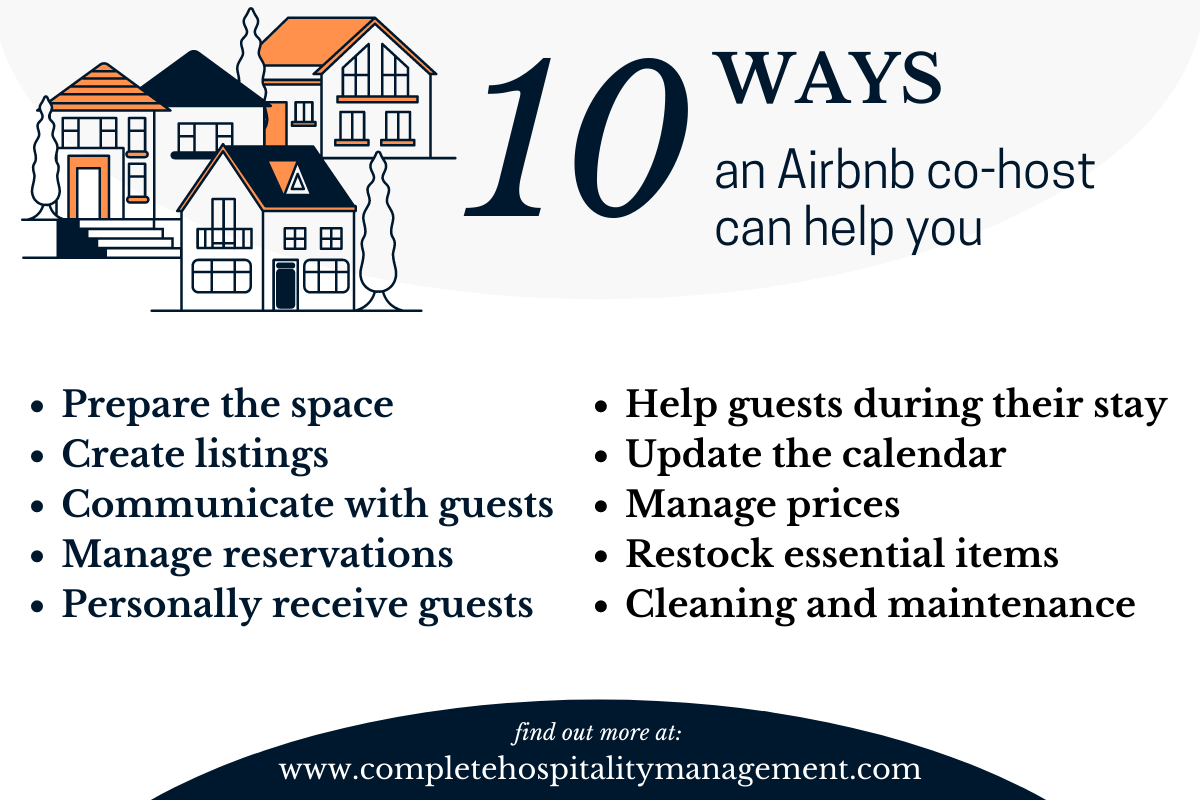
Image via Complete Hospitality Management
Co-hosting is simple. A property owner has an Airbnb listing but does not want to run it. Maybe they are busy. Maybe they live far away. Maybe they tried hosting and got bad reviews. They bring in a co-host to handle the work.
As the co-host, you do everything:
- Set the nightly price and adjust it based on demand
- Reply to guest messages and handle check-in
- Book cleaners between guests
- Deal with any problems that come up during a stay
- Get five-star reviews so the listing stays on page one
In return, you earn 10 to 25 percent of every booking. The owner keeps the rest. You do the work. They own the asset. Both of you win.
Most Airbnb owners are not good at running their own listing. They price too low or too high. They reply to messages late. They get three-star reviews and wonder why. A good co-host fixes all of this. You are not asking for a favor. You are solving a real problem that costs the owner real money every month.
Co-Hosting vs Rental Arbitrage vs Buying
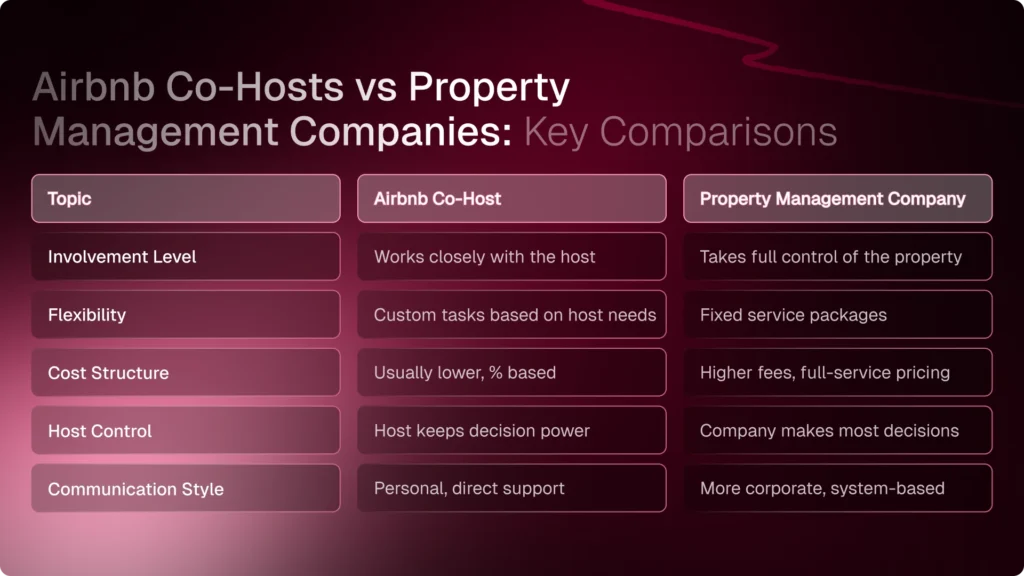
Image via HOSTassis LLC
These three models all use the same skills. The only thing that changes is who holds the lease or deed and how the money gets split.
| Model | You Own It? | Startup Cost | Your Cut | Risk Level |
|---|---|---|---|---|
| Co-Hosting | No | $0 to $500 | 10 to 25% | Low |
| Rental Arbitrage | No (you lease) | $5,000 to $10,000 | 100% of profit | Medium |
| Buy and List | Yes | $50,000+ | 100% of profit + equity | High |
Most of my students start with co-hosting because the barrier is so low. You can land your first client in 30 to 60 days with almost no money out of pocket. Once you prove you can run a listing well, you have two choices: keep co-hosting and add more clients, or use what you learned to sign your own leases and move into arbitrage.
I went straight into arbitrage 11 years ago. But if I were starting today, I would co-host first. The skills are the same and the risk is close to zero.
How Much Money Can You Make?
Let me show you the math with real numbers.
Say you co-host a property that brings in $3,000 per month on Airbnb. At 20 percent, you earn $600 per month from that one listing. Now look at what happens as you add more:
| Properties | Avg Revenue Each | Your 20% Cut | Your Monthly Income |
|---|---|---|---|
| 1 | $3,000 | $600 | $600 |
| 5 | $3,000 | $600 | $3,000 |
| 10 | $3,000 | $600 | $6,000 |
| 20 | $3,000 | $600 | $12,000 |
At 10 properties you are making $6,000 a month and most of the work is handled by your tools and cleaners. That is where it gets fun. Your income grows with each new client but your work per property goes down as your systems get better.
And here is the part most people miss. As a co-host, you are also building the best resume in the business. After running 10 properties for other owners, you know how to price, how to handle guests, and how to keep a listing at five stars. That is the exact skill set you need if you ever want to sign your own leases and keep 100 percent of the profit.
What You Will Learn
Getting Your First Client
- How to find owners who need help. Look for listings with bad reviews, stale photos, or gaps in the calendar. Those owners are losing money and they know it.
- How to pitch yourself. The exact scripts and email templates I use. You are not begging for work. You are showing the owner how much money they are leaving on the table.
- How to set your fee. Start at 15 to 20 percent for your first few clients. Go up to 25 percent once you have results to show.
- How to write a co-host agreement. What goes in the contract. How to protect yourself. When to walk away from a bad deal.
Running the Listing Like a Pro
- Pricing that fills the calendar. The Target Price and Pricing Masterclass courses teach you to set base rates, min rates, and seasonal bumps using PriceLabs. This is the single biggest skill in co-hosting because better pricing means more income for you and the owner.
- Guest messages on auto-send. Templates for every stage: booking, pre-check-in, welcome, mid-stay check, checkout, and review request. Set them up once and they run on their own.
- Cleaning that never misses. How to find, train, and manage cleaners using Turno. Your cleaners are the backbone of your business. One missed clean and you lose a five-star review.
- Listing photos that sell. Coach Caris teaches how to stage and shoot a listing so it stands out in search. Good photos are worth more than any ad you could run.
Keeping Owners Happy
- Monthly owner reports. What to include, how to format them, and how to use them to prove your value so the owner never thinks about firing you.
- Handling bad months. Every market has a slow season. The owner needs to know you have a plan. We teach you how to set the right picture up front so a quiet month does not turn into a lost client.
- Upselling owners on upgrades. Better photos, new furniture, a hot tub. When you can show the owner that a $2,000 upgrade will bring in $500 more per month, they say yes. And your 20 percent of that extra $500 adds up fast.
Scaling to 10, 20, 50+ Properties
- When to hire help. At 5 properties you can do it all yourself. At 10 you need a virtual assistant. At 20 you need a small team. We teach the exact triggers for each hire.
- When to switch to arbitrage. Once you are managing 5 to 10 co-hosted properties, you have the skills and the cash flow to sign your own leases. The Closers Crash Course ($800) teaches lease talks and deal closing.
- How I went from co-host to 100+ properties. The same path many of our students follow. Start with other people's listings. Learn the business on someone else's risk. Then take the leap when you are ready.
The 7 Coaches Who Work With You
You do not get one teacher who tries to cover everything. You get seven people who each know one part of the business better than anyone else.
| Coach | Focus | How They Help Co-Hosts |
|---|---|---|
| Sean Rakidzich | Strategy and ops | 100+ property model, pricing, market picks |
| Monish | Daily operations | Guest flow, turnover systems, tools setup |
| Josh | Scaling | Going from 5 to 50+ clients, hiring, growth |
| Caris | Interior design | Staging advice for owners, photo-ready spaces |
| Waseem Limbada | Business credit | Fund your setup costs without personal cash |
| Brandy | Taxes and books | Business entity, expense tracking, tax setup |
| Sean Ray | Real estate | For when you are ready to buy your own units |
When an owner asks you about tax setup for their rental income, you call Coach Brandy. When an owner wants to redo their living room to boost bookings, you call Coach Caris. When you need funding to take on your first arbitrage lease, you call Coach Waseem. No other co-hosting course gives you this kind of bench.
How to Find Your First Co-Hosting Clients
This is the part that stops most people. They learn the skills but never land a client. Here is the system that works:
- Search Airbnb in your city. Look for listings with 3 to 4 star ratings, gaps in the calendar, or photos that look like they were taken with a phone in 2019.
- Write down what is wrong. Bad photos? Weak title? No pricing tool? Make a list of 3 things you would fix and what each fix would do for their revenue.
- Find the owner. Check the host profile on Airbnb. Google the property address. Look on Facebook for local host groups. Most owners are not hard to find.
- Send the pitch. Not "hey I want to co-host your place." Instead: "I noticed your listing at [address] has 3.8 stars and an open calendar in May. Here are 3 changes that would fill those gaps and add about $800 per month. I would love to help and I only get paid when you make more money."
- Follow up. Most owners say no the first time or do not reply. That is normal. Follow up twice. Move on after the third try. You need about 20 pitches to land your first yes.
The course gives you the exact templates for each step. The pitch script alone has been used by thousands of students to land their first client.
Tools You Need (and What They Cost)
| Tool | What It Does | Cost |
|---|---|---|
| PriceLabs | Sets nightly prices based on demand | ~$20/listing/mo |
| Hospitable | Auto-sends guest messages | ~$25/listing/mo |
| Turno | Books and manages cleaners | Free to $8/listing/mo |
| Airbnb App | Your main platform | Free |
Total cost for 5 listings: about $200 to $250 per month. At 20 percent of $15,000 in total bookings, you are making $3,000 and spending $250 on tools. The math works from day one.
Here is how I use each tool in my own operation. In PriceLabs I set a base price, a minimum price, and seasonal adjustments. The base price is what I charge on a typical night. The minimum is the floor I will never go below even if the calendar is empty. Seasonal bumps go on during local events, holidays, and peak travel weeks. PriceLabs checks demand data every day and adjusts rates so I do not have to watch the market. One listing I manage in a beach market went from 58 percent occupancy to 84 percent in the first month after I set it up properly in PriceLabs. That single change added over $900 per month.
Hospitable handles every stage of the guest conversation. I have templates set up for the booking message, the pre-check-in message two days before arrival, the welcome message on check-in day, a mid-stay check on day two of a long stay, the checkout reminder, and the review request. Each message goes out at the right time without me touching anything. Guests feel taken care of and I spend almost no time on routine messages.
Turno connects your cleaning team to the booking calendar. When a guest checks out, Turno sends the cleaner an automatic job alert. The cleaner accepts or declines. If they decline, Turno can notify a backup cleaner. After the clean is done, your cleaner uploads photos so you can check the unit without driving over. This one feature has saved me more bad reviews than anything else I do.
A Day in the Life of a Co-Host
People think running Airbnbs means being on call 24/7. It does not. Here is what a normal day looks like once your systems are in place:
- 8:00 AM Check PriceLabs for any pricing alerts. Takes 5 minutes.
- 8:30 AM Scan guest messages. Hospitable handled most of them overnight. Reply to any that need a personal touch. Takes 10 minutes.
- 9:00 AM Check Turno to make sure today's cleaners are on track. Takes 3 minutes.
- Done. Unless a guest has a problem (rare), your morning takes 20 minutes.
At 5 properties this takes about 30 minutes a day. At 10 it takes about 45 minutes. At 20 you hire a VA to handle the morning check and you step in only for hard problems.
This is why co-hosting works so well for people with a full-time job. You can run 5 listings before work every morning.
How I Train My Own Co-Hosts (The Real Process)
I do not just teach co-hosting. I hire co-hosts for my own portfolio. Let me walk you through exactly how I brought on my last property manager because this is the same system I teach in the course.
Step 1: Create a Separate Airbnb Profile
I made a new Airbnb account called "Airbnb Automated." This is the company profile. My property manager logs into this account to do all her work. But here is the key part. This account has zero access to the money. She cannot see payouts. She cannot send payment requests. She cannot touch the finances at all.
This is how you protect yourself. You sandbox the money away from the day-to-day work. If the person leaves or you need to swap them out, the profile stays with you. Nothing breaks.
Step 2: Give Them a Company Phone
We got a separate phone with a dedicated phone number just for co-hosting. The phone has the Airbnb app, the Google Calendar with all our cleaning schedules, and delivery apps like Instacart and Prime Now with the company credit card attached.
If a guest says "hey there are no clean towels," she opens Instacart and orders towels to the address. If something small is missing she can fix it in 30 minutes without leaving her desk. And if she ever leaves the job, the phone, the number, and every app login stays with us. Zero gap in service.
Step 3: Start Small and Let Them Fail Safely
I did not throw her into all 21 properties on day one. That would be setting her up to fail. Instead I made her a secondary host first. That means she could see all the messages and watch me work but she could not change anything. Like a shadow.
After a week of watching, I made her the primary host on just 5 apartments. All in the same building. The building she lives next to. This way if she forgot to tell a guest something or missed a cleaning call, she could walk over and fix it in person.
You have to plan for them to make mistakes. That is how they grow. The point is to make those mistakes easy to fix.
After two weeks of smooth work on those 5 units, I made her the primary host on all 21 accounts. Today she handles everything. Guest messages, cleaner schedules, check-ins, problems. I check in once a day for about 10 minutes.
Step 4: Set Up the Systems Before You Hand Off
Before I gave her the keys I went through every single listing and made sure everything was tight:
- Check-in guides that work as standalone docs. A guest should be able to get in and be safe even if they skip the house manual.
- House rules that are clear and complete. No room for confusion on late checkout, noise, or parking.
- Google Calendar with every property's bookings exported via iCal. One calendar per city. Her phone has all of them so she can see what cleaners need to do each day.
- Template messages inside the Airbnb app. A welcome message that links to the house manual video. A checkout message that gently asks for a five-star review.
- Every unit fully stocked. Towels, soap, coffee, toilet paper. You do not want your new co-host's first guest message to be a complaint about a missing toaster.
This whole setup took two weeks. But once it was done, my property manager ran all 21 units and I got my time back. That is the power of co-hosting done right.
What to Charge as a Co-Host (From My Real Numbers)
I charge 10 percent plus cleaning fees on the properties I co-host. That is on the low end because I use co-hosting to keep my cleaners busy and give my property manager extra work. For me it is a way to earn extra income with a team I already have.
But here is how most co-hosts should think about pricing:
| Level | What You Charge | When |
|---|---|---|
| Starting out | 10% plus cleaning fees | First 1 to 3 clients |
| Proven results | 15 to 20% | After you can show results |
| Premium | 20 to 25% | Full service, you handle all |
| Bulk deal | 7 to 10% | One owner gives you 10+ units |
I have one guy right now who wants to give me 18 properties. We might do that deal at 7 percent instead of 10 because of the volume. At 18 units the lower rate still adds up to more total income than 3 units at 20 percent. Volume beats rate every time once you have the systems to handle it.
For context, booking platforms that only automate your calendar and pricing charge 10 percent. They do not handle cleaning or guest calls or anything in person. So if you are doing all of that, you are worth at least 15 percent. Do not sell yourself short.
Understanding Airbnb Co-Host Permission Levels
This trips up a lot of new co-hosts. Airbnb has three levels of access for any listing:
| Level | Can Do | Cannot Do |
|---|---|---|
| Admin | Everything. Add or remove co-hosts. Change payouts. Full control. | Nothing is off limits |
| Primary Co-Host | Handle messages, give refunds, request money, manage the calendar. Your face shows on the listing. | Change payout info |
| Secondary Co-Host | See messages, check guests in and out, handle basic tasks. | Request money, give refunds, show on listing |
One myth I hear all the time: you cannot transfer admin status. If you set up a listing with 40 reviews, you cannot sell that listing to someone else with the reviews attached. The only way to do it is to sell the whole Airbnb account. And Airbnb does not want you doing that either.
As a co-host, you will always start as secondary. That is normal. Once the owner trusts you, ask to be made primary. Primary means guests see your profile, call your phone, and you can handle most things on your own.
Mistakes That Kill New Co-Hosts
- Taking on a bad property. Not every listing is worth your time. If the owner will not let you change the photos, adjust the price, or fix the decor, walk away. You cannot make a bad product work.
- Charging too little. If you charge 10 percent you are working for free once you factor in your time and tools. Start at 15 to 20 percent and go up as you prove your value.
- No written agreement. Handshake deals fall apart. Always have a written co-host agreement that covers your fee, what you handle, and how either side can end the deal. The course gives you a template.
- Depending on one client. If your only client fires you, your income goes to zero. Get to 5 clients as fast as you can so no single owner controls your income.
- Skipping the pricing tools. Manual pricing is guessing. PriceLabs pays for itself on the first booking by setting the right rate for every night. This is not optional.
- Ignoring the cleaning operation. Your cleaners are your reputation. A missed clean, a dirty bathroom, or a missing towel turns into a three-star review. That review hurts the listing for months. Set up Turno before you take your first booking so cleaners get automatic job alerts and upload photos after every clean. If a cleaner flakes you need a backup ready. I keep two vetted cleaners for every property so I am never stuck.
- Trying to do everything yourself. At one or two properties you can handle everything. At five you need to hand off morning message checks to a virtual assistant or rely on Hospitable's auto-responses. At ten you need a part-time operations person. I have seen co-hosts burn out and quit at six properties because they refused to build a small team. The business only scales if you delegate the routine work.
How This Compares to 10XBNB
People always ask me about 10XBNB. It is the most promoted co-hosting course out there. So let me give you the honest breakdown.
10XBNB charges $7,000 for their base program. Their VIP tier is $10,000. Their top tier is $30,000. One instructor teaches all of it. They have about 1,600 students and list 24 co-hosted properties on their team page.
My single-topic courses start at $180. The full Cracking Superhost coaching program is apply-only and uses Succeed Now Pay Later so you pay half now and half after you hit your goal. We have 7 specialist coaches, each an expert in their area: design, credit, accounting, real estate, pricing, operations, and guest experience. Over 5,000 students in 76 countries.
Here is the side by side:
| Feature | Cracking Superhost | 10XBNB |
|---|---|---|
| Entry price | $180 (BIG DATA course) | $7,000 (DIY tier) |
| Full program | Apply only, Succeed Now Pay Later | $7,000 to $30,000 |
| Instructors | 7 specialist coaches | 1 instructor |
| Properties operated | 100+ (active now) | 24 (listed on site) |
| Students | 5,000+ in 76 countries | ~1,600 |
| Refund policy | 30-day money-back on courses | No refund posted |
| Risk model | Pay half after you hit your goal | Full payment upfront |
| Live coaching calls | Yes, weekly | Yes |
| Design coaching | Yes (dedicated design coach) | Not listed |
| Credit and finance coaching | Yes (dedicated credit coach) | Not listed |
| Accounting coaching | Yes (dedicated CPA coach) | Not listed |
| Course library | 6 standalone courses + full program | 1 program with tiers |
| Try before you commit | Yes, start with $180 course | No, minimum $7,000 |
The biggest gap is risk. At $7,000 with no refund you are betting on one teacher and hoping it works. With my model you can start with a $180 course, learn enough to land your first client, and then decide if full coaching is worth it. If you do join Cracking Superhost, you only pay half until you reach your goal. That is the whole point of Succeed Now Pay Later.
I do not have anything against the 10XBNB team. But the numbers speak for themselves. More coaches, more properties, more students, lower entry cost, and a refund safety net. Do your own research and pick what fits your budget and learning style.
"With the Co-Host Network, we're taking the work out of hosting. Starting today, you provide the home, and we'll provide an exceptional co-host."
Brian Chesky, Co-Founder and CEO, Airbnb, October 2024
Scaling from 1 to 50 Properties
Co-hosting scales in stages. Each stage has a different bottleneck and a different set of problems. I have watched hundreds of students go through this and I went through it myself. Here is what to expect.
Stage 1: Your First 1 to 5 Properties
This is the hustle stage. You are doing everything yourself: messages, pricing, cleaning check-ins, listing photos, owner reports. That is fine. You need to learn every part of the operation before you can hand it off.
Your bottleneck here is getting clients. Send 20 pitches a week. Go to real estate meetups. Join Facebook groups for landlords in your city. Call hosts with bad reviews and tell them what you would fix. Most people quit before they hit 20 pitches. Do not be that person.
At this stage your tools are simple: PriceLabs for pricing and your phone for everything else. Set up Turno for cleaner scheduling as soon as you have your first property so you build the habit early.
Stage 2: Growing from 5 to 10 Properties
At five you start to feel the time squeeze. You cannot answer every message yourself and still have a life. This is when you add Hospitable for auto-messages. It handles 80 percent of guest questions without you touching the phone.
When I had my property manager shadow me on my 21 accounts, I started her on just 5 units in one building near her house. She could walk over in 10 minutes if something went wrong. I let her make mistakes in a safe space before giving her more. Do the same with your first hire. Give them a small cluster, let them mess up, and let them learn.
Your bottleneck shifts from getting clients to keeping quality consistent. Set up a cleaning checklist with photo proof. Use Google Calendar exports from Airbnb iCal so your cleaners see the schedule without needing Airbnb access. I run a shared Google Calendar for each city and export every listing into it.
Stage 3: Pushing from 10 to 20 Properties
This is where most co-hosts hit a wall. The problem is not finding clients. At 10 properties your reputation gets you referrals. The problem is operations falling apart. A missed clean, a late check-in, a broken coffee maker that nobody fixed. Small things pile up and kill your reviews.
You need a dedicated operations person by now. Not a virtual assistant overseas doing messages. A local person who can go to the property in person, check that the cleaner did the job, and fix what is broken. I set up my ops person with a company phone that has Instacart, Amazon, and DoorDash loaded with the company card. If a guest says towels are missing, she opens an app and has them there in two hours.
I also gave her a second Airbnb profile that I own. She logs into that profile and does all her work through it. She does not have access to money. The phone, the profile, and the phone line all belong to the company. If she leaves, we swap in the next person with zero gaps in service.
Stage 4: Building to 20 to 50 Properties
At this level you are running a real business. You need systems for everything: onboarding new properties, training cleaners, owner reporting, financial tracking, and quality audits.
Your bottleneck is now owner relations. At 50 properties you might have 30 to 40 different owners. Each one wants to know how their listing is doing. Send monthly reports showing occupancy, revenue, review scores, and what you did that month. Owners who feel informed do not fire you.
Pricing gets more complex too. You should be using PriceLabs with custom rules for each market. A beach property in summer needs a different strategy than a city apartment in winter. The Pricing Masterclass course covers this in detail because at this stage pricing mistakes cost thousands per month.
The money gets real here. At 20 properties each earning $3,000 per month at 20 percent, that is $12,000 per month for you. At 50 that is $30,000 per month. This is when people start thinking about buying their own properties too. The skills are the same. The only change is who holds the lease.
Every stage has a different bottleneck. From 1 to 5 it is sales. From 5 to 10 it is automation. From 10 to 20 it is local operations. From 20 to 50 it is owner relations and pricing. Solve each bottleneck before trying to grow past it or your reviews will drop and owners will leave.
Course Options and Pricing
You do not have to jump into the full coaching program on day one. Here is the path most co-hosts follow:
| Course | What It Covers | Price | Best First Step? |
|---|---|---|---|
| BIG DATA | Market research and data | $180 | Yes, great start |
| RE:Algorithm | Airbnb search ranking | $600 | Yes, for listing setup |
| Target Price | Pricing basics | $410 | After first client |
| Pricing Masterclass | Advanced pricing | $525 | After 5+ listings |
| Closers Crash Course | Lease talks and deals | $800 | When ready for arbitrage |
| Cracking Superhost | Full 7-coach program | Apply only | For serious scaling |
All single-topic courses have a 30-day money-back promise. Cracking Superhost uses Succeed Now Pay Later: half now, half after you hit your goal.
Most co-hosts start with BIG DATA because picking the right market is the first decision you make. A weak market means empty calendars even with great pricing. BIG DATA teaches you how to read occupancy rates, average daily rates, and seasonal demand in any city before you commit. Once you pick your market, RE:Algorithm teaches how to get the listing to page one in Airbnb search. The algorithm rewards specific things: response time, listing quality, early bookings, and review speed. Most hosts do not know the rules. Target Price walks you through setting your base rate and minimum rate for each property. Pricing Masterclass goes deeper with seasonal strategy, gap night pricing, and how to react to competitor moves. I use Pricing Masterclass material on my own properties every week. The Closers Crash Course is for when you want to go from co-hosting into rental arbitrage. It covers how to find landlords, how to pitch the arbitrage model, and how to close a lease deal at a rate that makes the numbers work. Cracking Superhost is the full program with all 7 coaches, live calls, and the Succeed Now Pay Later structure.
Book a free 15-minute call. We will talk about where you are and whether co-hosting or arbitrage is the right fit for you.
Book Free CallHow to Get Started This Week
- Day 1: Take BIG DATA ($180). Learn how to read a market and pick your city.
- Day 2 to 3: Search Airbnb in your chosen city. Find 20 listings with bad reviews or empty calendars. Write down what you would fix on each one.
- Day 4 to 5: Write your pitch using the templates from the course. Send it to 10 owners.
- Day 6 to 7: Follow up with anyone who did not reply. Send 10 more pitches. The goal is 20 pitches by end of week one.
Most students land their first client within 30 to 60 days using this method. Some get lucky and land one in the first week. The key is volume. More pitches means more chances.
300,000+ fans learning Airbnb every week on Airbnb Automated.
Common Questions About Co-Hosting
What is Airbnb co-hosting?
You run someone else's Airbnb for a share of the money. You handle guests, pricing, cleaning, and reviews. The owner keeps the property. You earn 10 to 25 percent of each booking.
How is co-hosting different from rental arbitrage?
In co-hosting you manage the owner's listing for a cut. In arbitrage you sign the lease, pay rent, and keep all the Airbnb income. Arbitrage has more risk but more reward. Many people start with co-hosting because it needs less money.
How much can I make co-hosting?
One property at $3,000 per month gives you $450 to $750. At 10 properties that is $4,500 to $7,500 per month. Your income scales with how many owners trust you.
Do I need money to start?
Very little. Unlike arbitrage where you need $5,000 or more per unit, co-hosting only needs your time and skills. Tools cost about $50 to $150 per month.
How do I find owners who need a co-host?
Look for listings with bad reviews or low bookings. Reach out with specific ideas for how you would help. Check Facebook groups and local landlord meetups too.
What tools do I need?
PriceLabs for pricing, Hospitable for messages, and Turno for cleaners. Total about $50 to $150 per month. The course covers setup for each tool.
Can I co-host while working full-time?
Yes. With the right tools, most daily tasks take 20 to 30 minutes. Your messages auto-send and your cleaners book through an app. Most students start while still at their day job.
Do I need a license?
It depends on your city. Some places need a permit or business license. Others have no rules for co-hosts. The course walks you through how to check.
What is Succeed Now Pay Later?
Pay half of the coaching fee now and half after you hit your goal. Your coaches earn more when you win. If you do not reach your goal you do not pay the rest.
How long until I get my first client?
Most students land their first client in 30 to 60 days. It takes about 20 pitches to owners before you get a yes. The course gives you the exact scripts.
What if an owner fires me?
It happens. That is why you never depend on one client. Get to 5 or more so losing one does not hurt. The course teaches how to keep owners happy with monthly reports.
Is co-hosting better than buying?
Neither is always better. Co-hosting needs less money and has less risk. Buying gives you equity and full control. Many students start with co-hosting and buy later. Coach Sean Ray teaches the buying side.
What makes this different from other co-hosting courses?
I run 100+ properties right now through arbitrage. Co-hosting and arbitrage use the same skills. And you get 7 coaches instead of one teacher for everything.
What is the refund policy?
30-day money-back promise on all single-topic courses. Cracking Superhost uses Succeed Now Pay Later as the safety net.
Can I switch to arbitrage later?
Yes and many students do. The skills are the same. The only change is who holds the lease. The Closers Crash Course teaches lease talks for when you are ready.
About the Author
This analysis is by Sean Rakidzich, an 11-year short-term rental operator who manages 155 Airbnb properties generating $1M+/month in revenue. Sean has trained 5,000+ students across 76 countries with $1.4B+ in collective student results and is the author of The Revenue Manager's Handbook.
For Sean's framework on he operates 100+ Airbnb properties without owning any, using co-hosting and rental arbitrage skills taught in his course, see his full content library at rakidzich.com or book a 30-minute strategy session at rakidzich.com/book.
Sources
Co-Hosting Platform and Market Context
- CoHostMarket — CoHostMarket. Active co-host marketplace serving 4,000 or more providers across 80 or more countries; documents co-host commission structures ranging from 8 to 20% per booking and confirms the scope of co-host services: guest communication, reservations, check-ins, turnover coordination, and calendar and pricing management. Supports the 10 to 25% co-host fee range discussed in this article.
- Airbnb Service Fees for Home Hosts — Airbnb. Official fee documentation: hosts pay 3% under the split-fee model (or 15.5% under the single-fee model); the remaining net payout is the gross revenue base from which co-host compensation percentages are calculated and negotiated.
Note on Startup Cost Figures
- The startup cost ranges for each entry path (co-hosting at $0 to $500, rental arbitrage at $5,000 to $10,000, buying at $50,000 or more) are the author's operational estimates based on his portfolio experience. These figures are not drawn from a third-party data source and should be used as general orientation, not precise benchmarks.
More in this series
- Airbnb Arbitrage, Co-Hosting, and Ownership: Hedge Your 2026 Portfolio
- Airbnb Co-Hosting in Australia: How to Own the Market Before the Wave Arrives (2
- Airbnb Co-Hosting Learning Curve: 7 Lessons Theory Skips
- Airbnb Eviction Nightmare: Lessons for Hosts and Landlords
- airbnb sales narrative vs operational reality
- Airbnb Co-Hosting: Why Process Knowledge Cannot Be Faked
- How to Become an Airbnb Co-Host in 2026: The Complete Guide
- How to Become an Airbnb Co-Host in 2026: The Operator's Complete Guide
- How to Get Airbnb Management Clients: A Co-Hosting Acquisition Playbook
- Occupancy Tax for Airbnb Hosts in 2026: What You Collect
- The Real Airbnb Co-Hosting & Rental Arbitrage Process
- Rental Arbitrage vs Buying Property for Airbnb: 2026 Path Guide
- Your First Airbnb Listing: 7 Lessons That Beat Any Course