Your Airbnb Pricing Software Is Wrong Half the Time. Here Is How to Spot It.
TL;DR
Sean Rakidzich finds that traditional pricing software often fails to account for significant events and regional shocks, leading to suboptimal revenue.
Sean's testing shows that pricing software works best when used as a tuning tool after establishing a grounded home base rate through manual experience.
Sean recommends using a three-phase deviation method, starting with manual pricing, then setting a home base, and finally using software for small adjustments. By Sean Rakidzich, 155-property operator. Strategy session at rakidzich.com/book.
Mistakes to Avoid
| Mistake | Cost | Fix |
|---|---|---|
| Sean recommends a three-phase deviation approach when using pricing software: st | see source | - The Revenue Manager's Handbook, Softwa |
| Pricing software handles day-of-week patterns , lead-time curves , and small sea | see source | - The Revenue Manager's Handbook, Chapte |
| "The core of your rates will be right, thanks to good old-fashioned trial and er | see source | - The Revenue Manager's Handbook, page 2 |
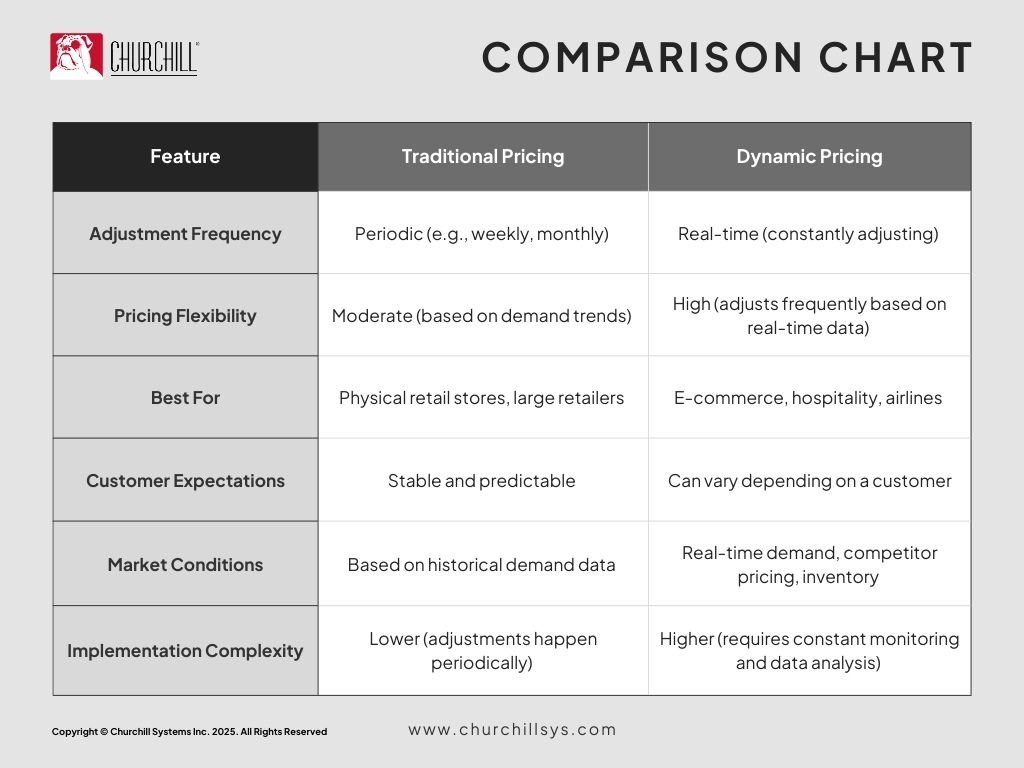
Image via Churchill Systems Inc.
- Pricing software works best after you know what your listing is worth - not before.
- Software is excellent at repetitive patterns (day-of-week, lead time, small seasonals) and terrible at events and regional shocks.
- The three-phase deviation method: no software first, establish home base, then layer software on top.
- If revenue dropped after enabling software, turn it off for a week and observe what you would set manually.
Every pricing tool promises the same thing. Set it up once. Walk away. The software will optimize your revenue. The truth is less clean. I have used them all. And I learned the hard way when to trust them and when not to.
What I thought pricing software was
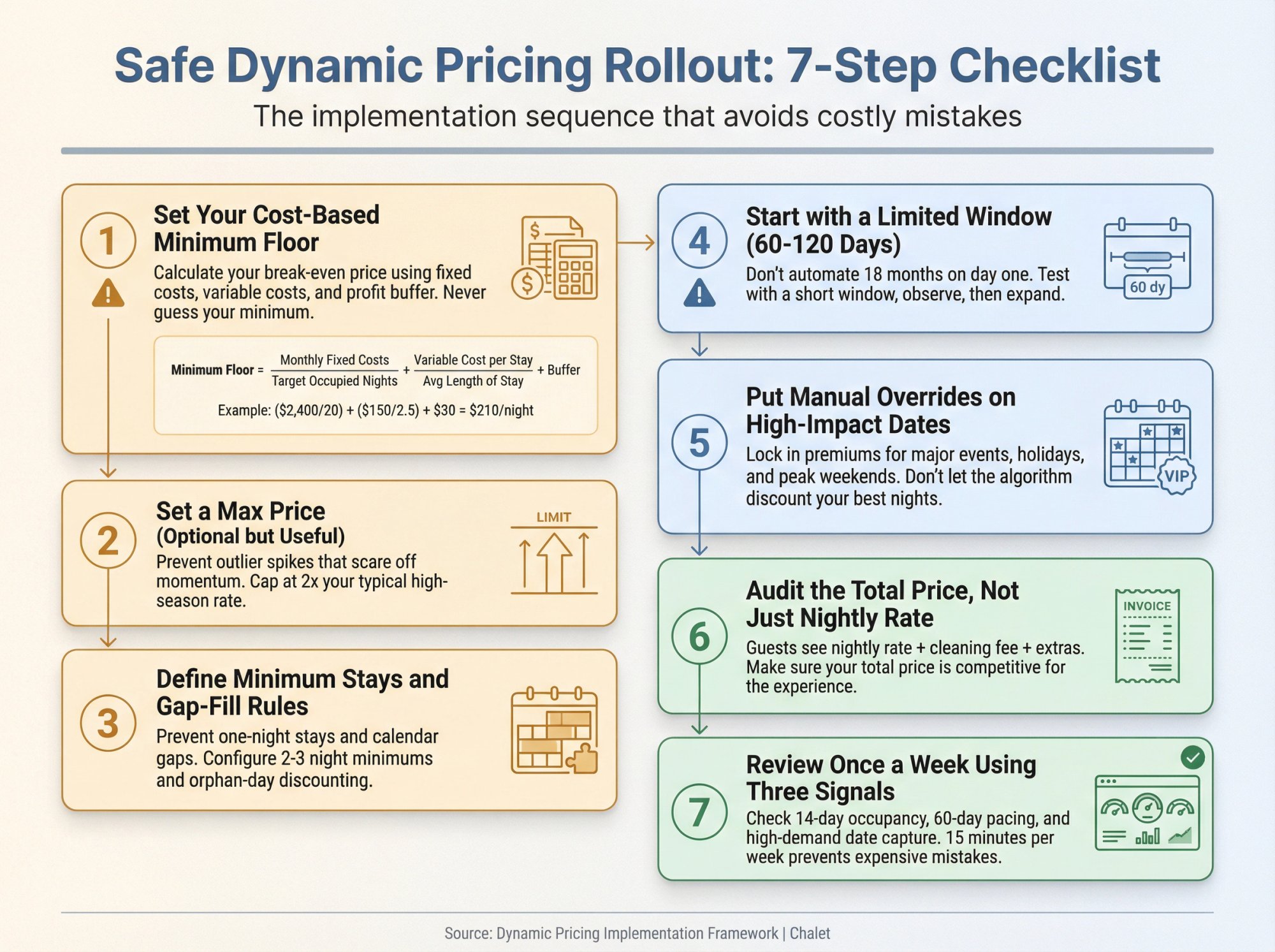
Image via Chalet
When I first heard about PriceLabs, I felt relief. Finally, someone else could do my pricing for me. I could sleep at night. I plugged it in. I walked away.
Then I checked my revenue a month later. It was lower than the month before. Same listings. Same market. Worse result.
I stared at the screen and asked myself a question. If this software is so smart, why did I just lose money?
PriceLabs costs $19.99 per month per property. That is a real cost, and it deserves a real return. Wheelhouse is a cleaner-interface alternative that includes pace tracking. Rabu.com is free and shows seasonality demand patterns by month. Each tool has a different strength. None of them replaces the judgment call you have to make first.
The moment I stopped trusting the black box
I started looking at the daily price changes. One day the software wanted $120. The next day it wanted $240. Then back to $140. Then up to $310 for no reason I could see.
I looked for an event. There was none. I looked for demand spikes in the market. There were none. The software was just jumping. I realized I did not know what it was doing. And neither did the software, most of the time.
Here is how I describe it in the book:
"They will raise and lower daily rates based on voodoo, quantum physics, or Taylor Swift's tour calendar. All the while, the core of your rates will be right, thanks to good old-fashioned trial and error."
- The Revenue Manager's Handbook, page 230
That sentence took me years to earn the right to write.
What pricing software actually does well
It is not all bad. Software is great at the boring parts. Day-of-week patterns. Lead time curves. Seasonal trends. Small adjustments based on how far out a date is. These are repetitive tasks. Computers are better at repetitive than I am.
But software has no idea what a “big event” means in your city. It does not know that the county fair is the highest-demand weekend of October. It does not know that a hurricane just wiped out the neighboring market. It does not know what you know.
This is the split I work with now. Software handles the baseline. I handle the deviations.
My three-step approach
I built a system I call the three-phase deviation method. It took me years to find it. It works like this:
One. Start completely off the map. Set your prices without looking at any software. Use your own market read. Sell a few nights. Learn what “too high” and “too low” feel like in your specific city.
Two. Find a home base. This is your core nightly rate. It is the price where your listing books at a healthy pace. Not too fast. Not too slow. Just right.
Three. Dial in your zones. Now and only now do you let pricing software do small adjustments around your home base.
I realized that pricing software works best after you already know what your listing is worth. It does not work well as a starting point. It works well as a tuning tool.
Used correctly, dynamic pricing tools add 15 to 40 percent more revenue according to PriceLabs's own data. That range is wide because it depends entirely on whether the host set a grounded home base first. The hosts at 40 percent did the manual work first. The hosts at 15 percent handed the wheel to the software from day one.
Why this matters right now
If your software has been running for 6 months and your revenue has gone down, I know what probably happened. You trusted it too early. You never set the home base. The software chased its own tail and dragged your rates down with it.
You can fix this. It starts with turning the software off for a week. Watch what you would set without it. Then decide what to re-enable.
Never give a discount when full price will do. That rule matters most when you are re-calibrating. The software will often suggest a discount on a date that would book at full price if you simply waited two more days. Your home base tells you when to hold.
What Each Tool Actually Does Well (And Where Each One Breaks)
I have used PriceLabs, Beyond Pricing, and Wheelhouse across my portfolio. They are not interchangeable. Each one has a specific strength and a specific failure mode. Using the wrong tool for your situation costs more than using no tool at all, because it gives you false confidence in bad numbers.
As I compare in detail in the full pricing tools comparison, PriceLabs charges $19.99 per listing per month flat and integrates with 150+ PMS and channel manager systems. It is the most customizable option and best fit for operators who want granular rule control. Beyond Pricing charges 1 to 1.25% of total revenue — on a $5,000 per month listing that is $50 to $62 per month versus $19.99 on PriceLabs. Wheelhouse is the only major tool with a free plan plus real-time pace tracking, making it the best entry point for single-listing operators who want to test before committing.
Where all three break: events and regional shocks. When Taylor Swift announces a tour date in your city, no dynamic pricing tool has that data in its base model. The tools see a demand spike after bookings start accelerating. By the time the software reacts, the best-paying guests have already booked. You need to be ahead of the software on these moments, not behind it.
A 2025 study tracking 541 listings across 34 countries measured a 36% revenue increase after switching from static to dynamic pricing, according to StaySTRA. The industry-wide benchmark is 20 to 40% annual improvement. Those numbers assume you are using the tool correctly. Plugging in a tool with no home-base rate and letting it run blind will not get you 36%. It will get you whatever the algorithm guesses, which is sometimes $120 when you should be at $310.
How to Set Your Home Base Before You Turn Any Software On
Every pricing tool needs a starting point. That starting point is what I call the home base — the rate your listing should earn on a normal, non-event weeknight with moderate demand. Without a home base, the software has nothing to calibrate against. It will oscillate randomly around whatever it thinks the market is, and that number changes every day.
The method runs in three phases. Phase one: run no software. Set a manual price for 30 days and watch what happens. Which dates book fast? Which sit empty? What rate fills a normal Tuesday? That data is your home base. It cannot come from a tool. It has to come from observation.
Phase two: establish the home base as a number you can defend. In the dynamic pricing guide, the correct base price for an established listing is the market median for your bedroom count and location. For new listings, price 10 to 15% below median to build booking velocity. The base is not the ceiling. It is the floor your software adjusts from.
Phase three: layer the software on top. Now the tool has context. When it wants to go to $310 on a random Tuesday, you can look at that against your home base and know whether it makes sense. When it drops to $95 on a Friday, you know that is wrong because your home base says Fridays hold at $150 minimum in your market.
Airbnb Smart Pricing should be off. Full stop. It optimizes for Airbnb's occupancy goals, not your revenue maximization. Every third-party tool — PriceLabs, Beyond, Wheelhouse — outperforms Smart Pricing. The 20% average revenue increase reported by hosts who switch from manual or Smart Pricing to a third-party tool comes from giving a better algorithm better inputs. Your home base is those better inputs.
Key numbers behind this story
All stats below are from the source book, verified from the original manuscript.
- Sean recommends a three-phase deviation approach when using pricing software: start with no software, establish a home base rate, then layer software adjustments on top - never start with software alone. - The Revenue Manager's Handbook, Software Chapter 1 (p. 225)
- Pricing software handles day-of-week patterns, lead-time curves, and small seasonal trends well. It fails at event-driven demand, regional shocks, and listing-specific anomalies - the exact places where the largest revenue swings happen. - The Revenue Manager's Handbook, Chapter 17 (p. 131)
- "The core of your rates will be right, thanks to good old-fashioned trial and error." - Sean Rakidzich, on why human judgment still beats algorithms on base pricing. - The Revenue Manager's Handbook, page 230
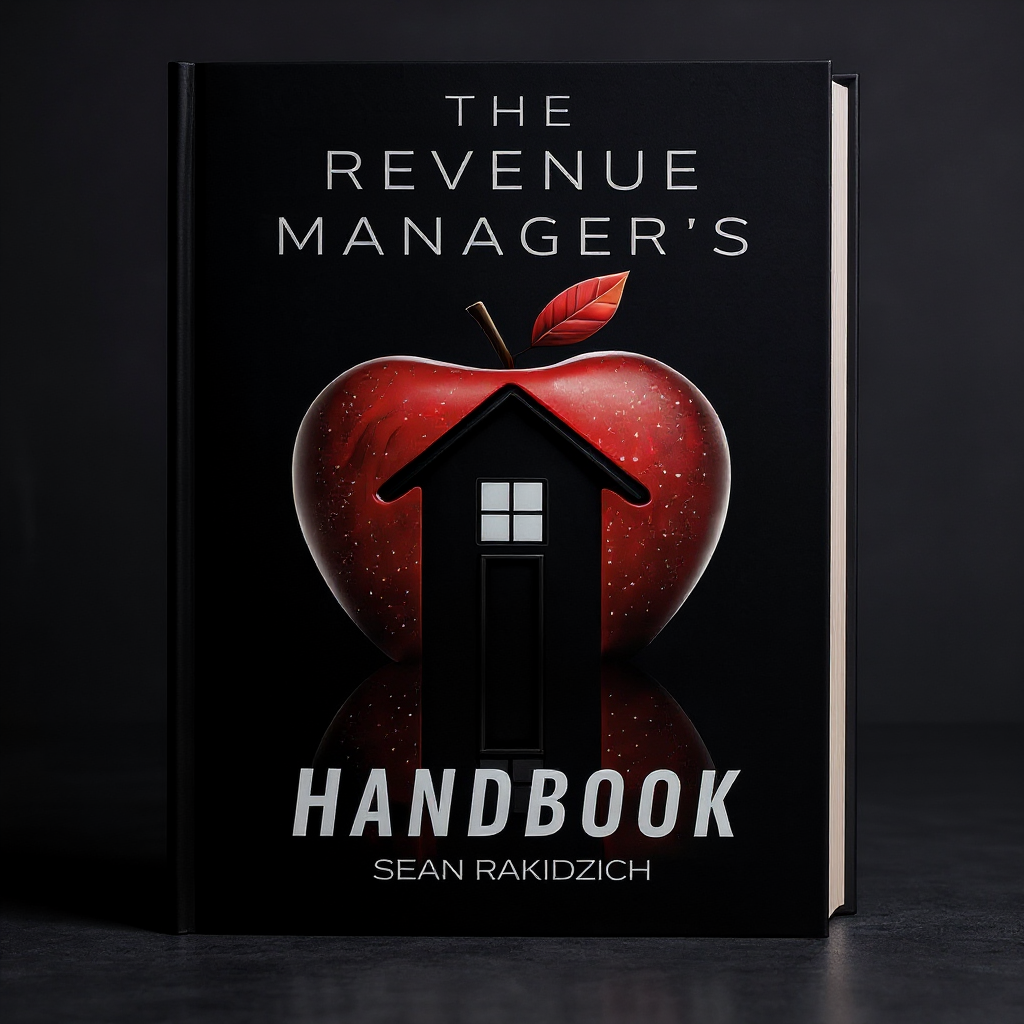
Get The Revenue Manager's Handbook
Sean Rakidzich's complete system for Airbnb pricing, revenue management, and scaling - available now.
Get the BookFrequently Asked Questions
Is Airbnb pricing software worth it?
Yes, but only after you establish a home base rate yourself. Pricing software handles day-of-week patterns, lead-time curves, and small seasonal trends well. It fails at event-driven demand, regional shocks, and listing-specific anomalies - exactly where the largest revenue swings happen. Use it as a tuning tool, not a starting point.
What is the three-phase deviation method for Airbnb pricing?
Sean Rakidzich's three-phase approach: (1) Start completely off the map - set prices without software to learn what your market feels like. (2) Find your home base - the rate where your listing books at a healthy pace, not too fast, not too slow. (3) Layer software adjustments on top of that home base. Never start with software before you know your own listing's value.
Why did my Airbnb revenue go down after using PriceLabs?
If you connected pricing software before establishing a home base rate, the software had no reliable anchor. It may have chased its own adjustments in a downward spiral. The fix is to turn the software off for a week, observe what you would set manually, establish a home base, then re-enable software adjustments on top of that base.
What does Airbnb pricing software get wrong?
Software gets event-driven demand wrong, misses regional shocks like nearby market closures, and cannot account for listing-specific signals like your photo quality or review sentiment. It excels at repetitive patterns - day of week, lead time, small seasonal curves - but the biggest revenue opportunities require human judgment.
About the Author
This analysis is by Sean Rakidzich, an 11-year short-term rental operator who manages 155 Airbnb properties generating $1M+/month in revenue. Sean has trained 5,000+ students across 76 countries with $1.4B+ in collective student results and is the author of The Revenue Manager's Handbook.
For Sean's framework on traditional pricing software often fails to account for significant events and regional shocks, leading to suboptimal revenue, see his full content library at rakidzich.com or book a 30-minute strategy session at rakidzich.com/book.
Affiliate disclosure: Some links on this page (anything starting with rakidzich.com/p/) are affiliate links. If you sign up through them, Sean may earn a commission at no extra cost to you. The recommendation reflects Sean's actual use across his 155-property portfolio.
Sources & Resources
Sean Rakidzich
- The Revenue Manager's Handbook - Available in Paperback & Hardcover
- Airbnb Automated YouTube - 300,000+ subscribers
- Cracking Superhost Course Suite - RE:Algorithm, Target Price, Pricing Masterclass