How I Got Started in Airbnb: From Homeless in 2008 to 155 Properties
TL;DR
Sean Rakidzich transformed from a homeless individual in 2008 to operating 155 Airbnb properties by applying insights from his experience selling newspapers.
He observed that newspapers use price discrimination based on zip codes, which inspired him to treat each Airbnb date as a separate product with its own price.
Sean recommends viewing the Airbnb calendar as inventory, differentiating prices for each date to optimize revenue, and using RevPAN as a key performance metric. By Sean Rakidzich, 155-property operator. Strategy session at rakidzich.com/book.
Key Facts
| Item | Value | Source |
|---|---|---|
| Sean's first short-term rental framework treats every calendar date as a separat | see source | - The Revenue Manager's Handbook, Chapte |
| A 3-day minimum stay setting puts your listing against over 390 competitors in t | see source | - The Revenue Manager's Handbook, Chapte |
| Sean managed more than | 100 properties | - The Revenue Manager's Handbook, About |
| "Misplaced effort is a waste in the recipe for success." - Sean Rakidzich. | see source | - The Revenue Manager's Handbook, Prefac |

Image: Katie Haugland Brown, via Wikimedia Commons, CC BY 2.0
- Every calendar date is a separate product with its own price - not a flat nightly rate.
- Price discrimination (the newspaper model) is the core insight behind Airbnb revenue management.
- A 3-day minimum stay puts your listing against 390+ competitors versus 119 for a 1-night stay.
- The habit of seeing your calendar as inventory is the starting point - everything else follows from it.
In 2008 I was broke. I slept in my car in Houston, Texas. I had dropped out of music school. I took a job selling newspaper subscriptions. I did not know it yet, but that job would teach me everything about making money from Airbnb.
The job I did not want
I needed money. That was the only reason I took the job. I was a homeless music school dropout. I had to eat. So I knocked on doors and sold newspapers. I was good at it. I got promoted to sales manager in Houston. It was hard. I felt lost most days. I did not know how to lead people. I did not even know what leading meant.
But I paid attention to the product I was selling. That is what saved me.
The weird thing newspapers do with price
Here is something most people do not know. Newspapers do not charge the same price everywhere. They use something called a price discrimination map. Rich zip codes pay more. Poor zip codes pay less. Same newspaper. Different price.
I thought this was strange at first. Then I understood it. The paper was not selling paper. It was selling news to a person. Different people have different budgets. So you meet them where they are.
This was the lesson. I just did not know yet how big it would become.
The day I saw my calendar in a new way
Years later I got into short-term rentals. I stared at the Airbnb calendar one day and felt something click. I realized every night was not just a night. Every night was a product. A Saturday is a different product than a Tuesday. A date one month out is a different product than a date six months out.
This was my “aha” moment. I had stopped thinking like a host. I started thinking like the newspaper company. I was not selling one thing. I was selling many things. Each date had its own price.
In the book I wrote about this later, I said:
"From the beginning, I have always perceived days of the month as units of inventory."
- The Revenue Manager's Handbook, page 31
That single idea changed everything I did next.
Why this matters for you
Most new hosts set one price. They call it their “nightly rate.” They feel good about it. Then they get confused when some nights book and other nights do not. They drop the price. More nights book. Revenue drops. They feel worse.
The fix is not a better price. The fix is a better way of seeing. Every date is a separate product. You do not need to be smart. You just need to stop treating all dates the same.
This is the start of revenue management. It is the reason I went from zero properties to more than 100. It is the reason my students with no business background hit six figures in their first year.
I started my first rental arbitrage property in 2015. By the time I had 155 properties across 8 cities, the calendar-as-inventory idea was still the foundation of every pricing decision I made. The scale changed. The core insight did not.
My students are now in 43 countries. Their collective earnings have crossed $1 billion. The starting point for every one of them was the same: stop treating your calendar like one product and start treating every date as its own.
Apply This Today
- Open your Airbnb calendar and look at next month.
- Identify Friday nights, Saturday nights, and Tuesday nights in the same week. They are different products.
- Are your prices differentiated? If every night is the same price, start there.
- Set Friday and Saturday 20-30% higher than mid-week to begin treating dates as separate inventory.
The real lesson from 2008
I thought the newspaper job was wasted time. I hated it while I was in it. But it was the only job where I had to see the same product at different prices, all day, every day. That shaped how I see Airbnb. That shaped what I built.
Your past job might have taught you something big. You just have not connected it to Airbnb yet. Mine was sales. Yours might be hotel front desk, retail, or spreadsheets at an office job. Look for the connection. It is probably there.
I later wrote that lesson into The Revenue Manager's Handbook and launched the Cracking Superhost education platform in 2018 to teach it systematically. The price is what the market will pay at that moment in time - not what you wish it would pay, not what it paid last month.
RevPAN: The One Number That Replaced My Gut Feeling
After I understood that every night is a separate product, I needed a single number to tell me how well each product was performing. ADR was too simple — it hid the nights I left empty. Occupancy was even worse — it rewarded filling nights at any price. Neither told me whether the listing was actually healthy.
The number that fixed this is RevPAN — Revenue Per Available Night. It is ADR multiplied by occupancy rate. Two listings can both run at 70% occupancy and have completely different RevPAN figures depending on what they charge per night. RevPAN captures both dimensions at once. As I explain in the revenue management guide, this is the metric that shows true earnings power in a single number.
In my first year I had a listing at $80 ADR and 80% occupancy. My neighbor had a listing at $150 ADR and 54% occupancy. My occupancy looked better. His RevPAN destroyed mine. I was proud of a number that was lying to me.
The US average occupancy rate in 2025 is 54.3%, according to AirDNA. Supply growth slowed to 4.5% in 2025, down from 9.5% in 2024. That deceleration means well-managed listings have more room to capture above-average RevPAN — but only if you are measuring the right thing.
The newspaper job taught me that different people pay different prices for the same product. RevPAN taught me how to measure whether your version of that product is earning what it should. You cannot manage what you do not measure. And if you are measuring the wrong metric, you are managing the wrong problem.
PriceLabs users average 40% higher revenue than manual pricers, according to the same framework I built my portfolio on. The tool is not magic. It is the newspaper's price discrimination map, automated.
The 30-Day Launch Formula and Why the First Month Is Different
When I sold newspapers, new routes got a temporary rate cut to build subscriber density before prices normalized. Airbnb works the same way. A new listing needs momentum before the algorithm treats it as a proven asset.
The formula I use: price 15 to 20% below market for the first 30 days. Not permanently. Not because you are cheap. Because you are buying reviews, and reviews are the asset that unlocks the real price later. As I detail in the complete pricing strategy guide, new listings should price 10 to 15% below the market median to build booking momentum fast.
The new listing boost Airbnb gives you lasts 30 to 60 days. Every day you waste it on a broken setting or an above-market price is a day you cannot recover. Once the boost expires, your listing competes on its earned record — reviews, conversion rate, response time. If that record is thin, the algorithm moves you to the back of the line.
I have watched hosts burn the launch window by pricing too high, collecting zero reviews, then dropping their price in month two when the boost is gone. You get neither the reviews nor the momentum. You just get a listing that looks abandoned.
The average annual earnings for a US Airbnb host reached $44,235 in 2025, according to AirDNA — a 216% increase from roughly $14,000 in 2022 and 2023. That number is available to any host who builds the right foundation in month one. The hosts who miss it almost always priced for ego in the launch window instead of pricing for momentum.
The job I did not want in 2008 taught me one thing above all. Price is not about what you want. It is about what the market will pay at this moment, for this product, in this context. The 30-day launch is that lesson applied to the specific moment when a new listing enters the market with no history and no proof.
Why Seasonal Calendars Built 90 Days Ahead Beat Reactive Pricing
I price my whole portfolio 90 days forward on a rolling basis. Most hosts price the next two weeks and call it done. The difference in outcome is not small.
Demand for a specific date gets priced into the market long before that date arrives. Event weekends book out months in advance. Seasonal peaks fill from the top of the funnel first — the guests who plan ahead are the ones who pay the most. If your calendar is not priced correctly when those guests are searching, you do not get a second chance at them.
The pricing strategy I built, described in the complete Airbnb pricing strategy guide, uses three approaches: Top-Down Reductive (start high, drop with reason), Pace (adjust based on booking speed), and Battleship (search for the right price when you have no data). All three require a forward-looking calendar to work.
Monthly revenue for US Airbnb hosts averaged $4,300 between November 2023 and December 2024, according to Uplisting. Top markets like Vail, Colorado reached $15,842 per month. The difference between average and top-market performance is not luck or location alone. It is calendar discipline. Hosts who build their seasonal rate structure 90 days ahead capture demand premiums before competitors do.
The newspaper never changed its price discrimination map reactively. The map was built on data, applied consistently, and adjusted seasonally. That is exactly how I treat my Airbnb calendar. The insight from a dead-end sales job in Houston turned out to be the most durable pricing principle I have ever used.
Key numbers behind this story
All stats below are from the source book, verified from the original manuscript.
- Sean's first short-term rental framework treats every calendar date as a separate product with its own price, rather than using one flat nightly rate. - The Revenue Manager's Handbook, Chapter 3 (p. 31)
- A 3-day minimum stay setting puts your listing against over 390 competitors in the search a guest uses, versus 119 competitors for a 1-night stay - a structural difference that kills your ranking before price matters. - The Revenue Manager's Handbook, Chapter 8 (p. 78)
- Sean managed more than 100 properties across 8 U.S. cities using this pricing approach before writing the book. - The Revenue Manager's Handbook, About the Author
- "Misplaced effort is a waste in the recipe for success." - Sean Rakidzich. - The Revenue Manager's Handbook, Preface (p. 27)
You just read one idea. The Revenue Manager's Handbook has the system. Chapter 3 breaks calendar-as-inventory end to end. Chapter 8 shows why a 3-day minimum stay puts you against 390+ competitors versus 119 for a 1-night stay. The remaining chapters cover weekend-vs-weekday price gaps, launch-phase pricing for zero-review listings, the conversion equation, seasonal rate curves, and the 12 pricing levers most hosts never touch.
Why Sean over any other coach: he is one of the only teachers who actively runs a 155-property portfolio while teaching. The math in the book is the math running his listings today. His 5,000+ students have generated a collective $1B+ in short-term rental revenue applying it.
The promise: if calendar-as-inventory landed, the book turns that instinct into a portfolio-grade system you can ship by Monday - on your ADR, your minimum stays, your weekend multipliers, and your launch-phase rate curve.
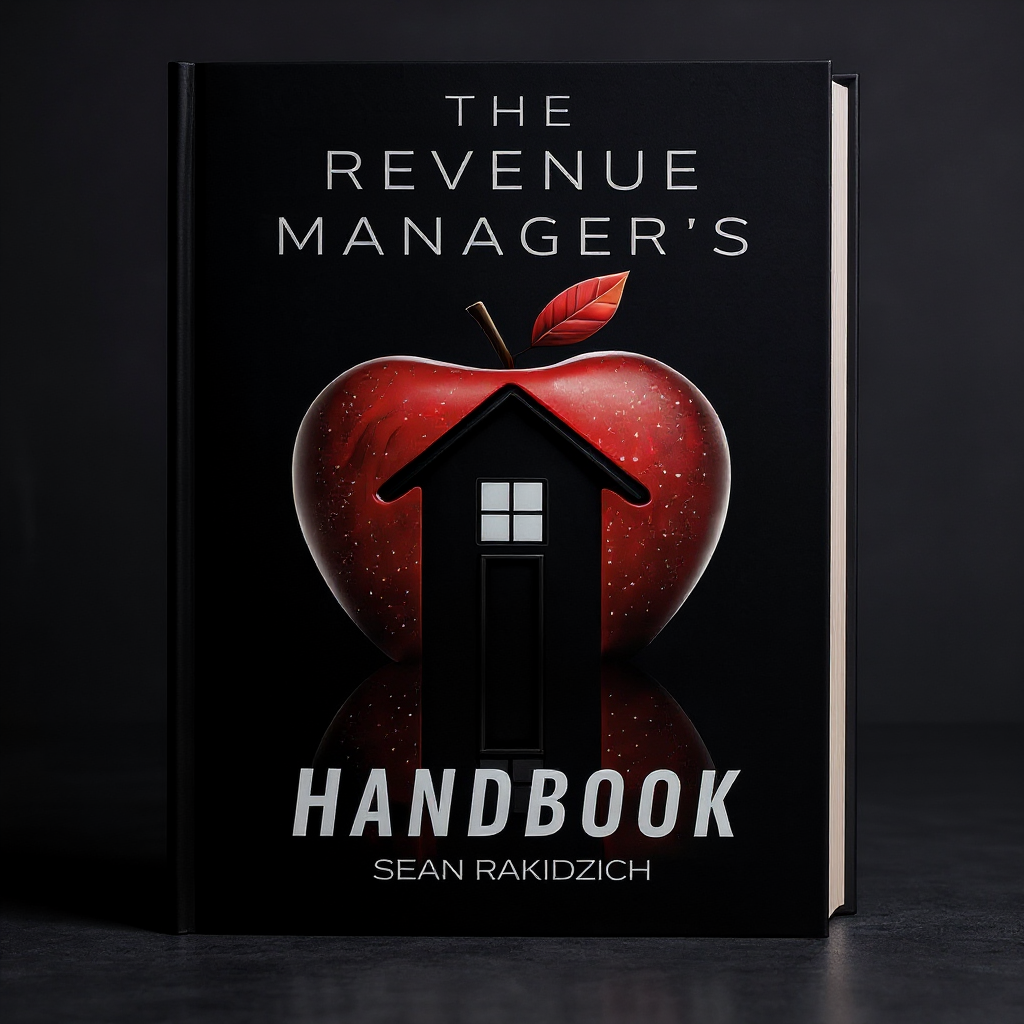
Get The Revenue Manager's Handbook
Sean Rakidzich's complete system for Airbnb pricing, revenue management, and scaling - available now.
Get the BookFrequently Asked Questions
What is revenue management in Airbnb?
Revenue management means treating every calendar date as a separate product with its own price. A Saturday is a different product than a Tuesday. A date one month out is a different product than a date six months out. Once you see the calendar this way, pricing decisions become clearer and more profitable.
What did Sean Rakidzich do before Airbnb?
Sean Rakidzich was a homeless music school dropout in 2008, sleeping in his car in Houston. He took a door-to-door newspaper sales job and was eventually promoted to sales manager. That job taught him price discrimination - the same insight he later applied to Airbnb date-by-date pricing.
What is price discrimination in Airbnb hosting?
Price discrimination in Airbnb means charging different prices for different nights based on demand, day of week, and lead time - just as newspapers charge different subscription rates in different zip codes. The same property, different dates, different prices.
How did Sean Rakidzich manage more than 100 Airbnb properties?
Sean Rakidzich managed more than 100 properties across 8 U.S. cities using rental arbitrage and a systematic approach to pricing. His framework, documented in The Revenue Manager’s Handbook, treats every date as a unit of inventory priced according to demand signals rather than a single flat nightly rate.
About the Author
This analysis is by Sean Rakidzich, an 11-year short-term rental operator who manages 155 Airbnb properties generating $1M+/month in revenue. Sean has trained 5,000+ students across 76 countries with $1.4B+ in collective student results and is the author of The Revenue Manager's Handbook.
For Sean's framework on Sean Rakidzich transformed from a homeless individual in 2008 to operating 155 Airbnb properties by applying insights from his experience selling newspapers, see his full content library at rakidzich.com or book a 30-minute strategy session at rakidzich.com/book.
Sources & Resources
Sean Rakidzich
- The Revenue Manager's Handbook - Available in Paperback & Hardcover
- Airbnb Automated YouTube - 300,000+ subscribers
- Cracking Superhost Course Suite - RE:Algorithm, Target Price, Pricing Masterclass