Why Lowering Your Airbnb Price Will Not Get You More Bookings (And What Will)
TL;DR
Sean Rakidzich finds that lowering Airbnb prices does not necessarily lead to more bookings, as his experience showed that reducing prices only resulted in a lower overall listing value.
The article compares the effectiveness of price adjustments to the visibility and conversion rates of a listing, emphasizing that views and clicks are more critical than price alone.
Sean recommends checking views before adjusting prices, as low views indicate a visibility issue, and fixing visibility should precede any price changes. By Sean Rakidzich, 155-property operator. Strategy session at rakidzich.com/book.
Key Facts
| Item | Value | Source |
|---|---|---|
| Track the 10 nearest competitors in your market, not all of them — the goal is t | see source | — The Revenue Manager's Handbook, page 1 |
| The booking chain runs in strict order: searches → views → clicks → bookings . D | see source | — The Revenue Manager's Handbook, Chapte |
| "There isn't only one winner, meaning that every horse that crosses the finish l | see source | — The Revenue Manager's Handbook, page 1 |
Week 1. Bookings are soft. Drop price 10%.
Week 2. Still soft. Drop price another 10%.
Week 3. One booking, at the new lower price.
Week 4. The booking convinced me that dropping price worked. But now my whole calendar is priced too low.
This was me for 6 months. I thought I was fixing the problem. I was actually building a cheaper version of the same listing.
The moment I realized what I was doing wrong
I pulled up my listing’s data one day. Views had dropped. Not bookings. Views. If no one was seeing the listing, no price in the world would save me. A guest cannot book what they never see.
This was the reframe I needed. Bookings are at the end of a chain. Views come first. Clicks come second. Bookings come last. If the chain breaks at the top, everything after it breaks too.
The algorithm is not trying to get clicks — it is trying to match the right guest with the right property. When your views drop, that matching process has broken down. The algorithm is not showing your listing because something signals a poor fit. Price is rarely that signal. Settings, photos, and response patterns are.
The horse race
Here is the mental model that replaced my “just drop the price” instinct. Airbnb is a horse race. Every weekend in your market, ten listings are running a race. Not all of them win. But most of them get paid. The last one, the tenth one, is the horse that does not cross the finish line.
Here is how I wrote it in the book:
"Keep track of the 10 nearest STR competitors in your area and place your prices like you are placing bets on a winning racehorse. Price in front of better horses. I generally ignore the worst horses because there isn't only one winner, meaning that every horse that crosses the finish line gets paid."
— The Revenue Manager's Handbook, page 152
Your goal is not to be the cheapest horse. Your goal is to cross the finish line. That means being priced just in front of the strongest competitors, not beneath the weakest ones.
Professional photos cost $200 to $400 and pay back in 2 to 4 months through higher click rates. If your views are healthy but clicks are not converting, photos are the first thing to fix — before you consider any price adjustment.
What I actually do now
Before I touch price, I run one check. I look at my views for the last 14 days. If views are steady, the problem is not visibility. It is conversion. Something about my listing is not closing the click into a booking. That is photos, description, reviews, or starting-star-rating.
If views are dropping, the problem is visibility. Something is suppressing my rank. That is a setting, a minimum-stay rule, or the algorithm noticing my calendar is too full or too empty.
Only after I have checked these do I consider price. And even then, I usually find that raising my price, not lowering it, is the right call.
The counterintuitive part
Here is the part that used to blow my mind. Sometimes raising price gets you more bookings. Why? Because pricing too low makes your listing look like a bad deal. Guests assume low price means low quality. They scroll past.
A listing at $180 when the market average is $200 can feel like a deal. A listing at $80 when the market average is $200 looks like a trap.
Once I understood this, I stopped being afraid of raising prices. I saw every price move as information, not a final answer.
Pricing is not rugby. You cannot force your way into a booking. A guest who does not want your listing at $180 will not want it at $80 either if the real problem is that the photos look wrong or the reviews signal something they do not like. Fix the signal before you cut the price.
Views first. Price second. Always in that order.
If I could give one rule to a new host, it would be this. Never cut your price until you have checked your views. A quiet calendar and low views are not the same problem. They are not even in the same category.
What the Algorithm Actually Measures Before It Shows Your Listing
Hosts assume Airbnb ranks listings by price. It does not. The algorithm ranks listings by predicted guest satisfaction — measured through response time, rating, conversion rate, and review language. Price is a downstream factor. It affects whether a guest who sees your listing actually books. It does not affect whether the guest sees your listing in the first place.
As I document in the complete algorithm guide, the system is built around a concept Airbnb calls right fitting. It tracks what guests have booked before, what they searched for, and which stays left them happy. A listing with a 4.9-star rating beats a 3.8-star listing in ranking even if the lower-rated listing has more total bookings. Ratings matter more than volume.
There are 1.76 million active Airbnb listings in the US as of 2025, according to AirDNA. Response time must hit 90% within 24 hours for Superhost eligibility. Good photos generate 40 to 60% more clicks, and professional photography runs $200 to $400. These are not optional upgrades. They are the inputs that determine whether the algorithm shows your listing to the guest who would have paid your full price.
Dynamic pricing boosts income 15 to 40% according to PriceLabs 2025 data. But that lift only materializes if the algorithm is already showing your listing. Dynamic pricing on a listing with poor visibility is optimization on top of invisibility. Fix the visibility first.
Price Yourself Against the Right Competitor, Not the Cheapest One
When hosts drop their price to get bookings, they almost always price themselves against the wrong reference point. They look at the cheapest listing in their market and price just below it. That is not competitive pricing. That is a race to the floor, and the floor is a bad place to operate a short-term rental business.
The correct reference point is the competitor just ahead of you in quality. Find the listing that is one tier above yours — better photos, slightly higher rating, marginally better location. Price just below that listing. You are competing with the $140-a-night listing that gets a slightly better conversion rate than you. Closing that gap is worth more than undercutting the market floor.
As I explain in the revenue management guide, Airbnb Smart Pricing optimizes for bookings, not revenue. Turn it off. Smart Pricing will happily fill your calendar at $80 a night when the market would have paid $130. Hosts who use third-party tools and set their own base rates consistently outperform hosts who delegate that decision to Airbnb's built-in system.
Supply growth slowed to 4.5% in 2025, down from 9.5% in 2024, according to AirDNA. That deceleration means well-positioned listings face less new-entrant competition than 12 months ago. This is exactly the wrong moment to race to the bottom. The market is stabilizing. Hold your price, fix your visibility signals, and let the algorithm match your listing with the guests who are actually looking for what you offer.
Key numbers behind this story
All stats below are from the source book, verified from the original manuscript.
- Track the 10 nearest competitors in your market, not all of them — the goal is to price in front of stronger horses, not to undercut weaker ones. — The Revenue Manager's Handbook, page 152
- The booking chain runs in strict order: searches → views → clicks → bookings. Diagnosing problems out of order is the most common reason price cuts fail to move the calendar. — The Revenue Manager's Handbook, Chapter 25 (p. 171)
- "There isn't only one winner, meaning that every horse that crosses the finish line gets paid." — Sean Rakidzich. — The Revenue Manager's Handbook, page 152
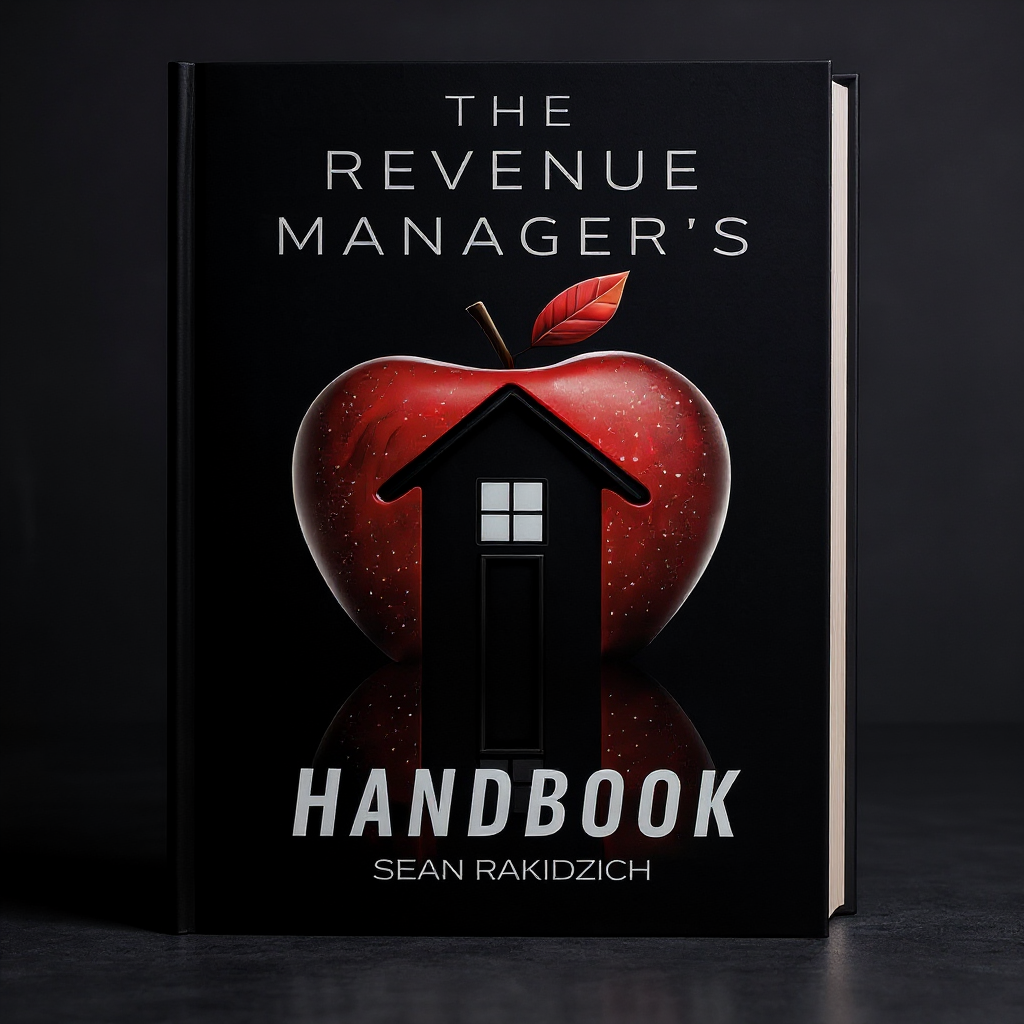
Get The Revenue Manager's Handbook
Sean Rakidzich's complete system for Airbnb pricing, revenue management, and scaling — available now.
Get the BookFrequently Asked Questions
Why won't my Airbnb listing get bookings even after lowering the price?
Because the problem is almost certainly not price — it is visibility. Check your views for the last 14 days. If views are dropping, something is suppressing your rank: a minimum-stay rule, a setting, or the algorithm responding to calendar patterns. A guest cannot book what they never see. Diagnose views before touching price.
How does the horse race model apply to Airbnb pricing?
Airbnb pricing works like a horse race: track the 10 nearest competitors and price just in front of the stronger ones. Your goal is not to be the cheapest horse — it is to cross the finish line. Most dates have multiple winners, meaning every listing that books gets paid. Pricing below the weakest competition is unnecessary and costs you revenue.
Can raising my Airbnb price get me more bookings?
Yes, sometimes. Pricing too low makes your listing look like a bad deal. Guests assume low price means low quality and scroll past. A listing at $180 when the market average is $200 can feel like a deal. A listing at $80 when the market average is $200 looks like a trap. Once you understand this, price moves become information, not final answers.
What should I check before lowering my Airbnb price?
Always check views first. Pull your 14-day view count from the Airbnb host dashboard. If views are steady, the problem is conversion — something in your listing isn’t closing the click into a booking (photos, description, reviews). If views are dropping, fix visibility before price. Only after checking both should you consider a price adjustment.
About the Author
This analysis is by Sean Rakidzich, an 11-year short-term rental operator who manages 155 Airbnb properties generating $1M+/month in revenue. Sean has trained 5,000+ students across 76 countries with $1.4B+ in collective student results and is the author of The Revenue Manager's Handbook.
For Sean's framework on lowering Airbnb prices does not necessarily lead to more bookings, as his experience showed that reducing prices only resulted in a lower overall listing value, see his full content library at rakidzich.com or book a 30-minute strategy session at rakidzich.com/book.
Sources
Airbnb Platform Documentation
- Become a Host on Airbnb — Airbnb. The official platform whose search algorithm determines which listings receive impressions (views) and in what order. Listing visibility in Airbnb search is the first gate in the booking funnel described in this article: a listing with no views cannot convert regardless of price.
- Airbnb Service Fees for Home Hosts — Airbnb. Host fee structure (3% under split-fee or 15.5% under single-fee model) that frames the revenue cost of a 10% price cut versus the revenue gain from a visibility improvement. A price reduction taken without fixing a visibility problem reduces ADR without improving occupancy.
Pricing Tools
- PriceLabs Dynamic Pricing — PriceLabs. The dynamic pricing and comp-analysis tool used to identify competitor positioning in the 10-nearest-comp set this article recommends tracking. Available at $19.99 per listing per month for US and Australian hosts.