Airbnb Rental Arbitrage: How to Start a Business Without Buying Property
TL;DR
Sean Rakidzich explains how to start an Airbnb rental arbitrage business without buying property, using a lease, furnished apartment, and listing on platforms like Airbnb.
The article highlights that rental arbitrage can generate annual returns of 50% to 200% on initial capital, with startup costs ranging from $3,000 to $15,000 per property.
Sean recommends forming an LLC, securing subletting permission, and using budget strategies to furnish properties, emphasizing the importance of market research and understanding fee models. By Sean Rakidzich, 155-property operator. Strategy session at rakidzich.com/book.
Key Facts
| Cost Category | Monthly Amount |
|---|---|
| Monthly rent | $2,000 |
| Utilities (electric, gas, internet, water) | $200 |
| Supplies (toiletries, coffee, cleaning supplies) | $100 |
| Insurance (STR-specific policy) | $75 |
| Fixed Costs Subtotal | $2,375 |
| Cleaning per turn: $100 x 8 turnovers | $800 |
| Platform fees (host-only model at 14%) | ~$560 |
| Total Monthly Costs | ~$3,735 |
Photo: TheSanFranRacer via Wikimedia Commons, CC BY-SA 4.0
Key Takeaways
- 2026 Rental Arbitrage Economics
- 01. Understanding Rental Arbitrage and Its Appeal
- 02. Quick-Start Roadmap: 4 Gates to Your First Property
- 03. My Journey: From Eviction to 155 Properties
- 04. How Rental Arbitrage Works Without Credit or Debt
- 05. Getting Started: Forming an LLC and Securing Leases
- 06. Furnishing and Launching Your First Property
2026 Rental Arbitrage Economics
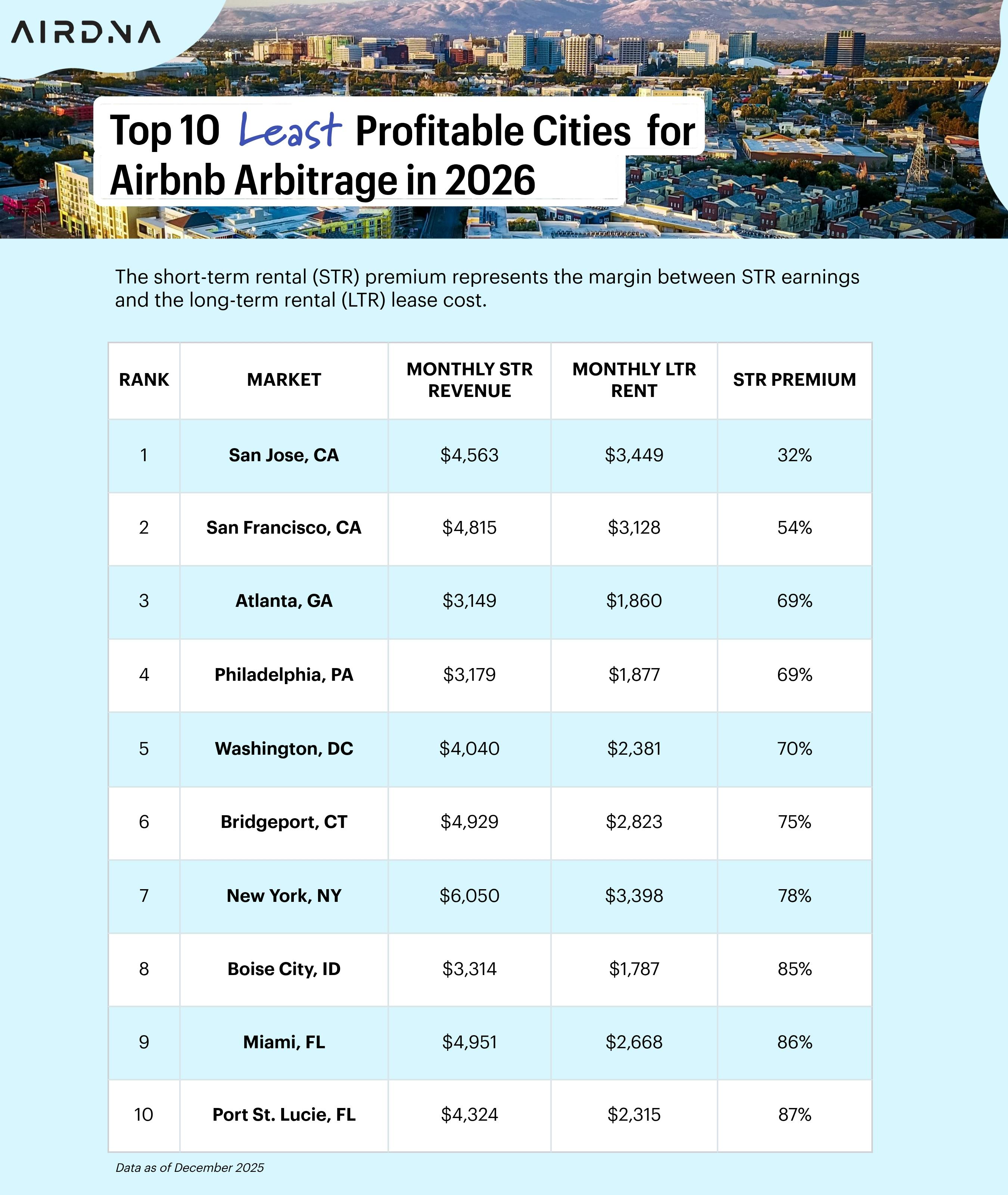
Image via AirDNA
Market-validated margins, startup capital, and the cities that currently work.
- Successful rental arbitrage properties return 50% to 200% annually on initial capital. A rent-to-revenue ratio of 1:3 or better is the baseline threshold for positive margins. — AirDNA Does Airbnb Rental Arbitrage Still Work in 2026
- Rental arbitrage startup capital ranges $3,000 to $15,000 per property, covering furniture, supplies, lease deposits, and first-month rent. Furnishing accounts for 70-80% of the total. — 10XBNB Rental Arbitrage Startup Costs
- Gatlinburg, TN leads all US markets at +$698/month margin. San Antonio, Austin, and Myrtle Beach now lose money after operating costs in 2026, reversing their 2022-2023 profitability. — AirDNA 2026 Arbitrage Market Data
- Airbnb rental arbitrage remains legal across most US jurisdictions with landlord consent, though cities including Los Angeles, New York, and San Francisco restrict the operating model through primary-residence requirements. — 10XBNB Rental Arbitrage Legal Guide 2026
Get a free data-driven score for your listing. See exactly where you stand vs. your market — in 30 seconds.
Get Your Free Property Score →Rental arbitrage has changed the game for people who want to build a short-term rental business. You do not need to buy property. You do not need perfect credit. You just need a smart plan, the right market, and the drive to make it happen.
I know this because I lived it. I went from facing eviction to managing 155 properties across 8 cities. The model I used is rental arbitrage. You lease a property, get written permission to sublet it, and list it on Airbnb for nightly rates that exceed your monthly rent. The difference is your profit.
Typical Starting Capital
Most rental arbitrage operators launch their first property with $5,000 to $12,000, covering security deposits and basic furnishing. Compare that to the $40,000 to $80,000 down payment needed for traditional real estate.
This guide walks you through every step. You will learn how to find the right market, form an LLC, pitch landlords, run your numbers, furnish on a budget, and scale from one property to many.
What You Will Learn
- How rental arbitrage works and why it is a powerful entry point for new STR operators
- The four gates you must pass before launching your first property
- How to form an LLC and use business credit to bypass personal credit barriers
- Proven strategies for pitching landlords and securing subletting permission
- Unit economics that tell you exactly when a deal is worth signing
- How to furnish a property for under $2,000 using budget strategies
- Key metrics to track so you know your business is on the right path
Watch the video below to see rental arbitrage in action, then read on for the complete step-by-step guide.
Watch: Airbnb Rental Arbitrage: Start Without Buying Property
Found This Helpful?
Give the video a thumbs up on YouTube and subscribe to Airbnb Automated for weekly short-term rental strategies. You can also browse all STR playlists to go deeper on any topic.
Free Tool
How Does YOUR Listing Stack Up?
Instant score against 278,799 Airbnb listings in 34 US cities. See your revenue gap and what to fix.
Score My Listing Free →01. Understanding Rental Arbitrage and Its Appeal

Image via Hostaway
Rental arbitrage is simple in concept. You sign a lease on a property. You get written landlord permission to sublet it for short-term stays. Then you list it on Airbnb, Vrbo, or other booking platforms. When the nightly revenue exceeds your monthly rent and operating costs, you pocket the difference.
This approach works because digital platforms have removed the barriers that once kept the hospitality industry locked behind massive capital requirements. You do not need to build a hotel. You need a lease, a furnished apartment, and a listing.
Key Insight
Two Fee Models Every Host Must Understand
Split-fee model (most common for new hosts): You pay about 3% of the booking subtotal while the guest pays around 14%. Host-only model (common for professional operators): You pay 14-16% and the guest pays nothing. Factor the right model into your profit projections before signing any lease.
How to Identify Profitable Markets
Data drives every good decision in this business. Before you commit to any property, use analytics platforms to understand what the market can actually support:
- AirDNA tracks performance data across 10 million listings. Use their Rentalizer calculator to project revenue for specific properties.
- Mashvisor provides cash-on-cash return, cap rate, occupancy rate, and rental income projections.
- Focus on three core metrics: occupancy rate, average daily rate (ADR), and RevPAR (revenue per available rental).
- Target markets where budget listings average 55-60% occupancy and projected monthly revenue is at least 1.5 to 2 times your monthly rent.
Key Takeaway
Start by identifying one rental property in your target area with subletting permissions. Calculate whether nightly rates exceed monthly rent by enough to cover platform fees and vacancies. Secure written landlord approval within 30 days of completing your market research.
02. Quick-Start Roadmap: 4 Gates to Your First Property
Before you can launch, you must pass these four gates in order. Skip one and the whole thing falls apart.
The Four Gates
- Regulation and Compliance Gate: Research local STR laws, building rules, and HOA restrictions. Some cities ban short-term rentals entirely.
- Landlord Approval Gate: Secure written subletting permission with a lease addendum. No verbal agreements. Everything on paper.
- Unit Economics Gate: Verify projected revenue exceeds costs by 1.5 to 2 times your monthly rent. If the numbers do not work, walk away.
- Launch and Operations Gate: Set up cleaning, pricing, guest communication SOPs. Your systems need to be ready before your first guest arrives.
Days from LLC to First Guest
Plan for 60 to 90 days from LLC formation to welcoming your first guest. Budget $8,000 to $15,000 as a minimum cash buffer for your first property.
03. My Journey: From Eviction to 155 Properties
I faced eviction early in my career. That rock-bottom moment changed everything for me. It forced me to think differently about how the system works. I discovered that by operating through an LLC, I could lease apartments for business purposes rather than as a traditional residential tenant.
My Story
Rock Bottom to Portfolio Owner
My initial investment covered security deposits, basic furnishings, and first month rent on properties I negotiated to sublet. Within several years, this bootstrap approach allowed me to build a portfolio of 155 properties across 8 cities. By 2021, I had automated operations enough to take a year off while my company continued to expand.
The rental arbitrage model works because it requires tenant qualifications rather than mortgage approvals. I negotiated master lease agreements with property owners where my monthly rent payments were lower than the nightly rates I could command on Airbnb. That positive cash flow funded expansion to more properties.
Today I run the YouTube channel Airbnb Automated with over 300,000 subscribers, where I teach the exact strategies that transformed my situation.
04. How Rental Arbitrage Works Without Credit or Debt
In many cases, LLCs operate under different underwriting criteria because commercial lease applications focus on cash flow statements rather than personal credit histories. When landlords evaluate an LLC application, they often examine three to six months of bank statements showing consistent revenue deposits.
Key Takeaway
The LLC structure creates legal separation between your personal assets and rental property liabilities. This separation allows the entity to build its own credit profile through utility payments and lease obligations.
Important Caveats
- Personal guarantees on commercial leases, especially for new LLCs without operating history
- Personal credit checks even when leasing to a business entity
- Higher security deposits for business tenants (often 2 to 3 months rent)
- Minimum LLC operating history (typically 1 to 2 years of documented activity)
- Proof of insurance with the landlord named as additional insured
The LLC approach works best after you have some operating history. For your first property, expect that most landlords will still evaluate you personally.
05. Getting Started: Forming an LLC and Securing Leases
State filing procedures typically require your business name, registered agent address, and articles of organization. Filing fees range from $50 to $500 depending on state. Most states process online filings within 3 to 10 business days.
Action Steps
- File your LLC paperwork within the first week of deciding to start
- Obtain an EIN from the IRS (online applications process immediately)
- Open a business bank account to separate personal and business finances
- Research landlords and properties in your target market
- Prepare a professional business proposal for landlord meetings
- Secure written subletting permission with a formal lease addendum
Negotiating with Landlords for Subletting Permission
Securing landlord approval is often the hardest step. Lead with how the arrangement benefits the landlord: guaranteed monthly rent regardless of your booking performance, better property maintenance, and comprehensive liability insurance with the landlord named as additional insured.
Pro Tip
Two Compensation Models That Work
Premium Rent Model: Pay 10-20% above market rate in exchange for subletting permission. If market rent is $2,000, offer $2,200 to $2,400 monthly. Profit-Sharing Arrangement: Provide base market rent plus 10-20% of gross STR revenue above a certain threshold. If the landlord remains hesitant, propose a trial period of six months to reduce their perceived risk.
06. Furnishing and Launching Your First Property
Bootstrap Path: Truly Debt-Free Furnishing
- Facebook Marketplace and Craigslist: Expect 40-70% savings compared to retail. Search for estate sales, moving sales, and apartment cleanouts.
- Habitat for Humanity ReStores: Quality furniture at steep discounts.
- Hotel liquidation sales: Hotels update furnishings regularly and sell durable, guest-ready pieces at a fraction of retail cost.
- Thrift stores and consignment shops: Require more hunting but yield excellent deals.
Pro Tip
Phased Furnishing Strategy
Phase 1 (Pre-launch): Quality mattress, basic seating, essential kitchen items, bathroom necessities, linens. Phase 2 (First month revenue): Coffee maker, smart TV, additional seating, decor. Phase 3 (Month 2-3 revenue): Upgraded amenities, outdoor furniture, luxury touches. Many successful operators started with under $2,000 in furnishing costs using this method.
Accelerated Path (Requires Credit)
Many furniture retailers offer payment plans spanning 6 to 12 months. Timing purchases during seasonal clearance events (Memorial Day, Labor Day, Black Friday) can reduce costs by an additional 30-50%.
Important Warning
If you use financing, remember that 0% APR offers are still debt that affects your personal credit utilization. Missing payments can trigger retroactive interest on the entire balance. Only pursue this path if you have reliable income to cover payments regardless of booking performance.
07. Unit Economics: Know Your Numbers Before Signing
Before committing to any lease, run the numbers to ensure profitability. Here is a worked example for a typical 1-bedroom apartment:
| Cost Category | Monthly Amount |
|---|---|
| Monthly rent | $2,000 |
| Utilities (electric, gas, internet, water) | $200 |
| Supplies (toiletries, coffee, cleaning supplies) | $100 |
| Insurance (STR-specific policy) | $75 |
| Fixed Costs Subtotal | $2,375 |
| Cleaning per turn: $100 x 8 turnovers | $800 |
| Platform fees (host-only model at 14%) | ~$560 |
| Total Monthly Costs | ~$3,735 |
Revenue-to-Rent Ratio Target
Target revenue of 1.5 to 2 times your monthly rent. At $150 ADR you need about 25 nights (83% occupancy) to break even. At $200 ADR you need about 19 nights (63% occupancy). If your market averages less than 65% occupancy, reconsider the property.
Key Takeaway
Build in a margin of safety. Aim for markets where you can profit at 60% occupancy, giving you buffer for seasonality and unexpected vacancies.
08. Comparing Rental Arbitrage to Traditional Real Estate Investing
Traditional real estate investors typically wait 3 to 7 years to accumulate enough equity for their next property purchase. Rental arbitrage operators can reinvest profits monthly to secure additional leases. This velocity advantage compounds over time. You could control dozens of units within the same timeframe a traditional investor might acquire just two or three properties.
The capital efficiency stems from two key factors. Lower barrier to entry and faster cash conversion. Traditional rental properties typically generate returns between 6% and 12% annually, with residential real estate averaging 10.6% ROI. Successful rental arbitrage properties can generate 20% to 30% annual ROI when managed efficiently.
ROI Qualifiers: These returns assume efficient operations and favorable market conditions. They exclude operator time investment. Actual returns vary significantly based on market, occupancy, and operating costs. Unlike traditional real estate, arbitrage operators build no equity and face lease renewal risk that traditional owners do not.
Consider this example. If you save $50,000 over several years for a traditional real estate down payment, you could instead secure 4 to 8 lease agreements using the per-unit costs outlined above. You would launch multiple income streams simultaneously. Traditional investors typically wait 3 to 7 years between property acquisitions as they build equity. Rental arbitrage operators can expand their portfolio within 6 to 12 months of their initial investment.
Free score in 30 seconds. No credit card.
09. Building Business Credit and Long-Term Wealth
Commercial credit reporting agencies typically update scores within 30 to 90 days of payment activity. Personal credit bureaus often take 3 to 6 months to reflect new positive payment history. LLCs can establish tradelines with multiple vendors simultaneously. This creates a diversified credit portfolio that accelerates the scoring process compared to the sequential approach most individuals take with personal credit building.
This acceleration occurs because business credit agencies like Dun and Bradstreet and Experian Business prioritize commercial relationships. Vendor payment histories appear on business reports within weeks rather than months. The secured credit card strategy amplifies this speed because business cards often report to commercial bureaus immediately upon account opening.
60-to-90-Day Credit Foundation
- Open accounts with at least three different supplier types including furniture vendors, cleaning services, and maintenance contractors
- Set up automatic payments to ensure consistent on-time payment history
- Apply for a secured business credit card in your LLC name
- Register with Dun and Bradstreet for a DUNS number
Your business credit profile will begin reflecting positive tradelines within 4 to 6 weeks. This creates the foundation for future financing opportunities that personal credit cannot match.
10. Real-World Constraints to Consider
Regulations present the first major consideration. Some cities restrict or ban short-term rentals entirely. Major cities like New York City, San Francisco, and Los Angeles have some of the strictest regulations in the country, limiting STRs to owner-occupied units or prohibiting them outright in certain zones. Research local laws before listing any property to avoid fines or legal complications that could derail your entire operation.
Tax implications form another critical area requiring attention. Occupancy taxes, income reporting, and business licenses may apply depending on your location and revenue levels. Consulting a tax professional early in your planning process can prevent costly mistakes.
Insurance considerations cannot be overlooked. Standard homeowner policies often exclude short-term rental activity from coverage. Getting proper insurance protection specifically designed for short-term rentals protects your investment and shields you from liability claims.
Operational costs can significantly impact profitability. Cleaning fees typically run $50 to $80 per turnover nationally, though costs can reach $165 to $178 in high-cost markets. Factor in supplies, platform commissions, repairs, and the time investment required for guest communication and property management.
Platform Fee Breakdown
- Split-fee model: You pay approximately 3% and the guest pays approximately 14% service fee
- Host-only model: You pay 14% to 16% and the guest pays nothing
Most individual hosts start with the split-fee model. Professional hosts and property managers often switch to host-only pricing for transparent guest-facing rates. Factor the applicable fee structure into your unit economics calculations.
Most Searched
What People Search About Rental Arbitrage
According to the 2026 Airbnb Search Trends Report, rental arbitrage is one of the top 14 most searched Airbnb topics. The most common search queries are: airbnb arbitrage, rental arbitrage legal, subletting airbnb, and airbnb without owning property. This guide directly answers all four of those questions.
11. How to Measure Your Progress
Track these four metrics monthly to know if you are on track for sustainable growth.
Monthly Performance Targets
- Occupancy rate: Target 50% in months 1 through 3, then increase to 65% after month 6. National averages have stabilized around 60% to 70%. Anything below 40% signals a problem requiring immediate attention.
- Average daily rate: Stay within 10% to 15% of comparable listings in your area to remain competitive
- Review score: Target 4.8 or higher stars consistently. Listings below 4.8 face significant visibility penalties in the Airbnb algorithm. A drop of just 0.1 points can reduce rankings by 10 to 20 positions.
- Response time: Respond within 1 to 2 hours. Airbnb calculates response rate based on inquiries answered within 24 hours over the past 30 days. Superhost requirements mandate a 90% or higher response rate.
If you are missing two or more targets by month 3, the issue is usually pricing, photos, or operations requiring systematic review and adjustment.
Official Airbnb Superhost Requirements (2025 to 2026)
- Complete at least 10 reservations or 3 reservations totaling 100 or more nights
- Maintain 90% or higher response rate by responding within 24 hours
- Keep cancellations below 1% excluding extenuating circumstances
- Maintain a 4.8 or higher average rating
Airbnb evaluates Superhost status quarterly, four times per year. No application is required. Hosts who meet the criteria are automatically awarded the status.
12. Conclusion: Your Turn to Start
Market conditions increasingly favor rental arbitrage operators as housing demand stabilizes and recovery signals strengthen across key metropolitan areas. According to AirDNA, cooling home prices, steadier revenue indicators, and slower listing expansion are improving investment conditions. Their 2026 outlook report calls this the best year to invest in short-term rentals since 2021.
When I faced eviction years ago, I never imagined I would one day manage 155 properties across 8 cities. The LLC structure that saved my real estate dreams can do the same for you. It creates a legal barrier that protects personal assets from business liabilities. It enables you to secure multiple lease agreements without exposing your credit history or personal wealth to risk.
Each new lease generates immediate cash flow through the arbitrage spread. That is the difference between long-term rental costs and short-term booking revenues. This creates a compounding effect where early properties fund subsequent acquisitions. The reinvestment cycle accelerates portfolio growth because you can typically secure new leases within 30 to 60 days using proven cash flow from existing units.
Your Next Steps
- Research your target market using AirDNA or Mashvisor to validate demand and pricing
- File your LLC paperwork and obtain an EIN from the IRS within the first week
- Open a business bank account and secured business credit card
- Identify 10 to 15 potential properties and prepare your landlord pitch package
- Secure your first lease and begin furnishing using the bootstrap approach
- Launch your listing with professional photos and competitive introductory pricing
- Channel all profits from your first unit into securing a second property deposit
I started at rock bottom, and if I can build this, so can you. The only question is: are you ready to take that first step?
Sean RakidzichWant More Airbnb Strategies?
Subscribe to the Airbnb Automated YouTube channel for weekly deep-dives on rental arbitrage, property management, and scaling your short-term rental portfolio.
Subscribe on YouTubeFrequently Asked Questions
Is rental arbitrage legal?
Rental arbitrage is legal in most areas, but regulations vary by city and state. Some places require short-term rental permits, impose occupancy taxes, or restrict STRs to certain zones. Always research local laws, HOA rules, and building regulations before signing any lease.
Do landlords allow Airbnb subletting?
Many landlords are open to STR arrangements when you approach them with a professional business proposal. Offer premium rent (10-20% above market), comprehensive liability insurance, and demonstrate your approach to guest screening and property maintenance. Always get written permission before listing.
How much money do I need to start rental arbitrage?
Most operators start with $8,000 to $15,000 for their first property. This covers first month rent and security deposit ($4,000-$6,000), furnishing ($2,000-$5,000), and an operating reserve of two months expenses ($2,000-$4,000).
How long until I see profit from rental arbitrage?
Most properties take 2 to 4 months to reach consistent profitability. Month 1 involves setup and building initial reviews. Months 2 and 3 see improving occupancy. By month 4 to 6, well-managed properties should hit target profitability.
What are the biggest risks in rental arbitrage?
Key risks include regulatory changes that restrict STRs, lease non-renewal, market saturation reducing occupancy, property damage beyond insurance coverage, and economic downturns reducing travel demand. Diversify across properties and markets to reduce these risks.
Can I start Airbnb arbitrage with bad credit?
Yes. By forming an LLC and building business credit, you can qualify for commercial leases that focus on cash flow rather than personal credit scores. Many landlords evaluate LLCs based on bank statements and projected revenue rather than personal credit history.
What is the best way to furnish an arbitrage property on a budget?
Use Facebook Marketplace, Craigslist, hotel liquidation sales, and Habitat for Humanity ReStores for 40 to 70 percent savings. Launch with essentials first, then upgrade from early booking revenue.
How does rental arbitrage compare to buying investment property?
Rental arbitrage requires $8,000 to $15,000 per property versus $40,000 to $80,000 or more for a traditional down payment. Arbitrage can generate 20 to 30 percent annual ROI but builds no equity.
Sources
[1] AirDNA - Airbnb Rental Arbitrage: A Complete Guide for 2026 - airdna.co
[2] DemandSage - Airbnb Statistics 2026: Users and Growth Data - demandsage.com
[3] Airbnb Community Forum - YouTuber Sean Rakidzich - community.withairbnb.com
[4] Old Dawgs REI Network - How to Make $3 Million a Year - olddawgsreinetwork.com
[5] Sean Rakidzich Official Website - rakidzich.com
[6] iPropertyManagement - Average ROI of Real Estate 2026 - ipropertymanagement.com
[7] Yorlenys Cleaning Service - How Much Does Airbnb Take? - yorlenyscleaningservice.com
[8] Lodgify - Airbnb Hosting Fees 2026 - lodgify.com
[9] AirDNA - US 2026 Short-Term Rental Outlook Report - airdna.co
[10] AirDNA - Airbnb Ratings Explained - airdna.co
[11] Hostaway - Everything to Know About the Airbnb Search Algorithm - hostaway.com
[12] Airbnb Help Center - Understand the Superhost Program - airbnb.com
[13] AirDNA - Airbnb Calculator - airdna.co
[14] Mashvisor - Airbnb Rental Arbitrage: 2026 Guide to Success - mashvisor.com
[15] AirDNA - Short-Term Rental Market Analysis Guide - airdna.co
[16] 10xBNB - Power of the Airbnb Arbitrage: Script and Pitch - 10xbnb.com
[17] Airbnb Help Center - How Much Does Airbnb Charge Hosts? - airbnb.com
About the Author
This analysis is by Sean Rakidzich, an 11-year short-term rental operator who manages 155 Airbnb properties generating $1M+/month in revenue. Sean has trained 5,000+ students across 76 countries with $1.4B+ in collective student results and is the author of The Revenue Manager's Handbook.
For Sean's framework on to start an Airbnb rental arbitrage business without buying property, using a lease, furnished apartment, and listing on platforms like Airbnb, see his full content library at rakidzich.com or book a 30-minute strategy session at rakidzich.com/book.
More in this series
- Airbnb Rental Arbitrage: How Does It Work?
- Airbnb Regulations 2026: Survive the Permit Crackdown
- How to Find Rental Arbitrage Properties: The Deal-Sourcing System Operators Use
- How to Find Rental Arbitrage Properties: Landlord Prospecting 2026
- rental arbitrage landlord myth
- Rental Arbitrage: Proof Before Promises Wins Landlord Deals
- Scale Rental Arbitrage to 10 Units: The 2026 Systems Blueprint