Slow Season Is Not a Pricing Problem. It Is a Strategy Problem.
TL;DR
Sean Rakidzich finds that slow season is not a pricing problem but a strategy problem, as slashing prices 40% generates almost the same revenue as holding at 70% with significantly more work and worse reviews.
Sean's testing shows that mid-term rentals (30-day minimum) hold revenue within 15% of peak while cutting turnover labor by 90%, and that structured discounts attract the right guests without collapsing revenue.
Sean recommends pivoting to mid-term rentals and overriding dynamic pricing tools in slow season to attract long-term guests and protect review history. By Sean Rakidzich, 155-property operator. Strategy session at rakidzich.com/book.
Key Facts
| Item | Value | Source |
|---|---|---|
| In Sean's side-by-side test, a listing at | $65 | — The Revenue Manager's Handbook, Chapte |
| Mid-term rental guests ( 30-day minimum ) compare pricing to monthly apartment l | see source | — The Revenue Manager's Handbook, Chapte |
| Converting to mid-term in slow season typically holds monthly revenue within | 15% | — The Revenue Manager's Handbook, Chapte |

Image: Terabass, via Wikimedia Commons, CC BY-SA 3.0
- Slashing prices 40% in slow season generates almost the same revenue as holding at 70% — with twice the work and worse reviews.
- Slow season asks a different question: who am I selling to? The nightly traveler disappears. The long-term guest appears.
- Mid-term rentals (30-day minimum) hold revenue within 15% of peak while cutting turnover labor by 90%.
- Slow season punishes the hosts who panic and rewards the hosts who shift strategy.
My first winter hosting, January came and my calendar emptied overnight. I panicked. I cut every price by 40 percent. Bookings came. Revenue tanked anyway. I thought I had solved my slow season. I had actually dug the hole deeper.
The trap I walked into
Here was my logic at the time. Low demand means low price. Drop the price. Bookings come. Cash flow continues. Problem solved.
This logic is wrong in a specific way. When you drop prices 40 percent, you fill your calendar with low-rate bookings. Those bookings block higher-paying guests who might have shown up in week 3. Worse, they create reviews from a cheaper guest profile. A year later, when you want to charge premium rates, those reviews anchor new guests’ expectations at the cheap level.
I learned the hard way. Slow season is not a pricing problem. It is a guest-selection problem in disguise.
The moment I stopped racing to the bottom
I had two listings side-by-side. Same floor plan. Same neighborhood. I dropped one to $65 a night in January. I held the other at $120. I watched what happened.
The $65 listing filled 85% of nights. Revenue in January: about $1,700.
The $120 listing filled 45% of nights. Revenue in January: about $1,620.
Almost the same revenue. Twice the check-ins at the cheap listing. Twice the cleanings. Twice the wear. Twice the guest complaints. Twice the review risk.
That was my moment. The cheap strategy did not make more money. It just made more work. And the reviews coming off the $65 guests were meaningfully worse.
73 percent of something beats 100 percent of nothing. Every empty night is a sunk cost. But the math only works if the rate you fill at is worth the turnover it creates. At $65 it was not. No one should ever go half empty — but going full at a rate that destroys your margin and your reviews is not the answer either.
The real answer: change the product
Slow season asks a different question than peak season. Peak asks: how much can I charge? Slow asks: who am I selling to?
My breakthrough was this. In slow season, the nightly-rental guest disappears. The long-term guest appears. Nurses on travel contracts. Professionals between apartments. Remote workers looking for a month somewhere warm. These guests do not compare you to hotel rates. They compare you to a 30-day apartment lease.
Their math is different. Their budget is different. Their needs are different. And they are looking for exactly the kind of product that a slow-season Airbnb can become, if you position for them.
For nightly guests who do stay in slow season, off-peak pricing should run 15 to 25 percent below your base rate — not 40 percent. Weekly stays warrant a 10 to 15 percent discount. Monthly stays warrant 25 to 30 percent. Those structured discounts attract the right guest at each length-of-stay without collapsing your revenue floor.
The mid-term pivot
I started converting my slow-season calendars to mid-term rentals. 30-day minimum. Monthly rate. Targeted toward travel nurses and remote workers.
Three things happened. One, my monthly revenue held steady, not at peak levels but within 15% of them. Two, my turn costs dropped because I cleaned once a month instead of ten times. Three, the reviews I got were professional, respectful, and helpful for the next guest.
Monthly renters yield 10 to 15 percent higher profit margins than nightly renters because turnover costs disappear. The same-day last-minute discount I had been offering nightly guests averaged 27 percent off — that discount evaporates entirely with a 30-day minimum. You give up occupancy flexibility and gain margin.
This is what I wrote about in the book:
"The mid-term rental market operates on different math. These guests are not comparing you to hotels or to other Airbnbs. They are comparing you to a short-term apartment lease."
— The Revenue Manager's Handbook, page 185
How to know if this works for your market
Not every market can pivot to mid-term. You need demand from a specific type of guest: medical workers, remote professionals, insurance-displaced residents, or seasonal workers. Check your market’s mid-term demand before you commit.
The quickest check: search Furnished Finder for your city. If you see 10+ active listings in your area, there is a market. If you see two or three, the market is thin and you need to stay in nightly mode.
What I wish I had done my first winter
I would have kept my nightly rates at 70% of summer instead of 40%. Taken the slower calendar. Then pivoted half my portfolio to mid-term for the coldest 60 days. I would have earned more, worked less, and protected my review history.
Slow season punishes the hosts who panic. It rewards the hosts who shift strategy.
What Dynamic Pricing Tools Do in Slow Season (And Why You Need to Override Them)
Dynamic pricing tools are calibrated on average market behavior. In peak season, that calibration works in your favor — the tool sees demand and raises your rates. In slow season, the same calibration works against you. The tool sees low demand and drops your rates — sometimes far below the floor where your listing can operate profitably.
As I cover in the dynamic pricing guide, last-minute discounts are designed to fill calendar gaps by earning 73% of your rate instead of earning nothing from an empty night. That logic is correct for a short-term gap. It is destructive as a slow-season default. When your tool drops rates to 73% of base across 60 consecutive nights, you have not filled your slow season — you have priced it at a level that attracts the lowest-quality guest profile.
The fix is a slow-season floor price set manually before slow season starts. A 2025 study across 541 listings in 34 countries found a 36% revenue increase from dynamic pricing, according to StaySTRA. The hosts pulling that number are not letting the tool run blind in January. They are overriding the floor.
PriceLabs, Beyond Pricing, and Wheelhouse all allow manual floor settings by date range. Set your slow-season floor 30 days before slow season begins, not after you see the tool dropping rates in real time. Reactive overrides arrive too late. The bookings that would have hit your floor have already gone to competitors who held their price.
Why Slow Season Hits Rental Arbitrage Operators Hardest
Rental arbitrage has a fixed cost that owner-operators do not have: the monthly lease payment. That payment does not pause in January. It does not negotiate with your occupancy rate. It arrives on the first of every month regardless of how many nights you filled. This makes slow season strategy a survival issue for arbitrage operators, not just a revenue optimization question.
As I detail in the complete rental arbitrage guide, successful arbitrage properties require a rent-to-revenue ratio of 1:3 or better to produce healthy margins. Startup capital ranges from $3,000 to $15,000 per property, with furnishing accounting for 70 to 80% of total startup costs. An operator who enters slow season without a strategy is burning through the capital that funded their launch.
The mid-term rental pivot — switching to 30-day minimum stays in slow season — is especially powerful for arbitrage operators. A mid-term tenant at 85% of your nightly rate times 30 days often produces more revenue than 15 scattered short-term bookings at discounted prices, with zero turnover cost and zero review risk.
Gatlinburg, Tennessee leads US rental arbitrage profitability at +$698 per month margin, according to AirDNA 2026 data. Markets like San Antonio, Austin, and Myrtle Beach now lose money after operating costs. The operators who survive built a slow-season plan before they signed the lease.
Key numbers behind this story
All stats below are from the source book, verified from the original manuscript.
- In Sean's side-by-side test, a listing at $65/night with 85% occupancy generated $1,700 in January while an identical listing held at $120/night with 45% occupancy generated $1,620 — nearly identical revenue, dramatically different workload and review quality. — The Revenue Manager's Handbook, Chapter 11 (p. 103)
- Mid-term rental guests (30-day minimum) compare pricing to monthly apartment leases, not to nightly Airbnbs — a completely different anchor that keeps rates closer to peak season even in slow months. — The Revenue Manager's Handbook, Chapter 27 (p. 185)
- Converting to mid-term in slow season typically holds monthly revenue within 15% of peak levels while cutting cleaning and turnover labor by roughly 90%. — The Revenue Manager's Handbook, Chapter 27
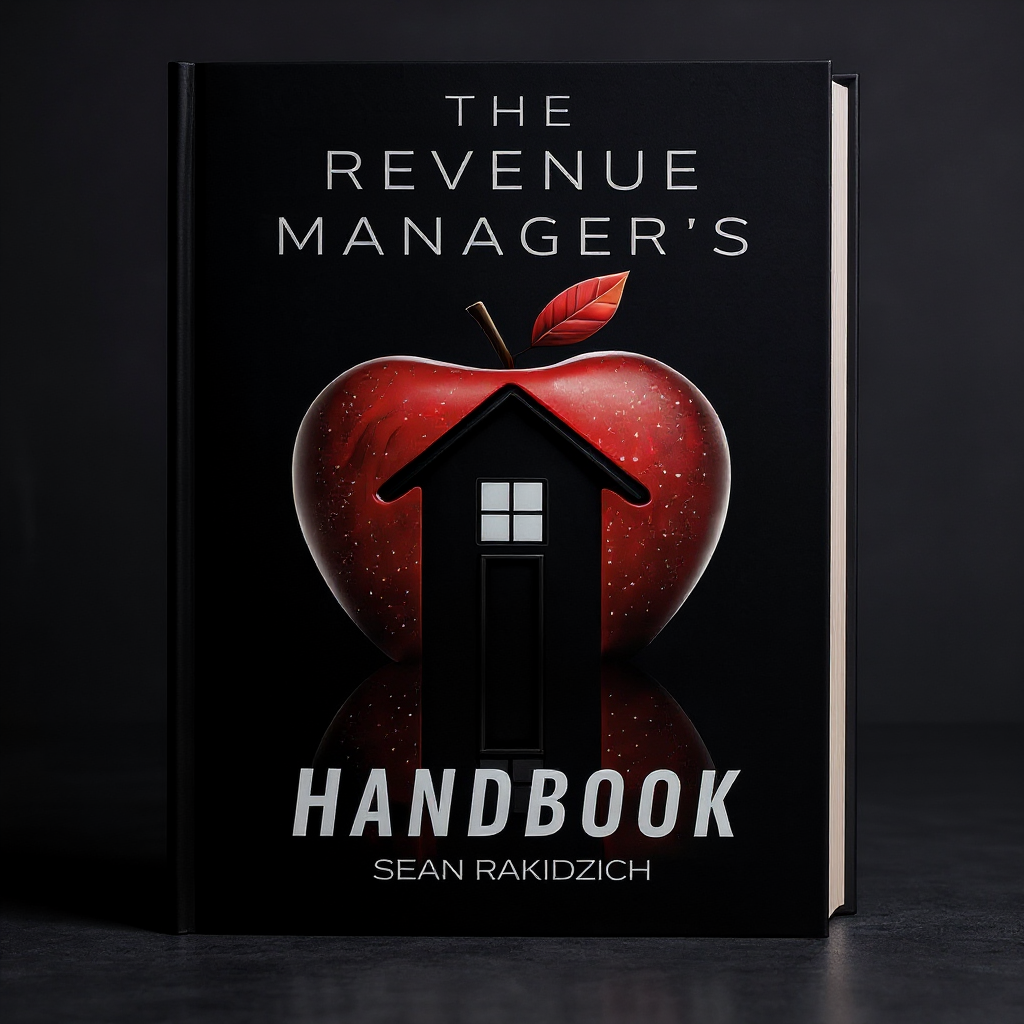
Get The Revenue Manager's Handbook
Sean Rakidzich's complete system for Airbnb pricing, revenue management, and scaling — available now.
Get the BookFrequently Asked Questions
What is the best Airbnb slow season strategy?
Don't race to the bottom on price. Sean Rakidzich's side-by-side test showed a $65/night listing at 85% occupancy generated $1,700 in January while an identical $120/night listing at 45% occupancy generated $1,620 — nearly identical revenue, but twice the check-ins, cleanings, wear, and review risk at the cheap listing. The better strategy is to hold rates at 70% of peak and pivot part of your portfolio to mid-term rentals for the coldest 60 days.
What is a mid-term Airbnb rental?
A mid-term rental sets a 30-day minimum stay and targets a different guest profile — travel nurses on contracts, remote workers, professionals between apartments, or insurance-displaced residents. These guests compare your price to a monthly apartment lease, not to a nightly hotel rate. That different anchor keeps your effective rate closer to peak levels even in slow months.
How do I know if my market supports mid-term Airbnb rentals?
Search Furnished Finder for your city. If you see 10 or more active listings in your area, there is a real mid-term market. If you see two or three, the market is thin and you should stay in nightly mode. Also look for presence of hospitals, medical centers, corporate offices, and seasonal industries that generate contract workers.
Does cutting Airbnb prices in slow season hurt reviews?
Yes. When you slash rates 40%, you attract a cheaper guest profile. Those guests leave reviews with lower expectations set, making it harder to charge premium rates the following peak season. Guests who paid $65/night leave meaningfully worse reviews than guests who paid $120/night, even if the property is identical. Slow season pricing affects your review asset well into the next year.
About the Author
This analysis is by Sean Rakidzich, an 11-year short-term rental operator who manages 155 Airbnb properties generating $1M+/month in revenue. Sean has trained 5,000+ students across 76 countries with $1.4B+ in collective student results and is the author of The Revenue Manager's Handbook.
For Sean's framework on slow season is not a pricing problem but a strategy problem, as slashing prices 40% generates almost the same revenue as holding at 70% with significantly more work and worse reviews, see his full content library at rakidzich.com or book a 30-minute strategy session at rakidzich.com/book.
Sources & Resources
Sean Rakidzich
- The Revenue Manager's Handbook — Available in Paperback & Hardcover
- Airbnb Automated YouTube — 300,000+ subscribers
- Cracking Superhost Course Suite — RE:Algorithm, Target Price, Pricing Masterclass